Maintenance decision guide
For maintenance, reliability, engineering, distribution, and procurement teams
Reviewed by FilterBagWorks Technical Team
Should You Replace All Dust Collector Filters at Once or Only the Failed Ones?
Frame a full-versus-partial changeout decision from the failure cause, the condition of comparable filters, cohort history, collector behavior, contamination, installation evidence, and the verification plan.
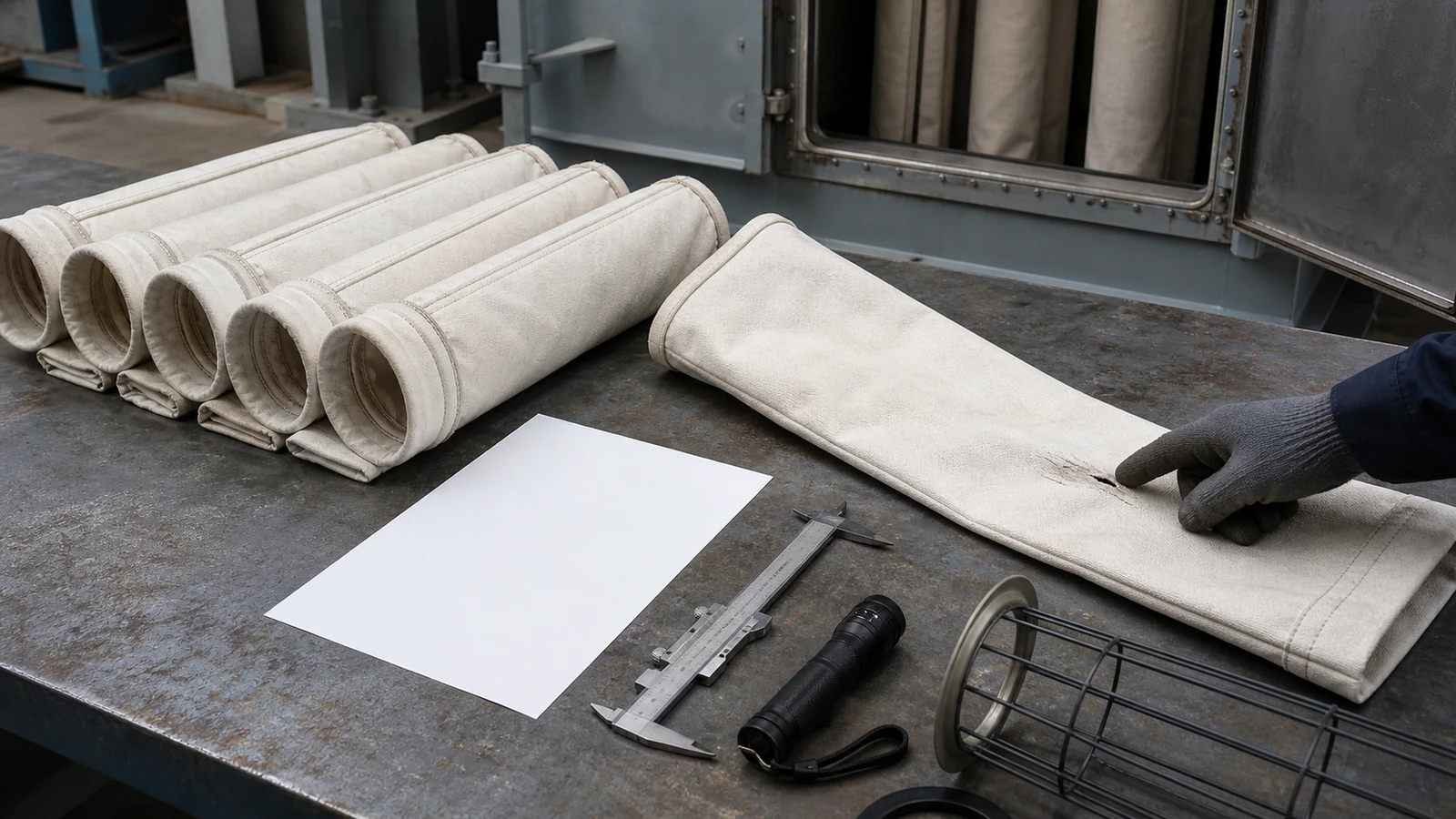
Direct answer
Do not decide from the failed element alone. First follow the collector manufacturer’s instructions and site controls, then determine whether the event is isolated or shared across the filter cohort. Review cause evidence, comparable-filter condition, installation and service history, collector behavior, contamination or exposure, and the planned post-change checks. If those records are missing or conflicting, hold the decision and collect evidence rather than treating either a full or partial changeout as a default.
Scope
This buyer- and site-owned review applies to bag or cartridge collectors; it is not a diagnosis, replacement interval, engineering approval, emissions determination, safety procedure, warranty interpretation, or entry instruction. The collector manual, site procedures, process-hazard review, permits, contamination controls, and authorized personnel govern. The decision tree is an illustrative workflow; site-specific review required. An OEM procedure remains limited to its named equipment and manual revision.
Evidence-first dust collector filter changeout review
Treat the damaged element as an observed symptom. Review cause, comparable condition, collector/system behavior, contamination or shared exposure, installation, and post-change checks. Keep observation, hypothesis, verification, correction, and purchasing decision separate.
1. Establish the governing instructions and safe work boundary
Identify the exact collector model, serial or configuration evidence, current operation-and-maintenance manual, filter instructions, site energy-control procedure, dust hazards, required protective equipment, containment method, and authorization for access. OSHA 29 CFR 1910.147 covers servicing or maintenance where unexpected energization, startup, or stored-energy release could injure employees and requires an energy-control program and procedures within its scope. [1] This article does not replace the employer’s hazard assessment or procedure and does not authorize opening, entry, testing, or restart.
2. Record the event before assigning a cause
Record which element, row, compartment, and orientation were involved; what was observed; when it appeared; and what alarm, emissions, differential-pressure, airflow, cleaning, process, or maintenance record led to the inspection. Preserve photographs, the removed element when permitted, its location map, and relevant installation and operating records. EPA’s current fabric-filter monitoring page identifies outlet particulate measures, opacity, pressure differential, inlet and temperature differential, exhaust-gas flow, cleaning operation, and fan current as possible performance indicators. [4] Which indicators and limits matter remains collector-, process-, permit-, and site-specific.
3. Test competing cause hypotheses
A tear, dust trace, high resistance, or early event does not by itself distinguish filter material, fit, installation, abrasion, temperature, chemistry, moisture, cleaning, airflow, support hardware, housing bypass, or a process upset. Donaldson’s general leakage article asks reviewers to examine filter age, differential-pressure history, access covers and gaskets, snap-band seating or cartridge orientation, hardware, clean-side dust patterns, housing damage, and operating upsets; it also says that replacing a damaged filter does not end the need to investigate the underlying cause. [3] Use those as investigation categories, not as a diagnosis of another collector.
4. Define the cohort and compare like with like
Define the cohort by shared installation, controlled construction, compartment or exposure, and operating history. Record installation dates, order references when available, prior replacements, repairs, cleaning, process changes, and event chronology. Compare representative locations under the approved procedure. Record wear, blinding, deformation, seals, support contact, clean-side traces, and construction differences without treating appearance as root cause. If age, construction, duty, or evidence quality differs, split the cohort or hold the comparison.
5. Review collector balance and the consequences of mixing conditions
Trend site-approved indicators before and after the event: differential pressure, airflow or fan evidence, cleaning behavior, outlet particulate or leak-monitor response where installed, process rate, temperature, and relevant upset records. EPA recommends assessing appropriate indicators and monitoring them in context rather than treating one signal as the complete condition picture. [4] One current Donaldson Packaged Downflo Evolution DFEP4–DFEP8 manual directs replacement through all filters in that specific procedure and requires airflow confirmation after any filter replacement because clean filters offer less resistance. [2] That is an OEM instruction for the named series, not a universal rule or threshold for other collectors.
6. Separate shared exposure from localized installation evidence
Shared dust, moisture, chemistry, temperature, sparks or embers, cleaning conditions, airflow distribution, and process upsets can affect more than the visibly failed element. Localized evidence can include a damaged cage, contact point, mis-seated band, wrong orientation, missing or loose hardware, dirty sealing surface, door or access-cover gasket problem, or a compartment-specific housing condition. Donaldson’s leakage guidance lists several of those installation and mechanical paths and recommends cleaning relevant sealing areas before new filters are installed. [3] Camfil APC likewise tells users to obtain filter-replacement guidance from the unit’s own manual and includes seals, hardware, moisture, leaks, and configuration among maintenance inspection items for its equipment. [6] Neither source proves the cause at the reader’s site.
7. Build a bounded partial-changeout case
Evaluate a partial path only when governing instructions permit it, the location is traceable, evidence supports a corrected local cause, comparable elements lack the same mechanism under approved review, mixed-condition operation and contamination are addressed, replacement configuration is verified, and monitoring can detect recurrence. Record what remains, why it is a different risk population, what could overturn that conclusion, and who accepts residual risk. This does not establish a generally acceptable failed-only practice.
8. Build a bounded full-cohort changeout case
Evaluate a full-cohort path when governing instructions call for it; evidence supports shared exposure, installation, construction, progressive deterioration, or non-comparable mixed condition; or an authorized site plan provides another documented basis. The work order must still address the suspected contributor, control contamination, verify replacement elements and seals, and define restart checks. A full changeout does not prove cause removal or guarantee performance, life, compliance, or warranty coverage.
9. Use HOLD when the evidence cannot support either path
Choose HOLD when governing direction is unresolved, the failed location is uncertain, comparable condition was not sampled, records conflict, operating history is missing, contamination changes the work method, or verification cannot show whether the action worked. EPA’s 2023 bag-leak-detection document describes multiple potential failure sources, integrated monitoring, site-specific plans, and alarm, cause, action, and inspection records. [5] These permitting-focused best practices are not a general filter-decision authorization.
10. Verify the work against a written baseline
Before authorized restart, complete the collector- and site-specific closure checks: correct part/configuration and orientation, seating and seal condition, cages or supports, hardware, access covers, clean-side housekeeping where required, tools and personnel accounted for, and safeguards restored. The Donaldson DFEP4–DFEP8 manual specifically requires access-cover gasket inspection and cleaning, replacement of worn or damaged gaskets, proper cartridge alignment and closure, and airflow confirmation for that series. [2] After restart under the authorized procedure, compare the defined indicators with the site baseline and record exceptions. Do not declare root cause closed merely because the immediate symptom disappeared.
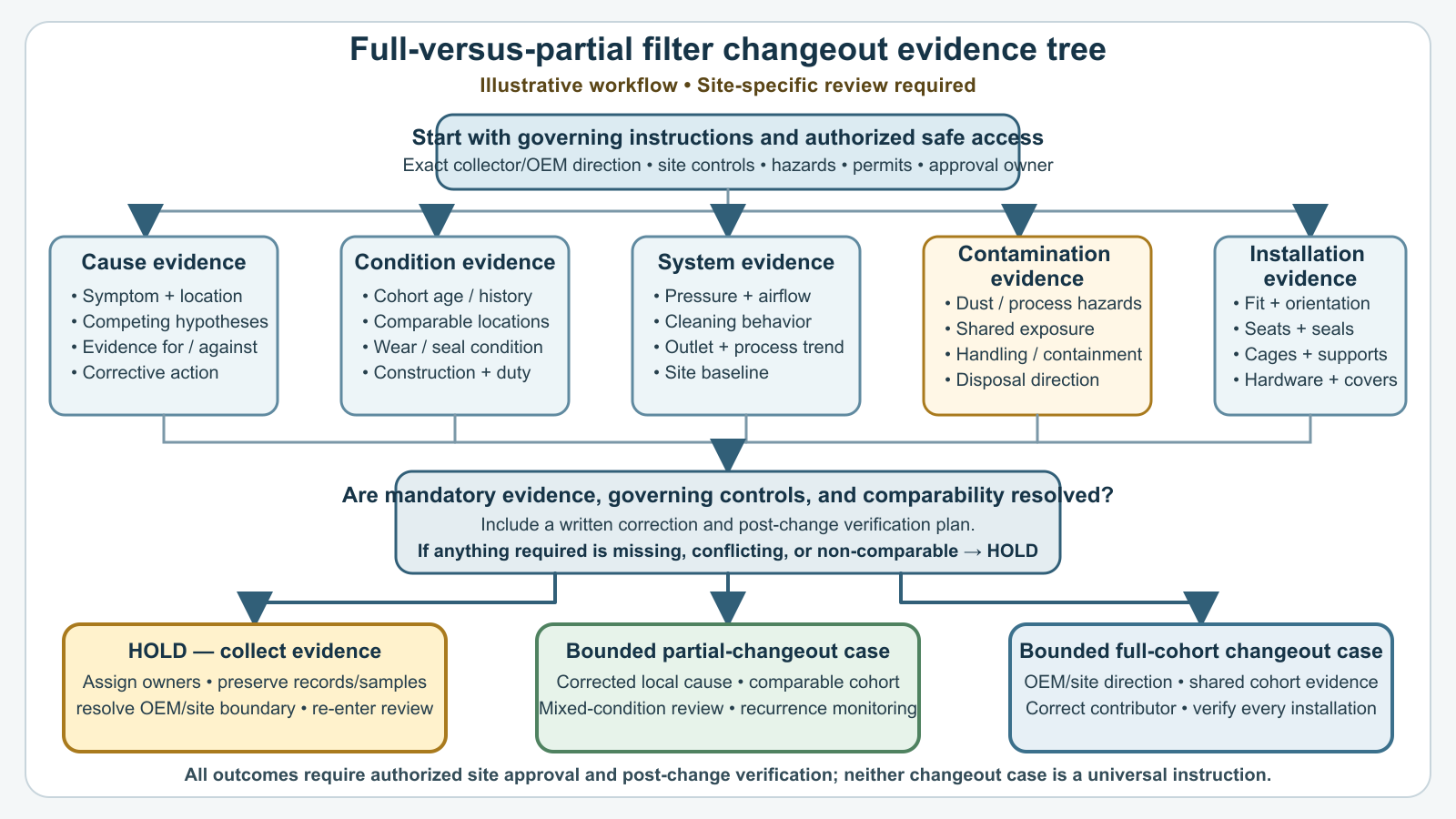
Full-versus-partial filter changeout evidence tree
This illustrative workflow is a discussion aid; site-specific review required. Start with governing instructions and safe access. Require cause, condition, system, contamination, and installation evidence before routing to a bounded partial-changeout case or bounded full-cohort changeout case. Any missing, conflicting, or non-comparable mandatory evidence routes to HOLD — collect evidence. The site owns the decision, authorization, work method, and post-change verification.
Scroll table horizontally
| Evidence gate | What to record | If unresolved |
|---|---|---|
| Governing boundary | Collector/manual, warranty, site, hazard, permit, and authorization controls | HOLD — collect controlling instructions |
| Cause evidence | Observation, competing hypotheses, location map, retained evidence, corrective action | HOLD — do not infer cause from one failure |
| Condition evidence | Cohort definition, age/history, representative comparable condition | HOLD — sample or split the cohort |
| System evidence | Site-approved trends for airflow, pressure, cleaning, outlet signal, and process | HOLD — establish comparable baseline |
| Contamination evidence | Dust/process hazards, shared exposure, handling, containment, disposal | HOLD — obtain site/EHS direction |
| Installation evidence | Part/configuration, orientation, seating, seals, supports, hardware, access covers | HOLD — inspect under approved procedure |
| Verification plan | Acceptance owner, restart checks, indicators, observation period, escalation trigger | HOLD — define how recurrence is detected |
On narrow screens, scroll horizontally to inspect the full-size diagram.
Changeout decisions that need escalation or more evidence
Stop the release of a generic instruction when a mandatory technical, safety, compliance, contamination, or authorization question remains open.
- A work order names a changeout scope without the exact collector manual or site procedure.
- One torn bag or leaking cartridge is labeled root cause without testing competing causes.
- The remaining elements are called good based only on a quick visual check or lack of a visible alarm.
- Cohort age, construction, prior replacements, location, or exposure history is unknown or mixed.
- The proposed replacement differs in fit, media, construction, seal, support, or installation requirement without approval.
- Dust, moisture, chemical, temperature, spark, cleaning, airflow, or process-upset evidence is missing.
- Contaminated elements are handled without the site’s approved protection, containment, and disposal controls.
- The plan leaves the suspected cage, sealing surface, access cover, pulse, housing, hopper, or airflow contributor unaddressed.
- Restart has no recorded baseline, acceptance owner, monitoring window, or escalation trigger.
Quote-ready filter changeout evidence package
Use the active dust collector filter RFQ checklist for the base request, then attach the changeout evidence below. The supplier can review the inquiry, but site personnel retain cause, safety, compliance, and maintenance authorization.
- Collector manufacturer, model, serial/configuration evidence, compartment or row, access arrangement, and current manual reference.
- Filter family, quantity installed, quantity proposed, part numbers, dimensions, construction, media, seals, cages/supports, orientation, and approved drawing or sample evidence.
- Installation dates, order or lot references when available, prior partial replacements, cleaning history, relocations, repairs, and failure chronology.
- Photos and location map of the failed element, comparable elements, seals, cages, tubesheet or mounting surface, access covers, hardware, and clean-side evidence where safely obtained.
- Dust/process description, contamination or exposure controls, cleaning method, normal and upset operating history, and any process changes near the event.
- Site-approved trends or records for differential pressure, airflow/fan, cleaning, temperature, outlet particulate or leak monitor, and emissions observations where applicable.
- Cause hypotheses, supporting and conflicting evidence, completed corrections, unresolved holds, and the authorized technical decision owner.
- Installation acceptance fields, restart authorization, post-change indicators, comparison baseline, observation period, and escalation trigger defined by the site.
Product path
- Replacement dust collector filtersUse the replacement path when part-number, dimensional, construction, collector, and operating evidence can define the inquiry.
- Dust collector filter bagsReview bag dimensions, top and bottom construction, media, finish, cages, cleaning method, and application evidence.
- Dust collector cartridge filtersReview cartridge dimensions, end caps, gasket, mounting, media, support, collector, and operating evidence.
Frequently asked questions
Does one failed dust collector filter mean the whole set is bad?
No conclusion follows from the failed element alone. Record the symptom and location, investigate competing causes, define the cohort, compare condition and history, review collector and process evidence, and follow the exact OEM and site instructions. Shared evidence can broaden the case; localized evidence can narrow it; missing evidence should remain on hold.
Can a plant leave older filters beside one new filter?
Only the collector manufacturer and the site’s authorized technical review can determine whether a mixed-condition arrangement is permitted and supportable. Evaluate airflow and pressure behavior, cleaning, seals, installation, remaining-filter condition, monitoring, contamination, and the consequence of recurrence. The Donaldson DFEP manual’s full-set procedure is specific to that named series and is not a general rule. [2]
Is differential pressure enough to decide the changeout scope?
No single indicator proves filter condition or cause. EPA lists outlet particulate measures, opacity, pressure differential, temperatures, exhaust-gas flow, cleaning operation, and fan current as possible fabric-filter indicators; the appropriate combination and limits are site-specific. [4]
What evidence supports a localized changeout review?
Traceable location, a verified and corrected local cause, comparable elements without the same mechanism under an approved review, confirmed replacement configuration and installation, acceptable mixed-condition assessment, controlled contamination handling, and a post-change plan that can detect recurrence. A site authority must accept the residual risk.
What evidence supports a full-cohort changeout review?
A governing OEM or site instruction, shared exposure or installation campaign, progressive cohort deterioration, non-comparable mixed condition, repeated event history, or another documented site basis can support review. The plan must still address the cause hypothesis and verify installation and operation afterward; a full changeout alone does not prove correction.
What should happen when the failure cause is unknown?
Place the scope on HOLD, preserve the failed element and records when allowed, map the location, inspect representative comparators under the approved procedure, reconcile installation and operating history, and assign evidence owners. If an urgent site action is required, the authorized site team must define it without converting uncertainty into a universal rule.
Can FilterBagWorks decide the changeout scope from a photo?
No. Photos can support an inquiry, but they do not establish the collector’s governing instructions, hidden condition, root cause, process hazards, contamination controls, emissions obligations, mixed-condition behavior, or safe work method. Send photos with dimensions, part numbers, construction, collector information, operating records, and the site’s open questions for review.
Sources
- OSHA 29 CFR 1910.147 — The Control of Hazardous Energy (Lockout/Tagout)
- Donaldson Packaged Downflo Evolution DFEP4 through DFEP8 Installation, Operation and Maintenance Manual
- Donaldson: Troubleshooting for Leaking Dust Collectors
- U.S. EPA: Monitoring by Control Technique — Fabric Filters
- U.S. EPA: Best Practices for Bag Leak Detection Systems in Clean Air Act Permitting
- Camfil APC: Dust Collector Servicing — Preventative Maintenance
Request a filter review
Send the collector and filter identification, dimensions and construction, photos and location map, cohort installation history, observed failure evidence, process and cleaning context, site-approved operating trends, proposed quantity, and unresolved questions. FilterBagWorks.com can review the replacement-filter inquiry; the site retains safety, cause, compliance, changeout scope, installation, restart, and verification authority.
Request a quote