Replacement filter buying guide
For procurement managers, engineers, distributors, and MRO teams
Reviewed by FilterBagWorks Technical Team
Dust Collector Filter RFQ Checklist: What Specifications Should Buyers Send?
Start a dust collector filter RFQ with collector details, component measurements, operating conditions, quantities, photos, and drawings. Keep measured, copied, observed, assumed, and unknown values separate so the quotation can identify what still needs review.
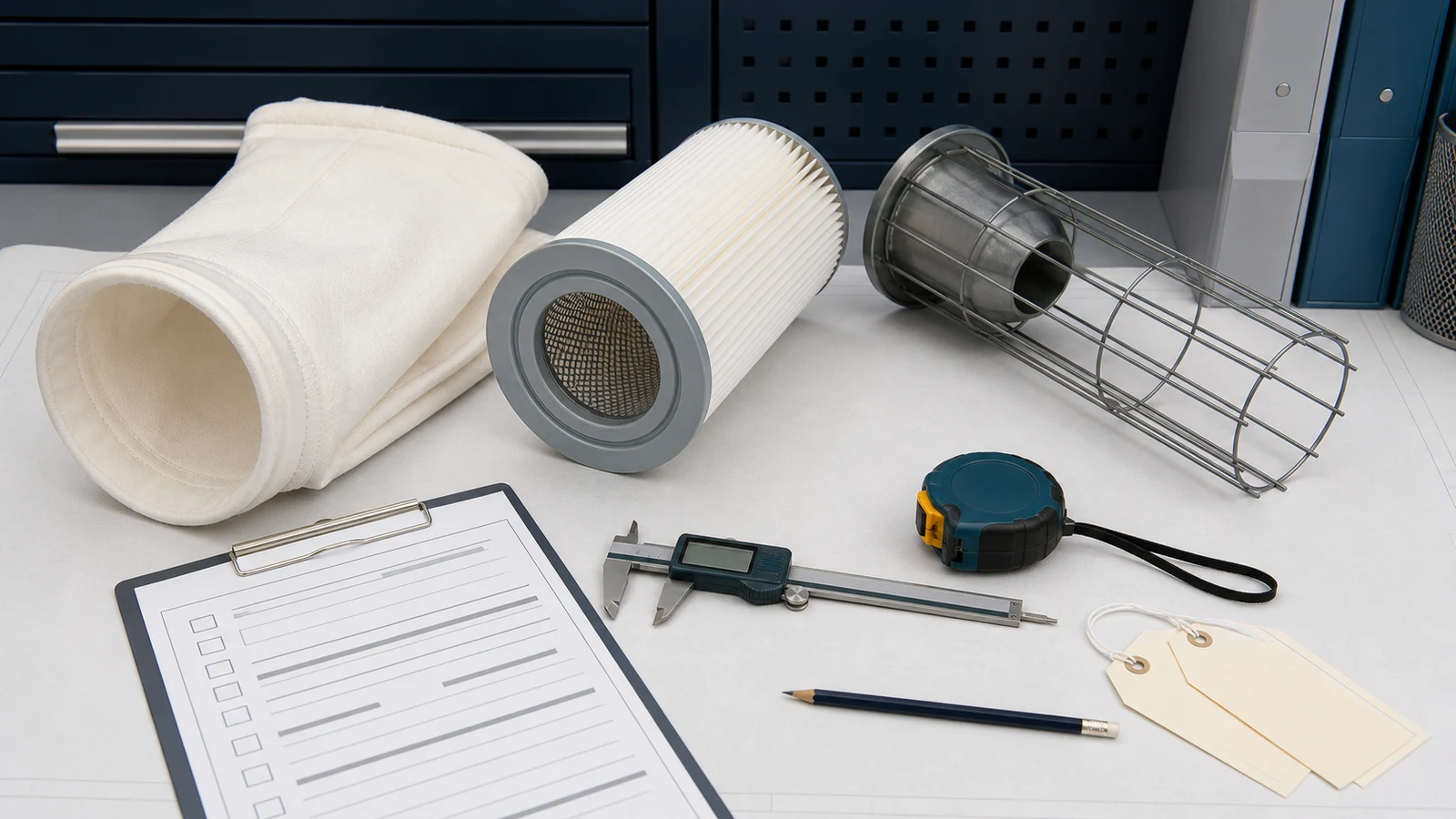
Direct answer
A useful dust collector filter RFQ checklist starts with the collector, component family, part-number evidence, units, quantity, and reason for replacement. Then add the fit-critical fields for the bag, cartridge, cage, venturi, or accessory; dust and operating conditions; packaging and timing needs; and clearly named photos or drawings. Mark every value as measured, copied, observed, assumed, or unknown so the quotation does not hide an unverified specification.
Scope
Use this guide to prepare replacement inquiries for industrial filter bags, cartridges, cages, venturis, and related accessories when the buyer has complete or incomplete records. It organizes evidence; it does not confirm fit, choose media, set a tolerance, establish an operating limit, approve safe handling, promise availability, or commit a supplier to price or delivery. The actual collector manual, drawing, OEM information, site requirements, responsible technical review, and written quotation remain controlling. The form audit below also distinguishes dedicated online fields from guidance that belongs in RFQ Details or a separately emailed specification sheet.
Dust collector filter RFQ checklist workflow
Work from common project identity to family-specific evidence, then operating context and purchasing scope. Use one unit system within a line item and give each photo, dimension, and copied record a status. When sources conflict, preserve the conflict and ask for review instead of choosing a convenient value.
Start with the verified RFQ form boundary
Project evidence shows general fields for contact information, product type, dimensions, quantity and timing, dust, temperature, media or exposure notes, part-number evidence, and RFQ details. Family-specific fields in this guide are preparation guidance, not a promise that every item has its own online control. The saved 2026 form configuration contains a file field, but direct inspection of the current public control was blocked during this audit. This guide therefore does not claim upload capability. Use the request page's separately visible email or WhatsApp paths for photos, drawings, and RFQ files, and place a concise index in the RFQ Details field.
Record universal RFQ fields before product geometry
Give the inquiry a project reference, contact and company, destination country or region, collector maker/model/serial/location when known, component family, installed position, every part number and its source, requested quantity, unit system, and reason for replacement. Manufacturer literature distinguishes fabric bags, cartridges, and rigid pleated baghouse elements, so select the family from observed construction rather than a casual site nickname. [1] Tag each value M for measured, C for copied, O for observed, A for assumption requiring verification, or U for unknown.
Filter-bag-specific fields
For a fabric bag, record overall length, body diameter or flat width, measurement method, top attachment, bottom construction, seam, bands, rings, loops, cuffs, reinforcement, and installed orientation. When a cage or tubesheet controls the fit, include the cage size and ends plus the tubesheet opening or other mating evidence. One LP baghouse manual shows a snap-band collar seated at a tubesheet before its cage is lowered into the bag; that equipment-specific example explains why collar, tubesheet, and cage should be documented together. [3] It is not a universal installation method.
Cartridge-specific fields
Record outer shape and dimensions, overall length, inner opening, both end caps, each open or closed end, gasket location and profile, flange, hooks, studs, center hardware, liner, support features, and installed direction. A Downflo Oval manual identifies the gasket end, sealing surface, yoke, and access cover as a related assembly for that collector. [4] A separate cartridge data sheet uses outer/inner diameter, length, pitch diameter, gasket, end caps, media pack, straps, and liner as field categories. [5] Copy none of its values unless they belong to the actual item.
Cage and venturi fields
For a cage, record outside diameter, overall length, longitudinal wire count, ring count or spacing, top style, bottom style, one-piece or jointed construction, joint details, and material or finish only when documented. Photograph bends, corrosion, rough welds, broken wires, worn rings, and the relationship to the bag. If a venturi is present, record its opening, height or overall dimensions, flange or seating geometry, attachment method, installed orientation, and whether it is integral or separate. Do not infer that another venturi is interchangeable because its silhouette looks similar.
Accessory fields
Name the accessory by its observed function and installed location: gasket, clamp, cap, nozzle, diaphragm, valve part, fastener, seal, or another component. Record overall dimensions, hole pattern, thread, flange, connector, clamp range, mating part, orientation, markings, quantity, and condition. If material or finish is unknown, describe appearance without assigning a grade. A photo of the accessory alone is incomplete; include the mounting position and the adjacent feature it must connect to.
Operating conditions and current construction
State the dust or fume and source process, collector arrangement, cleaning method, normal and documented peak/startup/shutdown/upset temperature information, moisture or condensation, oil or sticky material, known chemistry, abrasion, sparks or hot-particle history, airflow or process changes, current media when supported, and observed failure. EPA guidance identifies particle characteristics, cleaning mechanism, temperature, moisture, and corrosives as relevant fabric-filter considerations. [2] This checklist gathers those inputs; it does not convert them into a material recommendation or safe operating range.
Quantity, packaging, and timing fields
Separate quantity by line item and collector position. Say whether the request is a full changeout, partial set, spare stock, trial quantity, or repeat order, without implying that any order model is available. Specify protection, cartons, pallets, separators, moisture barriers, item labels, carton marks, lot separation, inspection records, or other documents only when the project requires them. State destination and shipping constraints. Give a required-by date, outage window, or desired review date together with flexibility; treat it as buyer planning information, never as a promised lead time.
Photo, drawing, and file naming rules
Photograph the full component from two sides, both ends, attachment and sealing details, tool placement, markings, installed orientation when safely available, mating parts, damage, and packaging evidence. Use a neutral file pattern such as PROJECT-COLLECTOR-COMPONENT-VIEW-01 and maintain an index that explains what each view proves. Do not put customer names or sensitive data in public filenames. Replacement indexes commonly use several fields together—part or OEM number, diameter, length, medium, and end cap—which reinforces why one number or one photo is not enough. [6] The index still does not confirm fit.
Example RFQ — fictional-free structure
Example RFQ (illustrative; no customer, order, price, lead time, or fit claim):
Project: SAMPLE-RFQ-01; destination region recorded; contact fields supplied in the form.
Component: fabric filter bag with separate cage; full-set versus partial-set status marked unknown pending collector count.
Records: label code copied as [C]; collector model unknown [U].
Bag: overall length and body diameter entered with units [M]; snap-band-style top [O]; closed reinforced bottom [O]; seam photographed; nominal tolerance unknown [U].
Cage/venturi: cage OD, length, wire count, and ring spacing [M]; top/bottom, joint, and condition [O]; venturi attachment photographed; material grade unknown [U].
Operating context: dust/process, cleaning method, normal and peak temperature records, moisture observation, and reason for replacement stated; current media copied from an old record but flagged for verification [C].
Commercial scope: requested quantity to be confirmed after compartment count; packaging labels requested by project reference; destination stated; required-by window is a buyer target, not a supplier commitment.
Files: SAMPLE-RFQ-01-BAG-OVERALL-01, -TOP-01, -BOTTOM-01, -SEAM-01, -CAGE-01, -VENTURI-01, and a drawing index sent through the listed email file path.
Open questions: confirm quantity, media record, tubesheet evidence, quotation deviations, exclusions, and the verification step required before ordering.
Route each field to the correct evidence block
Use the component map to avoid mixing bag, cartridge, cage, venturi, and accessory fields. Then complete the printable checklist as a cover sheet. Both visuals are illustrative and not to scale; they do not establish geometry, tolerance, compatibility, operating limits, or delivery requirements.
Scroll table horizontally
| RFQ block | Minimum evidence | Keep separate |
|---|---|---|
| Universal | Project, collector, family, records, units, status, quantity, reason | Measured facts versus copied records and unknowns |
| Fit / construction | Family-specific dimensions, ends, seals, support, mating parts | Bag, cartridge, cage/venturi, and accessory fields |
| Operating | Dust/process, cleaning, temperature context, moisture, chemistry, failure | Documented conditions versus material recommendation |
| Commercial | Line quantities, packaging, labeling, destination, required-by window | Buyer target versus supplier commitment |
| Evidence files | Overall, ends, details, tool placement, markings, orientation, damage | Filename, view purpose, and measurement status |
On narrow screens, scroll horizontally to inspect the full-size diagram.
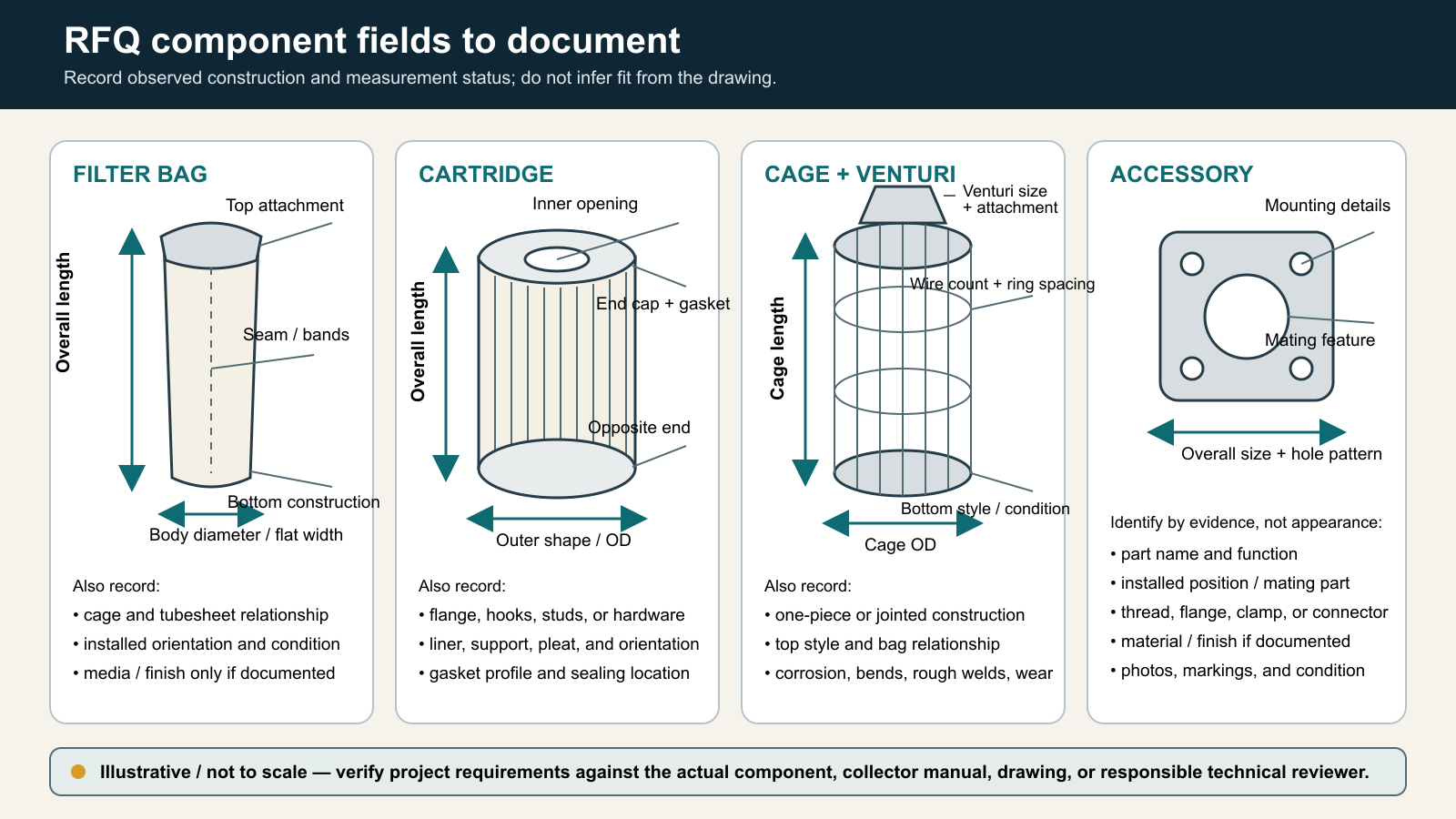
On narrow screens, scroll horizontally to inspect the full-size diagram.
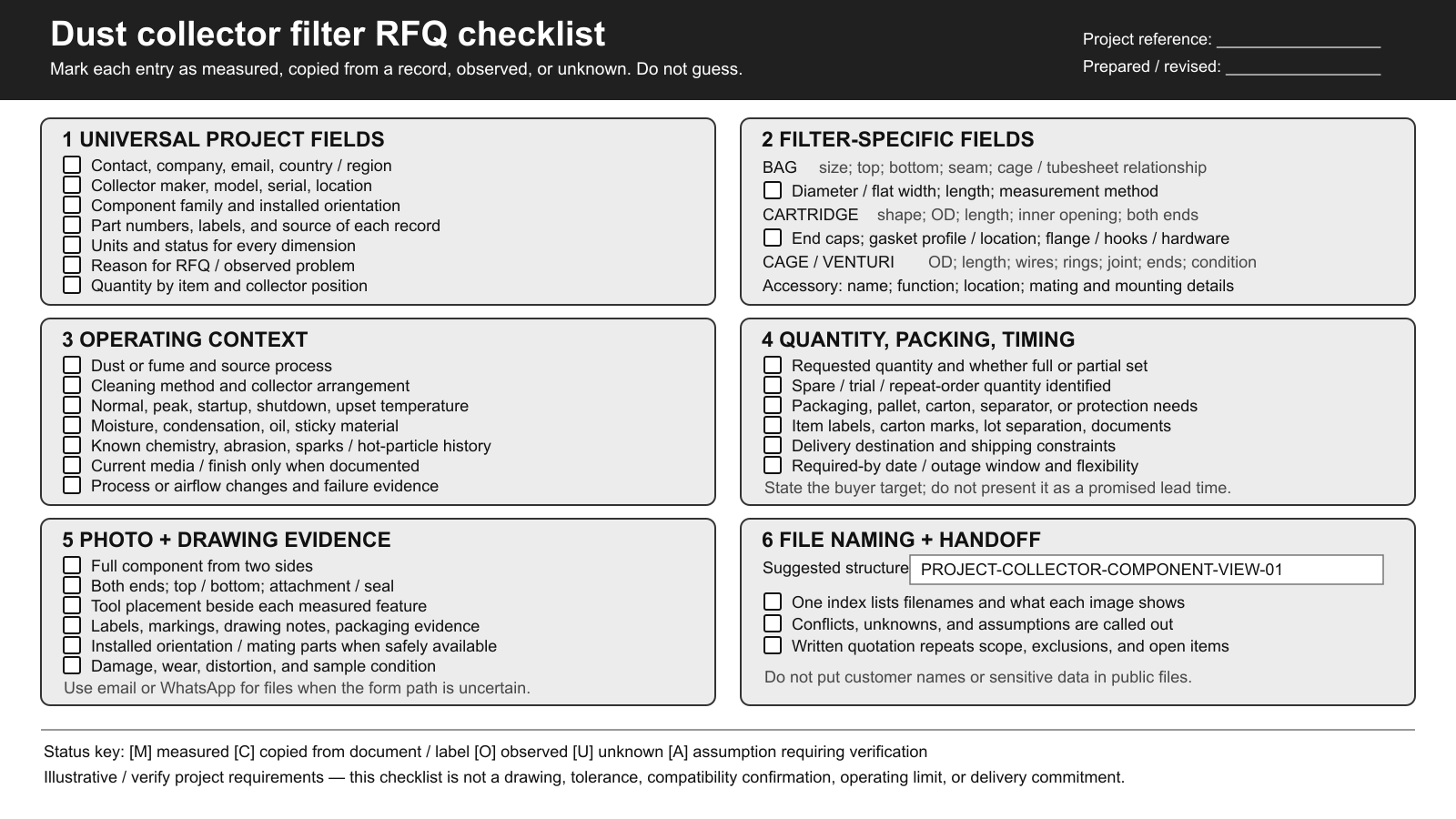
Common RFQ mistakes and red flags
Pause comparison when a quotation depends on a guessed fit field, silent scope difference, or promise that is not in the written offer.
- Mixing inches and millimeters or omitting units.
- Calling a copied catalog value measured.
- Sending one overall photo with no opposite end, seal, or orientation.
- Naming media, gasket, alloy, or finish from appearance.
- Combining full-set and partial-set quantities in one line.
- Leaving cage, venturi, tubesheet, yoke, cover, or mating evidence out of the fit review.
- Using a cross-reference as a fit or performance guarantee.
- Presenting a requested date as an agreed lead time.
Quote-ready handoff checklist
Send one cover sheet and one indexed evidence folder. If a field is unavailable, mark it unknown and identify the verification step.
- Project reference, contact, company, region, and delivery destination.
- Collector maker, model, serial, location, and installed position when known.
- Component family, part numbers, labels, and record source.
- Family-specific dimensions, units, method, and M/C/O/A/U status.
- Top/bottom, both end caps, seals, hardware, support, joints, and mating parts as applicable.
- Dust/process, cleaning method, temperature context, moisture, chemistry, and failure evidence.
- Quantity per line, full/partial/spare/trial/repeat status, and open count questions.
- Packaging, labels, lot separation, documents, and shipping constraints if required.
- Required-by or outage window clearly labeled as a buyer target.
- Overall, end, detail, tool-placement, marking, orientation, and damage photos.
- Filename index plus drawing or sample reference.
- Requested quotation scope, deviations, exclusions, and items requiring verification.
Product path
- Request a filter quoteUse the online intake for the general fields, then send indexed files through the separately visible email or WhatsApp paths.
- Dust collector filter bagsUse the bag path after size, top, bottom, seam, cage relationship, operating context, and quantity are documented.
- Dust collector cartridge filtersUse the cartridge path after both ends, gasket, mounting geometry, dimensions, orientation, and collector evidence are clear.
- Dust collector accessoriesUse the accessory path when position, function, mating details, dimensions, markings, condition, and quantity are documented.
Frequently asked questions
What are the minimum specifications for a dust collector filter RFQ?
Start with collector and component identity, product family, part-number evidence, fit-critical dimensions with units, quantity, reason for replacement, dust or process, cleaning method, temperature context, current media when documented, and clear overall and detail photos. Mark missing fields unknown rather than estimating them.
Can I request a quotation without a drawing?
Yes, a review can begin from the evidence available. Provide family-specific measurements, photos of the entire component and both ends, labels, collector information, operating context, quantity, and a retained sample reference when appropriate. The reviewer may still require a drawing, sample, manual, or additional measurement before ordering.
Which filter-bag dimensions should I include?
Include overall length, body diameter or flat width, measurement method, top attachment, bottom construction, seam, bands or rings, installed orientation, and the cage and tubesheet relationship when they control fit. State whether each field was measured, copied, observed, assumed, or is unknown.
Which cartridge details matter beyond diameter and length?
Document outer shape, inner opening, both end caps, every open or closed end, gasket location and profile, flange, hooks, studs or center hardware, liner and support features, pleat details when relevant, installed direction, collector model, and the sealing or mounting surface.
Should an RFQ include packaging and required timing?
Include packaging, item labels, carton marks, pallet or separator needs, lot separation, destination, shipping constraints, requested documents, and the required-by or outage window when they matter. State timing as a buyer target and wait for the supplier's written quotation to confirm what it can offer.
How should I send RFQ photos and drawings?
Create an indexed set with overall, both-end, attachment, gasket, tool-placement, marking, orientation, and damage views. Use neutral filenames such as PROJECT-COLLECTOR-COMPONENT-VIEW-01. Because current upload behavior was not directly verified in this audit, use the request page's separately visible email or WhatsApp file routes.
Sources
- Donaldson: Industrial Dust Collector Filter Types
- U.S. EPA: Fabric Filter — Pulse-Jet Cleaned Type Fact Sheet
- Donaldson LP Baghouse Installation and Operation Manual
- Donaldson Downflo Oval DFO 1-1 to 3-3 Installation and Operation Manual
- Donaldson Replacement Elements — Cartridges Series 325 Quick Fix 3 Hook
- Camfil APC Dust Collector Filters Search
Request a filter review
Use the online RFQ for contact, product, dimension, quantity/timing, operating-context, and project-detail fields. Send the indexed photos, drawings, or specification sheet through the request page's separately visible email or WhatsApp route. Mark every unknown, conflict, and assumption, and ask the written quotation to state scope, deviations, exclusions, and the verification required before ordering.
Request a quoteCatalogue-backed review routes
Match uploaded evidence to the product family being reviewed.
When using the verified site upload, pair photos, drawings or labels with the fields already listed in this checklist. The catalogue images below support product-family routing only; they do not prove project fit or performance.
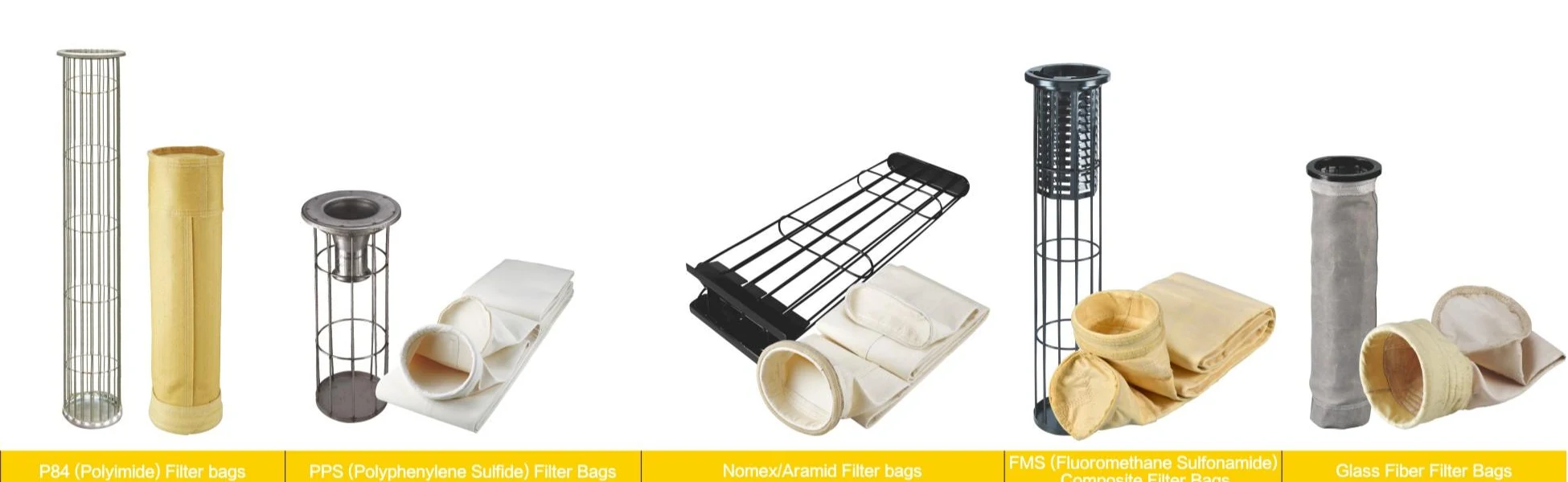
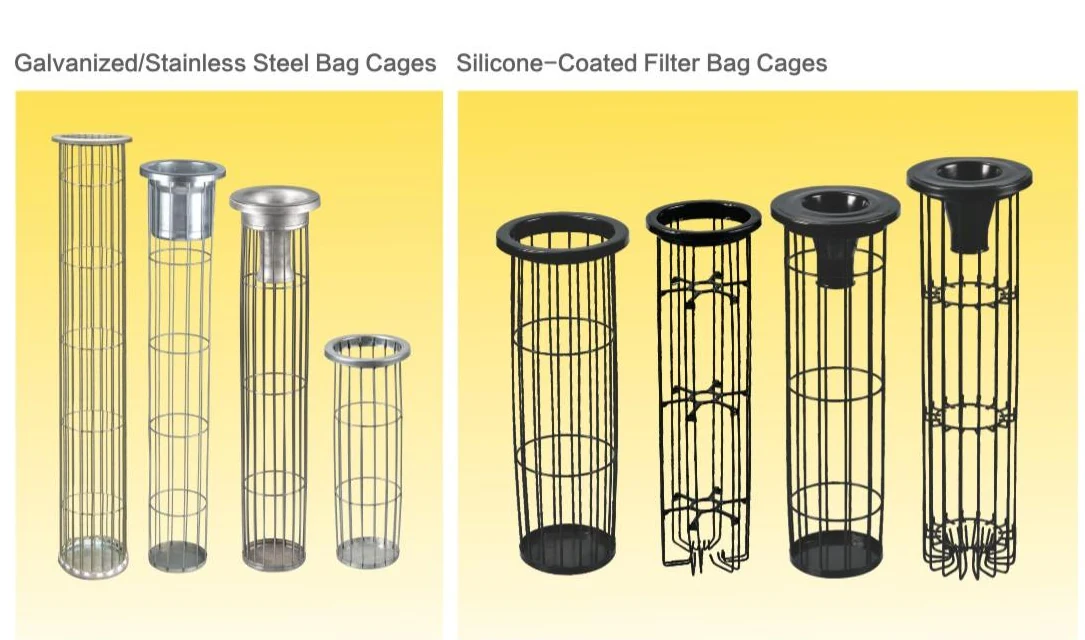
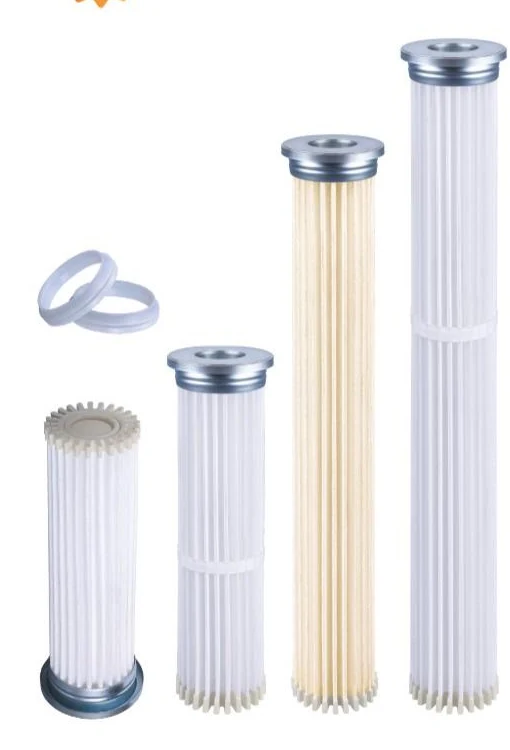
First-party source: Guanlin product catalogue, pp. 9, 10, 13 and 15. Existing upload fields and submission behavior are unchanged.