Welding-fume application guide
For fabrication plants, EHS teams, maintenance teams, and collector owners
Reviewed by FilterBagWorks Technical Team
What Filter Should You Use for Welding Fume Extraction?
Organize the complete source-capture and collector evidence before comparing a replacement cartridge: process, material, duty, capture arrangement, hot-particle path, filter geometry, media documentation, cleaning, maintenance, and unresolved fire or exposure questions.
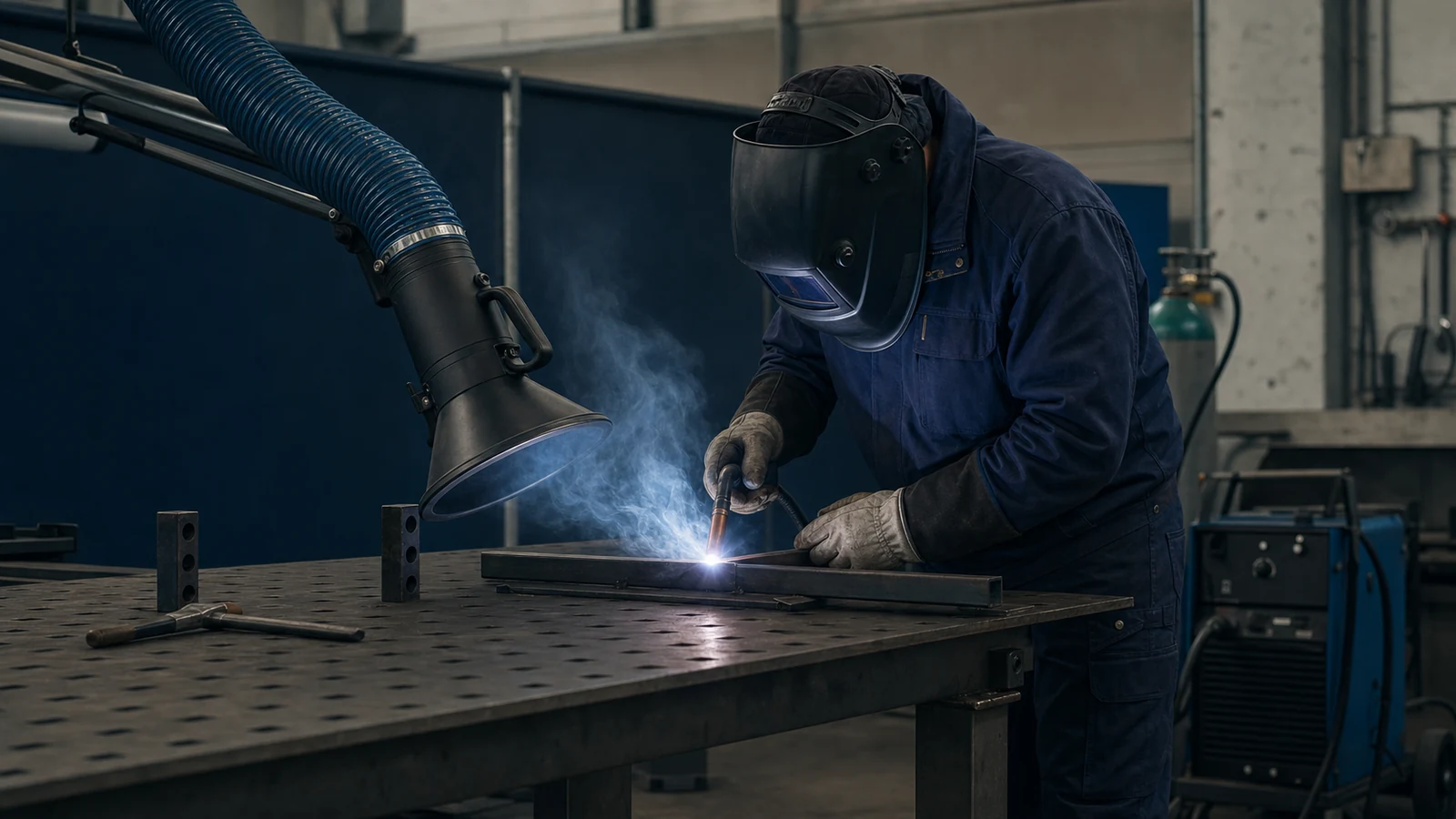
Direct answer
A filter cartridge alone is not a complete welding-fume control solution. Start with a competent exposure-control assessment and the federal, state, local, and site rules that apply. Then confirm source capture, process and material, hot-particle and fire-risk controls, collector geometry, cartridge fit, documented media performance, cleaning, discharge, and maintenance. HSE and NIOSH both put capture and ventilation ahead of downstream filter choice. [1] [4] Their guidance does not approve a specific US installation.
Scope and safety limits
Use this guide to prepare a cartridge or filter-pack review for manual or automated welding and related thermal-processing equipment. It helps a buyer describe MIG/MAG, TIG, FCAW/stick, robotic welding, laser cutting, plasma cutting, and grinding without assuming they share one control design. It does not calculate worker exposure, select respiratory protection, design LEV, permit recirculation, set airflow or capture distance, approve process separation, or specify fire/explosion protection. OSHA’s welding standard contains US ventilation, fire-prevention, confined-space, and PPE duties, while HSE requires a process-based risk assessment in its jurisdiction. [3] [1] A competent exposure-control professional and the parties responsible for fire protection, environmental requirements, the collector, and the welding process must decide the site-specific controls under applicable local rules.
Select welding fume filters from the complete control path
Follow the airstream in decision order: source and worker position, capture device, duct and any process-separation or hot-particle measures, collector inlet, cartridge and cleaning system, fan, discharge or return-air decision, and verification. This sequence keeps the filter from becoming a substitute for control-system review. HSE and NIOSH describe LEV as source-oriented engineering control, while manufacturer literature places the filter downstream within an extraction system. [1] [4] [8] Exact design values remain project-specific.
1. Establish the exposure-control basis before the cartridge
Record who performed the exposure assessment, what jobs and nearby workers it covers, the applicable contaminants and rules, and what control performance must be demonstrated. HSE says the assessment should consider the welding process, volume of work, workpiece, metal, and consumable; NIOSH notes that exposure can vary with wire, rods, flux, base metal, and work environment. [1] [5] Those sources establish variables, not a universal exposure result. Include coatings, surface contamination, stainless or other alloying constituents, shielding gases, confined or restricted spaces, production duty, and other workers who may enter the affected area. If this basis is missing, the next action is competent assessment—not choosing a more impressive media name.
2. Verify capture at the source
Identify whether the approved arrangement uses on-torch extraction, a movable hood, an extracted bench, a booth or enclosure, a process table, or another engineered inlet. HSE says source capture is the preferred approach where suitable and that movable hoods depend on correct positioning; its current WL3 guidance also explains that the capture design must match the task and workpiece. [1] [2] NIOSH evaluated particular portable LEV systems placed near the weld and exhausted outside, but that study did not test a cartridge or establish a universal hood distance. [4] Ask for commissioned airflow/capture evidence, operator positioning, cross-drafts, hood movement, workpiece obstruction, and any effect on shielding gas or weld quality; do not copy another facility’s setup.
3. Separate the manual welding-process evidence
For MIG/MAG, record wire designation and diameter, shielding-gas record, transfer or power settings available from the approved procedure, arc-on duty, work position, and whether an on-torch system was assessed. HSE identifies on-torch capture as an option for MIG, not a universal requirement. [1] For TIG, record base and filler materials, electrode/process details, shielding and purge gases, duty, and position; HSE warns that little visible TIG fume can make qualitative observation harder, so visibility alone cannot verify control. [13] For FCAW and stick, include the exact flux-cored wire or covered electrode because NIOSH identifies electrode and flux as potential contributors to the fume mixture. [4] Do not publish a universal emission ranking; material, consumable, parameters, duration, and task geometry can change the answer.
4. Treat robotic welding, laser, plasma, and grinding as distinct sources
For robotic or mechanized welding, document cell enclosure or hood, source nozzle if present, access openings, robot path, cycle time, operator and service positions, residual-fume clearance, and the control verification record. HSE includes automation in the control hierarchy and still addresses nearby workers; Nederman shows source nozzles and containment hoods as different manufacturer arrangements. [1] [10] For laser or plasma cutting, record table/enclosure type, metal and coating, duty, slag/dropout route, hot-particle history, and collector inlet arrangement. For grinding, record alloy, wheel or abrasive, dust test/hazard information, oil or residue, and spark generation. Nederman cautions that welding and grinding can require different collection approaches, but this manufacturer guidance is not a universal separation rule. [11]
5. Escalate hot particles, incompatible residues, and fire questions
Ask whether sparks, slag, embers, or hot particles can enter the capture path; whether dropout, separation, detection, quenching, or another measure exists; and what hazard analysis supports it. OSHA requires fire hazards around welding and cutting to be removed or guarded as applicable. [3] Donaldson lists several possible spark-mitigation approaches and material-specific systems while explicitly stating that none removes all hazards and that other fire-protection options remain application-specific. [7] If welding fume is combined with grinding dust or another residue, do not approve the mixture from names alone. A qualified fire/explosion-risk review must decide compatibility, process separation, collector location, and protective measures.
6. Stop cartridge selection when combustible-dust status is unresolved
Some metal dusts can be combustible, and a dust collector adds dispersion and confinement to the ignition question. OSHA’s combustible-dust guidance identifies fuel, ignition, oxygen, dispersion, and confinement, and specifically includes collectors and ductwork in the hazard context. [6] OSHA’s revised National Emphasis Program also directs attention to ignition control and protection or isolation around dust collection. [14] The directive is a U.S. federal inspection program, not a protection design or a substitute for applicable State Plan, state, local, or site requirements. These materials do not tell a buyer which protection to install. If the collected residue may be combustible, reactive, incompatible, or uncharacterized, pause the filter RFQ and route the case through the site’s qualified dust/fire assessment and applicable codes. A20 does not design venting, suppression, isolation, extinguishing, detection, grounding, bonding, or collector placement.
7. Match cartridge geometry before comparing media
Document collector maker/model, cartridge quantity and orientation, overall shape and dimensions, open/closed ends, end-cap details, gasket location/profile, mounting hardware, liner/support construction, pleat geometry, installed direction, and the clean- and dirty-air relationship. Add photos of labels, both ends, seals, access covers, and the installed cartridge before disposal. Donaldson’s leak guidance identifies damaged media, incorrect installation, gaskets, access covers, hardware, and housing/tubesheet condition as possible leakage evidence. [12] It is general manufacturer troubleshooting, not authority to access a live collector or perform testing. Follow the equipment manual, isolation procedure, and competent service plan. Similar diameter and length, a cross-reference, or a “welding fume” label does not prove fit or sealing.
8. Ask what the filtration layer is documented to do
Request the exact media construction, supplier data, test method and conditions, efficiency classification where relevant, any after-filter arrangement, and the basis for discharge or return air. Fine-fiber, nanofiber, membrane, and other surface-loading constructions are available for welding-fume collectors, but manufacturer sources present them within particular equipment and product families. [8] [10] Treat them as candidates, not a universal prescription. Review media against the actual particulate, moisture/oil, chemistry, loading, cleaning energy, pleat/support design, temperature context, and collector. The contextual cartridge filter product path supports a replacement inquiry only after those system and safety inputs are documented.
9. Do not turn special media labels into safety systems
A flame-retardant medium is not complete fire protection. Donaldson explains that an ignition source may contact accumulated dust cake and describes flame-retardant media as only one component of a mitigation strategy. [15] This is manufacturer guidance, not a fire-protection design standard. Likewise, do not specify conductive or antistatic construction merely because the process involves metal. Require the documented hazard basis, the complete collector electrical/grounding/bonding design where applicable, and confirmation from the parties responsible for the system. A filter treatment cannot compensate for unresolved combustible residue, an ignition path, incompatible process streams, or missing protection.
10. Verify cleaning, condition, leaks, and changeout as one maintenance record
Record the cleaning method, compressed-air supply and controls where relevant, the collector’s commissioned differential-pressure baseline, trend, alarm history, cleaning response, capture observations, discharge or clean-side evidence, and maintenance actions. HSE calls for LEV and filters to remain effective, for failure indication, and for checks against system performance; its detailed statutory intervals are UK-specific and must not be copied as universal US schedules. [2] [13] Donaldson recommends monitoring the whole extraction system and treating differential pressure as equipment/process evidence rather than relying only on calendar time. [9] Use the manual, baseline, alarms, inspection, exposure/emissions review, and competent judgment; A20 gives no universal change interval or pressure threshold.
11. Treat clean-side dust or discharge evidence as a stop signal
After a filter change, verify installation and system performance under the approved startup procedure. Inspect accessible evidence for damaged media, reversed cartridges, missing or poorly compressed gaskets, loose access covers, absent hardware, housing damage, and unexpected clean-side or discharge dust. Donaldson describes these as common leak-investigation paths and reserves tracer-powder testing for a controlled professional procedure. [12] HSE also requires filter failure indication and effective control checks. [2] These sources do not authorize opening, entering, or testing energized equipment. Follow site isolation, contamination-control, and equipment-manual requirements. Stop and investigate unexpected discharge evidence; do not assume that changing media alone corrects the root cause.
12. Keep recirculation and environmental discharge outside the cartridge promise
Record whether filtered air is discharged outdoors or considered for return to the work area, the contaminants assessed, after-filters and monitors if any, and the responsible approval. HSE distinguishes outside discharge from workplace return and says returned air needs thorough cleaning; OSHA requires ventilation to control contaminants under the applicable provisions. [1] [3] HSE’s wording is not permission for a US recirculation design, and OSHA does not make one cartridge universally acceptable. The exposure-control professional, environmental reviewer, collector designer, and applicable authority must determine discharge, recirculation, monitoring, and secondary-filtration requirements for the actual constituents and jurisdiction.
Use three separate decisions—control, process, and cartridge
The diagrams deliberately keep source capture and hazard decisions upstream from cartridge selection. They are editable editorial aids, not to scale and not a design, exposure-control, or fire-protection standard. Use them to identify missing evidence and the responsible reviewer, never to copy geometry or protective devices.
Scroll table horizontally
| Decision gate | Evidence to review | Stop / escalate when |
|---|---|---|
| Exposure control | Assessment, process, worker positions, source-capture method, commissioned evidence, local rules | Control basis or responsible competent party is missing |
| Process and fire | Material/coating, consumable, duty, hot particles, mixed residues, dust/fire assessment | Combustibility, compatibility, ignition, or separation is unresolved |
| Collector and cartridge | Collector record, geometry, seals, media data, cleaning, baseline, discharge decision | Fit, performance basis, leak evidence, or return-air approval is unresolved |
| Quote release | Marked measurements, photos, records, assumptions, open questions, approval path | The quotation would convert an unknown into a specification |
On narrow screens, scroll horizontally to inspect the full-size diagram.
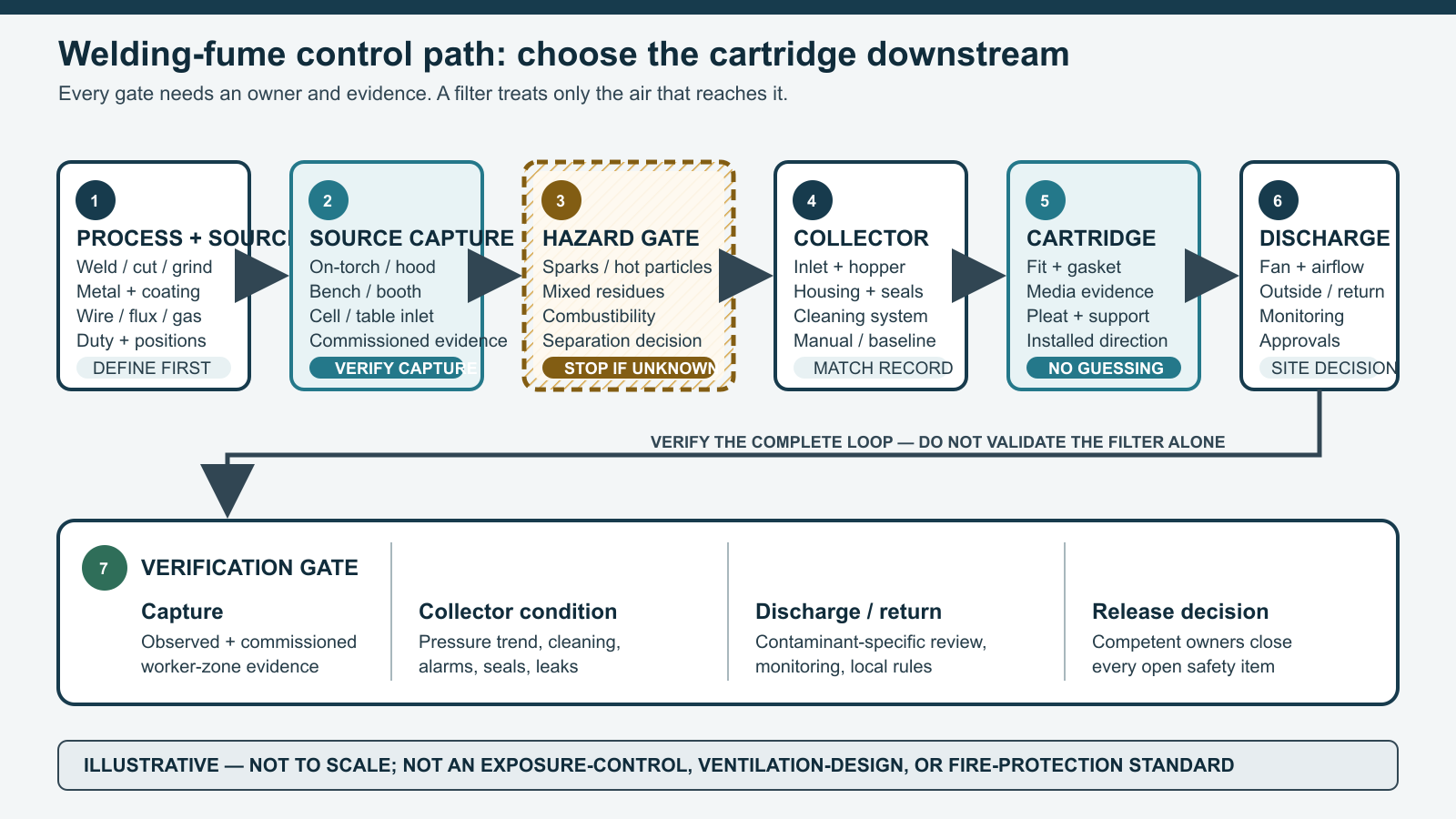
On narrow screens, scroll horizontally to inspect the full-size diagram.
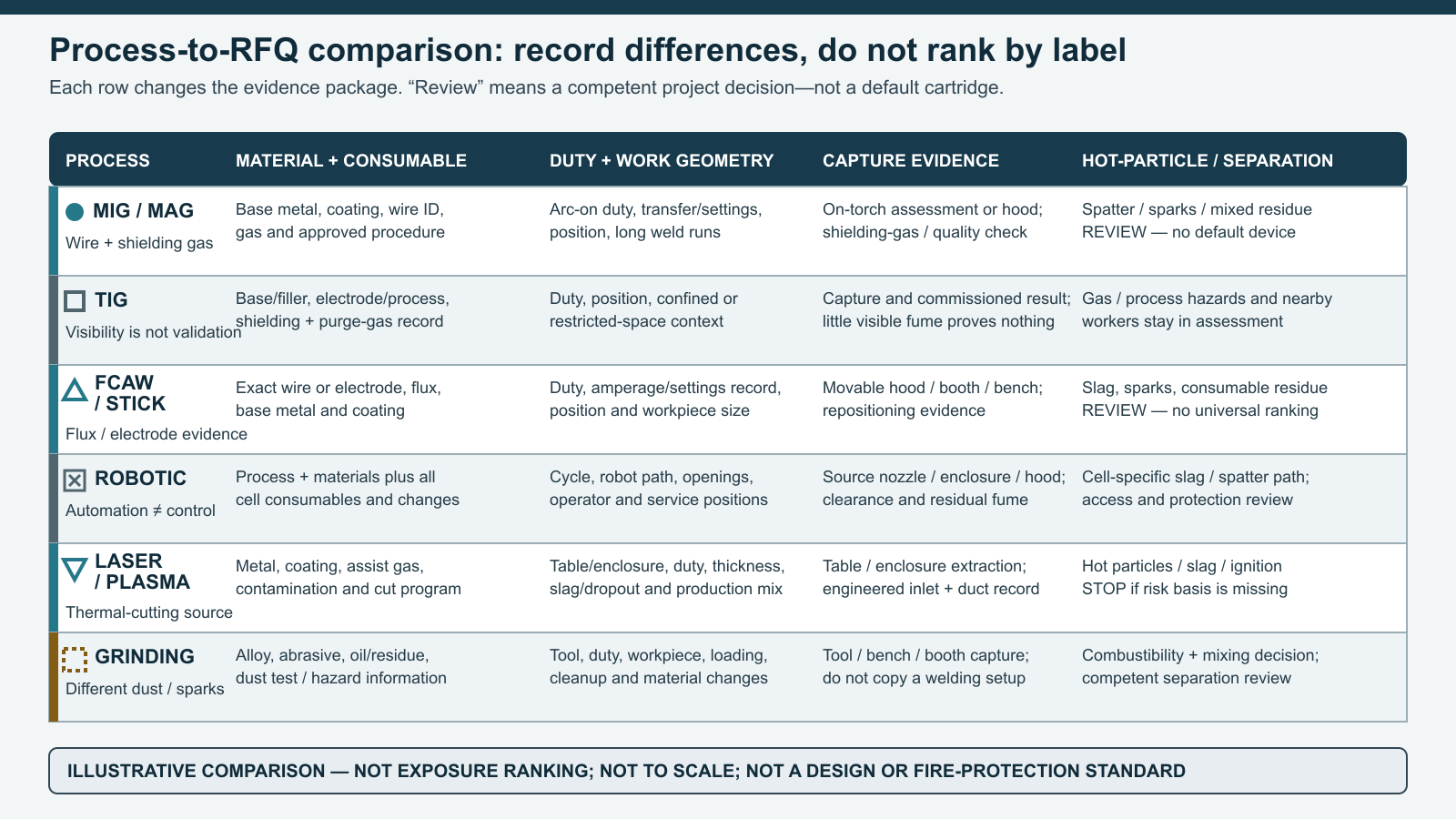
On narrow screens, scroll horizontally to inspect the full-size diagram.
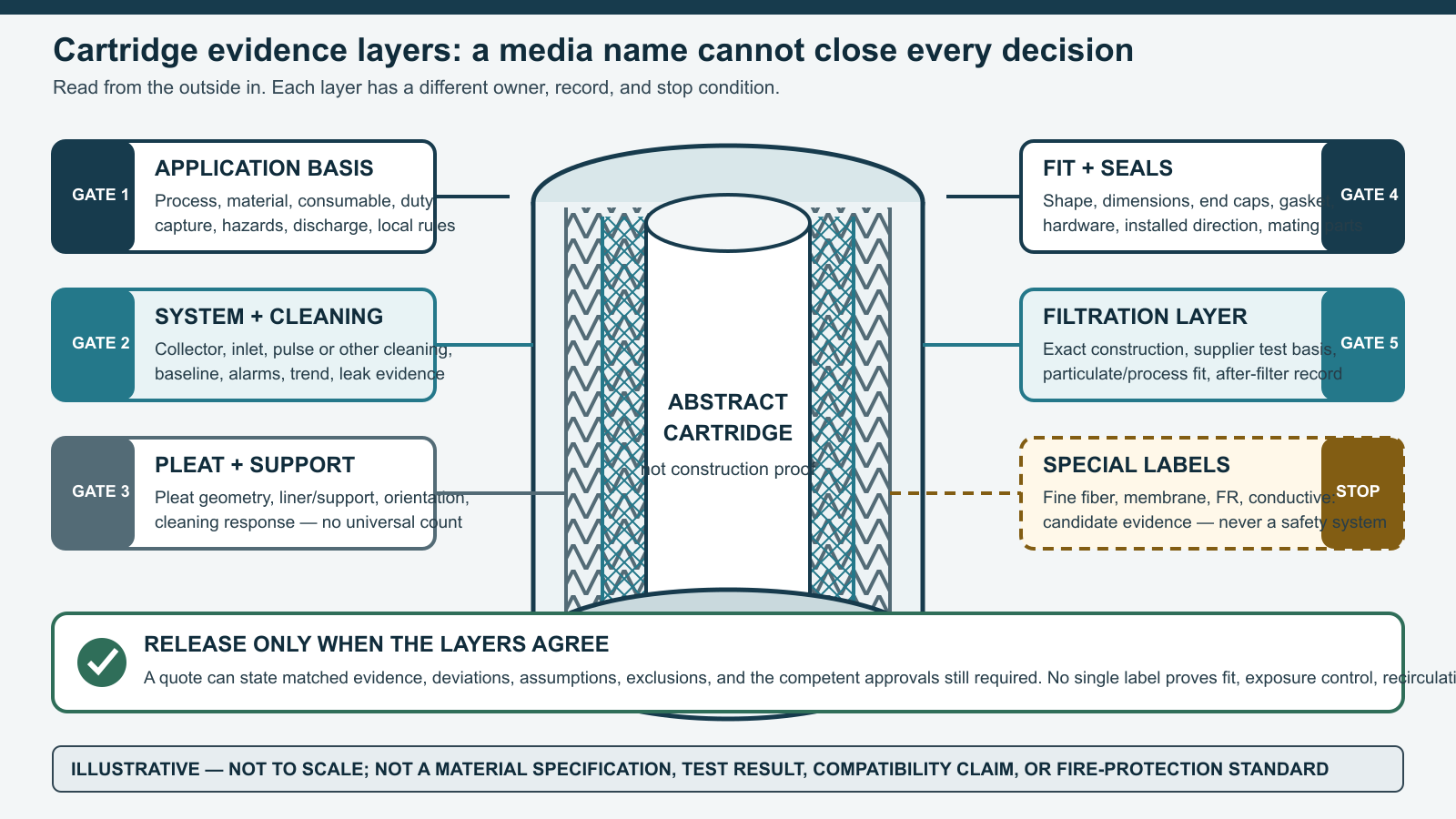
Common mistakes and safety red flags
Stop a filter-only quotation when the control, process, or hazard basis is missing. The following signals require verification or competent escalation, not a more confident cartridge guess.
- Choosing media before documenting source capture and the exposure-control assessment. [1][4] Limit: HSE is UK guidance; NIOSH applies to evaluated systems.
- Treating little visible TIG fume as proof that exposure is controlled. [1][5] Limit: HSE is UK guidance; NIOSH describes exposure factors, not this task.
- Assuming robotic welding removes exposure to operators, maintenance staff, or nearby workers. [1][10] Limit: HSE is UK guidance; Nederman shows manufacturer examples.
- Sending laser, plasma, welding, and grinding streams to one collector without a compatibility and fire-risk decision. [7][11] Limit: manufacturer process examples, not a universal separation rule.
- Calling a spark trap, flame-retardant medium, or conductive cartridge a complete fire-protection system. [7][15] Limit: manufacturer mitigation examples, not complete fire protection.
- Using cartridge diameter and length as a compatibility guarantee. [12] Limit: manufacturer troubleshooting examples, not a fit standard.
- Setting one universal change interval or differential-pressure threshold. [2][9] Limit: HSE is UK guidance; manufacturer values are equipment-specific.
- Allowing return air because a filter has a high-efficiency label, without contaminant-specific and jurisdictional review. [1][3] Limit: HSE is UK guidance; OSHA is U.S. federal.
- Continuing operation after unexpected clean-side or discharge dust without investigating system integrity. [2][12] Limit: HSE is UK guidance; manufacturer checks are examples only.
Quote-ready welding-fume filter checklist
Use the active dust collector filter RFQ checklist as a cover sheet, then add the welding-specific evidence below. Mark each item measured, copied, observed, assumed, or unknown. An unknown safety or process field remains an escalation item; it is not permission to quote a universal cartridge.
- Responsible exposure-control reviewer and applicable federal, state, local, and site requirements.
- Process: MIG/MAG, TIG, FCAW/stick, robotic, laser, plasma, grinding, or a documented combination.
- Base metal, coating or contamination, filler wire/electrode/flux, shielding/purge gas, approved process record, and duty.
- Workpiece size/position, operator and nearby-worker positions, source-capture type, cross-drafts, and commissioned evidence.
- Hot-particle, spark, slag, and ember history; mixed residues; dust/fire assessment status; responsible protection review.
- Collector maker/model, serial or drawing, inlet arrangement, cartridge count and installed orientation.
- Cartridge shape and dimensions, both end caps, gasket profile/location, mounting hardware, liner, support, and pleat construction.
- Exact media construction and supplier data; after-filter arrangement; no inferred flame-retardant or conductive requirement.
- Cleaning method, compressed-air and control record where applicable, differential-pressure baseline/trend, alarms, and cleaning response.
- Capture observations, leak or discharge evidence, maintenance history, previous cartridge life, and reason for change.
- Outdoor discharge or return-air proposal, assessed contaminants, approvals, monitoring, and environmental requirements.
- Quantity, full or partial changeout, photos, labels, old filter/sample status, required-by target, and open verification questions.
Product path
- Dust collector cartridge filtersUse this product path only after source capture, process hazards, collector geometry, seals, documented media evidence, cleaning, and discharge requirements are defined.
- Replacement dust collector filtersUse the replacement path to reconcile an installed cartridge, drawing, dimensions, end caps, gasket, media record, and operating history without treating fit as exposure-control approval.
- Dust collector accessoriesReview maintenance parts only against the actual collector manual and approved system design; an accessory is not a universal spark, fire, exposure, or compatibility solution.
Frequently asked questions
Is a welding fume filter cartridge enough by itself?
No. A cartridge treats particulate in air that the capture and duct system actually delivers to it. The complete decision begins with competent exposure assessment, source capture, ventilation, process and material, fire-risk controls, discharge, maintenance, and applicable rules. HSE and NIOSH support that control-first sequence; neither approves a particular US installation. [1][4]
Is nanofiber always the best media for welding fume?
No. Fine-fiber and nanofiber constructions are available in manufacturer welding-fume equipment, but selection still depends on documented test data, actual particulate and process, moisture or oil, chemistry, loading, cleaning, pleat/support design, collector fit, discharge basis, and supplier confirmation. The cited manufacturer examples are candidates, not universal prescriptions. [8][10]
Can MIG, TIG, flux-cored, and stick welding use the same filter?
Do not decide from process names alone. Document base and filler materials, wire/electrode/flux, shielding gas, duty, settings available from the approved procedure, work position, capture arrangement, and collector. HSE and NIOSH show that process, consumable, material, and task context matter, but they do not publish one interchangeable cartridge for these processes. [1][4][5]
Should robotic welding use ambient filtration or source capture?
That is a design decision for the actual cell. Review enclosure or hood geometry, source nozzles, openings, robot path, cycle, operators, service positions, residual fume, general ventilation, and commissioned results. HSE and Nederman describe multiple control arrangements; the manufacturer examples do not establish a universal robotic-cell solution. [1][10]
Can welding fume and grinding dust share one collector?
Not by assumption. Identify each material, residue, abrasive, spark source, and dust hazard, then have a qualified party decide compatibility, process separation, and fire/explosion controls. OSHA and manufacturer guidance show why dust, ignition, dispersion, confinement, and incompatible mixing matter; they do not create a universal rule for every facility. [6][7][11]
Does flame-retardant media eliminate welding-collector fire risk?
No. Manufacturer guidance says flame-retardant media is only one possible component of an overall mitigation strategy and cannot be assumed to stop ignition of accumulated dust cake. A qualified fire-risk review must address the actual fuel, ignition path, separation, collector, and protection under applicable codes. A20 does not prescribe those measures. [7][15]
When should welding-fume cartridges be changed?
There is no universal calendar interval in this guide. Use the collector manual and commissioned baseline together with differential-pressure trend, cleaning response, capture observations, alarms, clean-side or discharge evidence, condition inspection, exposure or emissions review, and competent judgment. HSE intervals are UK-specific; Donaldson's monitoring advice is equipment and process dependent. [2][9][13]
Sources
- HSE: Controlling the risks from welding
- HSE WL3: Welding fume control
- OSHA 29 CFR 1910.252: General requirements
- NIOSH: Welding Operations — Local Exhaust Ventilation Systems
- NIOSH: Welding Fumes and Manganese
- OSHA: Hazard Communication Guidance for Combustible Dusts
- Donaldson: Spark Mitigation
- Donaldson: What to Look for in a Weld Fume Extraction System
- Donaldson: Driving Optimal Performance From Your Weld Fume Collector
- Nederman: Welding Fume Extraction Systems
- Nederman: Fume and dust management in grinding and welding operations
- Donaldson: Troubleshooting for Leaking Dust Collectors
- HSE: Maintenance, examination and testing of LEV and RPE
- OSHA: Revised Combustible Dust National Emphasis Program (CPL 03-00-008)
- Donaldson: 5 Combustible Dust Misconceptions
Request a filter review
Send the control-system basis, welding or allied process, materials and consumables, capture arrangement, collector and cartridge records, hot-particle and fire-risk review status, dimensions and photos, media data, cleaning and pressure history, leak evidence, discharge decision, quantity, and unresolved questions. FilterBagWorks.com can use that package to review a replacement request; the responsible competent parties must approve exposure, fire, environmental, and system-safety decisions.
Request a quote