Filter procurement total-cost guide
For MRO buyers, maintenance managers, reliability teams, plant engineers, and sourcing teams
Reviewed by FilterBagWorks Technical Team
Cheap vs Premium Dust Collector Filters: Which Has the Lower Total Cost?
Compare two qualified filter options over one buyer-selected period. Keep purchase price separate from labor, downtime, disposal, attributable energy, observed replacement history, and documented events—and keep unknowns visible.
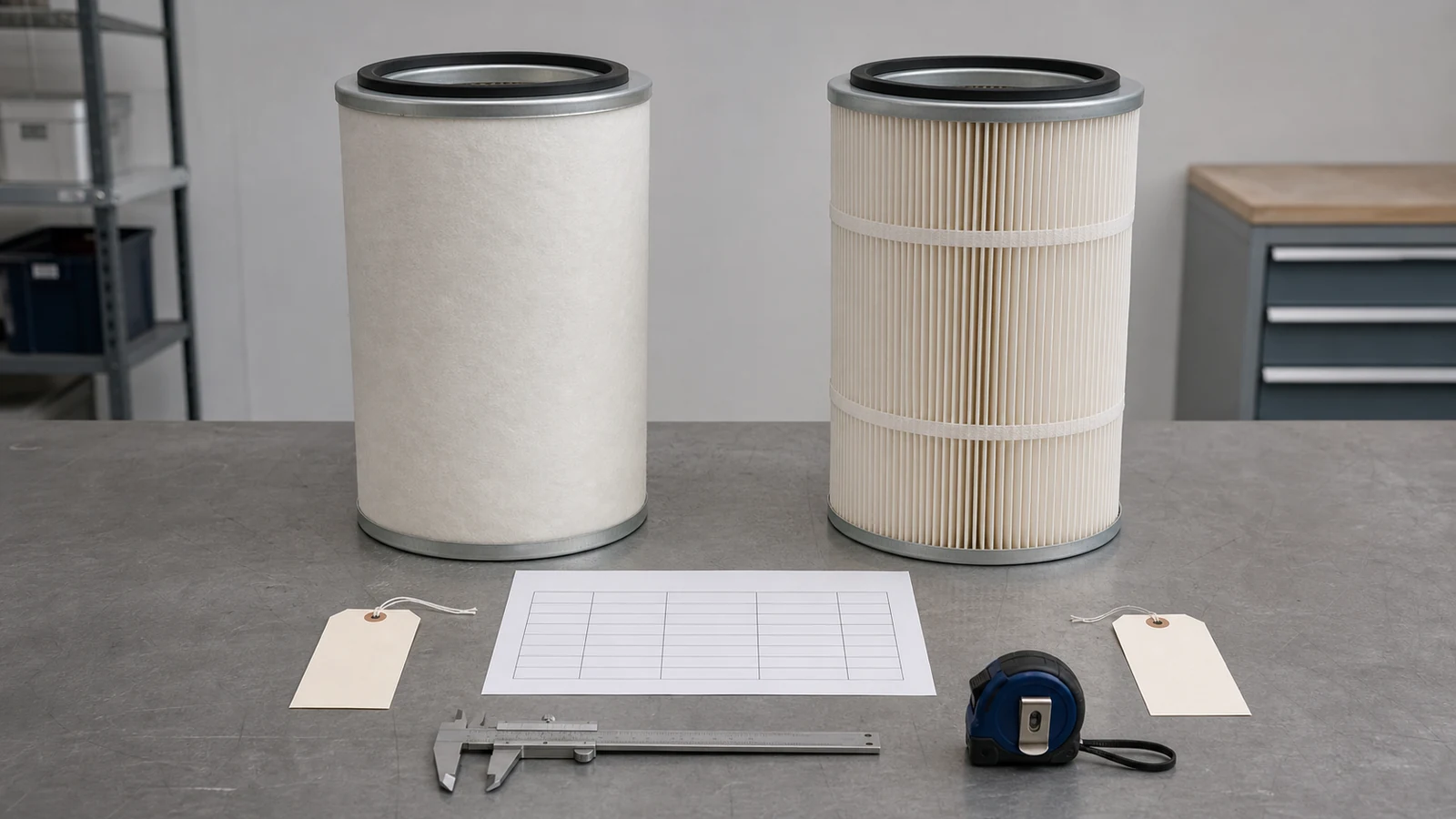
Direct answer
Purchase price alone is incomplete, but a higher price does not prove lower total cost, longer life, lower pressure drop, lower energy, better fit, or better filtration. First qualify Option A and Option B for the same collector and duty. Then compare buyer-recorded purchase, changeout labor, downtime, disposal and cleanup, attributable fan or compressed-air energy, observed replacement history, and documented leakage or quality-event costs over one stated period. Missing or non-comparable evidence stays on hold.
Scope, safety boundary, and evidence status
This guide compares two already-identified candidate filters for an existing dust collector. It does not qualify media, fit, seal, construction, cleaning, airflow, emissions, process compatibility, or safe changeout. Use current drawings, the collector manual, buyer measurements, operating records, and the applicable approval process first. Any inspection or changeout must follow the employer’s hazardous-energy procedures; OSHA places control of unexpected electrical, mechanical, hydraulic, pneumatic, chemical, thermal, and other energy within the employer’s servicing and maintenance responsibilities. [5] Mark each cost field measured, recorded, assumed, unknown, non-comparable, or excluded. Assumed values may explore a scenario but cannot release a purchase; unknown or non-comparable critical fields remain on hold.
Compare qualified options in this evidence sequence
1. Define one decision before collecting prices
Write the collector asset, filter family, installed quantity, requested quantity, operating duty, dust and process, airflow or capture requirement, cleaning method, and the decision owner. State whether the buyer is comparing one order, one changeout cycle, a fixed budget period, or another approved horizon. Use the same currency, tax and freight treatment, labor basis, production-cost method, utility boundary, and date basis. If one quote includes freight or hardware and the other does not, normalize the scope or hold it. Do not start with labels such as economy, standard, premium, OEM-equivalent, high efficiency, or extended life; those labels do not provide a measurable comparison boundary.
2. Qualify fit and duty before ranking cost
Confirm each candidate’s family, dimensions, top and bottom or end-cap construction, gasket or seal, retention, support, media, finish or treatment, loading direction, cleaning method, normal and upset conditions, and quantity. Use the dust collector filter RFQ checklist to make the evidence packages comparable. Neither same nominal size nor a higher price proves fit, compatibility, filtration, quality, or service life. If Option A and Option B are not both reviewable against the same requirements, stop the cost comparison and resolve specification evidence first.
3. Use the exact total-filter-cost category model
For the buyer-selected comparison period, total filter cost equals filter purchase cost, plus changeout labor, plus planned and unplanned downtime cost, plus disposal and cleanup cost, plus attributable fan and compressed-air energy difference, plus documented leakage or quality-event cost. This is a category model, not a universal accounting rule. The buyer chooses which categories are in scope and records the reason for every exclusion. Measured zero, unknown, non-comparable, and excluded are different states. Keep fan energy and compressed-air energy separately supported even though they enter one category. Keep planned and unplanned downtime separate during evidence collection so a scheduled task does not conceal an upset.
4. Record purchase cost without turning price into a grade
Capture unit price, extended price, quantity, freight, tax or duty within the buyer's boundary, required hardware, packaging, quote date, validity, and exceptions. Compare the same delivered scope; do not divide by an unproven service-life claim. A quote evidences commercial cost for its stated scope, not pressure drop, efficiency, fit, construction consistency, useful life, support quality, or compatibility. Compare optional media or treatment as a separate configured candidate. Mark budgetary, expired, conditional, or scope-unclear quotes rather than entering false precision.
5. Turn filter life into an observed replacement-count input
Use installation date, removal date, installed quantity, removed quantity, removal reason, condition evidence, duty, process changes, and whether units remain in service. EPA treats replacement parts and replacement labor as recurring cost categories, while its current monitoring page lists particulate outlet concentration or leak indication, pressure differential, temperature, flow, cleaning operation, and fan current as operating indicators. [3] [4] These sources set no universal interval. Compare cohorts only when collector, duty, dust, airflow, cleaning, maintenance, and removal criteria align. Treat still-running filters as censored observations, not completed life; keep supplier estimates as assumptions.
6. Build changeout labor from the approved task sequence
List isolation, access, containment, removal, handling, cleaning, inspection, installation, seal or retention verification, closeout, startup checks, and recordkeeping. Use crew size, role, loaded labor rate, elapsed time, contractor charges, lifting or access equipment, and consumables from actual work orders. OSHA defines the hazardous-energy boundary; it supplies no standard changeout time or labor value. [5] Compare only approved site procedures or a controlled sample task. If one record excludes setup or cleanup, normalize it or hold the labor comparison. Never trade safety steps for a lower model.
7. Separate planned downtime from unplanned interruption
For planned downtime, record the scheduled window, production state, shared maintenance, approved allocation, and restart or verification time. For unplanned downtime, record the event, start and return-to-service times, affected line, lost-production or delay method, investigation status, and approved cost owner. An outage during a filter change does not make its entire cost filter-attributable. When production mix, line rate, shared work, or event cause differs between options, mark it non-comparable instead of forcing a per-hour value.
8. Use actual disposal and cleanup evidence
EPA identifies dust disposal as a cost category and says disposal cost is site-specific. [3] Use the buyer’s approved waste route, filter and captured-material classification, container count, containment, transport, disposal invoice, cleanup labor, in-boundary consumables, and reusable-hardware disposition. Do not borrow the chapter’s historical dollar examples. Size, weight, price, or time in service does not automatically determine disposal cost. Different packaging or classification requires current site evidence.
9. Attribute fan and compressed-air energy instead of guessing
Pressure drop is one part of a fan system, not a savings value. DOE explains that operating point depends on fan and system resistance and that field flow can differ from laboratory conditions. [1] Match airflow or capture requirement, production, fan control, damper, filter seasoning, system configuration, measurement point, hours, and measured power. For pulse cleaning, DOE recommends electrical measurement for more accurate compressed-air energy work. [2] Isolate pulse frequency, compressor loading, pressure, controls, leaks, other demand, and hours. Not attributable or comparable means hold—not zero.
10. Include leakage or quality events only after cause review
EPA identifies particulate outlet concentration or a bag leak detection system as ways to monitor bag breakage and leakage. [4] Record only a documented event with date, equipment, observed evidence, investigation status, approved cause or allocation, cleanup, rework, scrap, complaint, inspection, replacement, and buyer-approved cost. An observation, alarm, reject, or cleanup does not prove a filter defect or identify the responsible component. Never invent event probability or expected loss. Open, shared, or non-comparable cause keeps the category on hold.
11. Normalize records and stop when evidence cannot compare
Build an evidence note beside every number: source record, date, quantity, unit, boundary, operating state, attribution method, owner, and status. Convert units only through an approved method and keep original records. A number from another collector, dust, line, production rate, or accounting period is not automatically transferable. Do not silently fill blank fields with zero, average unmatched records, or choose a favorable removal from a mixed population. Run separate scenarios when an assumption is useful, label it assumed, and show how the result changes. A decision remains on hold when a material input is unknown, non-comparable, causally unresolved, or based only on a supplier performance statement.
12. Illustrative worked example: a partial subtotal is not a winner
Every number in this example is illustrative, not a FilterBagWorks test result or savings claim. The example shows why visible holds matter; it does not describe a product, plant, test, service life, or expected result.
Scroll table horizontally
| Example input | Option A | Option B |
|---|---|---|
| Comparison period | Illustrative: 24 months; not a FilterBagWorks test result or savings claim | Illustrative: 24 months; not a FilterBagWorks test result or savings claim |
| Filter purchase cost in period | Illustrative: $18,000; not a FilterBagWorks test result or savings claim | Illustrative: $24,000; not a FilterBagWorks test result or savings claim |
| Changeout labor | Illustrative: $4,000; not a FilterBagWorks test result or savings claim | Illustrative: $2,500; not a FilterBagWorks test result or savings claim |
| Planned and unplanned downtime | Illustrative: $6,000; not a FilterBagWorks test result or savings claim | Illustrative: $3,000; not a FilterBagWorks test result or savings claim |
| Disposal and cleanup | Illustrative: $1,500; not a FilterBagWorks test result or savings claim | Illustrative: $1,000; not a FilterBagWorks test result or savings claim |
| Attributable fan/compressed-air energy difference | HOLD — no comparable attributable evidence | HOLD — no comparable attributable evidence |
| Documented leakage or quality-event cost | HOLD — event cause is unresolved | HOLD — event cause is unresolved |
| Partial subtotal of documented example rows | Illustrative: $29,500; not a FilterBagWorks test result or savings claim | Illustrative: $30,500; not a FilterBagWorks test result or savings claim |
The illustrative partial subtotal differs, but neither option can be ranked because two material categories remain on hold and technical qualification is outside the arithmetic. Completing the model could preserve, reverse, or eliminate the difference. No ROI, payback, savings percentage, or purchasing conclusion follows.
Total-cost formula, sensitivity view, and blank buyer worksheet
Use the formula graphic to confirm the selected categories, then use the sensitivity graphic to test how assumptions can change the ranking. Both use neutral Option A and Option B labels. Every displayed scenario number is illustrative, not a FilterBagWorks test result or savings claim. The blank table is for buyer inputs; unknown or non-comparable evidence routes to HOLD and must not be invented.
Scroll table horizontally
| Buyer input | Option A | Option B | Evidence source / date / owner | Status or hold reason |
|---|---|---|---|---|
| Comparison period and quantity | ____________ | ____________ | ____________ | ____________ |
| Filter purchase cost | ____________ | ____________ | ____________ | ____________ |
| Changeout labor | ____________ | ____________ | ____________ | ____________ |
| Planned downtime cost | ____________ | ____________ | ____________ | ____________ |
| Unplanned downtime cost | ____________ | ____________ | ____________ | ____________ |
| Disposal and cleanup cost | ____________ | ____________ | ____________ | ____________ |
| Attributable fan energy difference | ____________ | ____________ | ____________ | ____________ |
| Attributable compressed-air energy difference | ____________ | ____________ | ____________ | ____________ |
| Documented leakage or quality-event cost | ____________ | ____________ | ____________ | ____________ |
| Total or HOLD | ____________ | ____________ | ____________ | ____________ |
On narrow screens, scroll horizontally to inspect the full-size diagram.
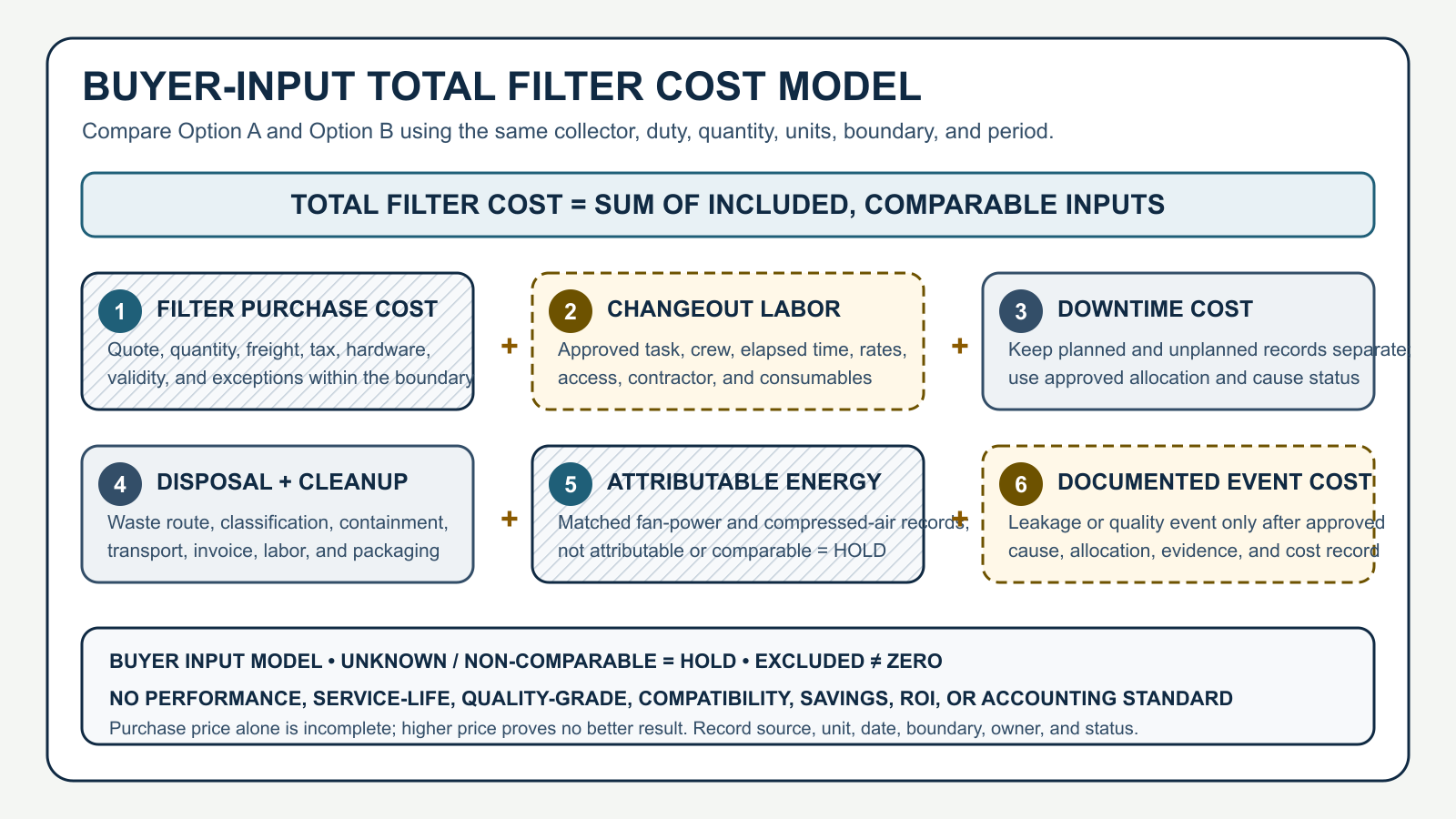
On narrow screens, scroll horizontally to inspect the full-size diagram.
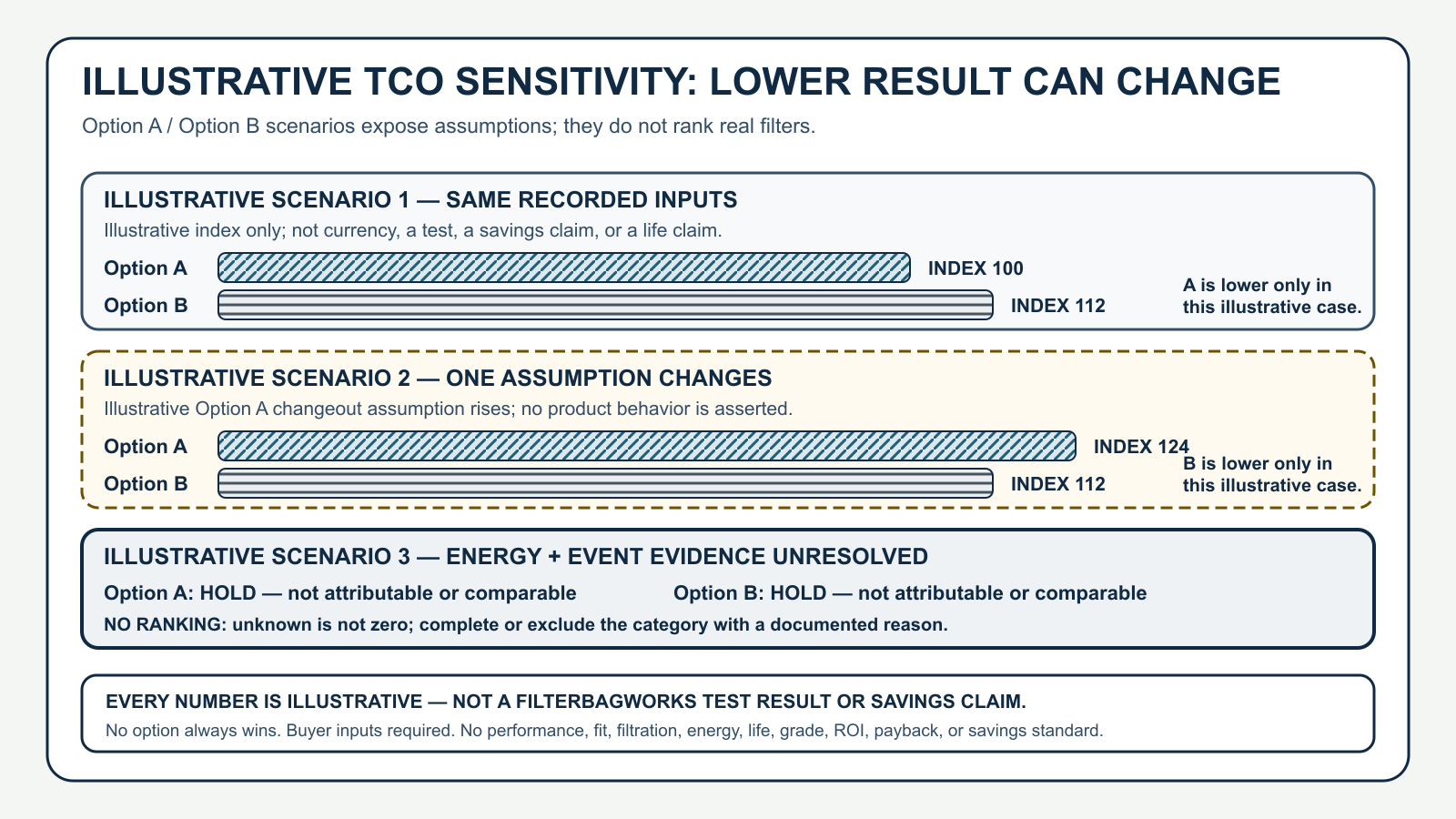
Common total-cost comparison mistakes and red flags
Hold the decision when any of these shortcuts replaces qualification, comparable evidence, or buyer ownership.
- Ranking by unit price before confirming fit, seal, media, cleaning, process, and quantity.
- Treating premium, economy, OEM-equivalent, high-efficiency, or extended-life language as a verified quality grade.
- Using a higher price as proof of lower pressure drop, lower energy, longer life, better filtration, better fit, or lower total cost.
- Using a lower price as proof that technical differences do not matter.
- Dividing price by a promised life value that is not observed under comparable duty.
- Comparing pressure drop or power at different airflow, filter seasoning, production, fan control, or system condition.
- Allocating a whole outage, cleanup, reject, alarm, or emissions event to the filter without an approved cause and boundary.
- Entering zero for an unknown, excluded, non-comparable, or not-attributable category.
- Borrowing labor, utility, disposal, ROI, payback, or savings percentages from another plant or vendor case.
- Presenting an illustrative partial subtotal as a purchasing decision while material holds remain open.
Quote-ready evidence for a fair Option A / Option B comparison
Attach the active RFQ checklist, then align these commercial, fit, operating, maintenance, and event records for both options.
- Collector maker/model or asset ID, filter family, installed quantity, requested quantity, and current drawing or manual revision.
- Dimensions, top/bottom or end-cap construction, gasket/seal, retention, support, media, finish, loading direction, and cleaning method.
- Dust and process, normal and upset conditions, airflow or capture requirement, operating hours, cleaning history, and current symptoms.
- Option A and Option B quotes with configured part, revision, quantity, unit and extended price, freight/tax boundary, hardware, exceptions, validity, and date.
- Buyer-selected comparison period, currency, accounting boundary, quantity basis, production basis, and decision owner.
- Dated installation/removal cohorts, removal reasons, condition evidence, remaining in-service units, and process or maintenance changes.
- Approved changeout task sequence, crew and elapsed time, loaded labor rates, contractor/access charges, consumables, and work-order references.
- Planned and unplanned downtime records with allocation method, affected production, shared work, investigation status, and owner.
- Waste route, classification, containment, transport, disposal and cleanup invoices, labor, and packaging or reusable-hardware disposition.
- Matched airflow, fan speed/control, damper, production, pressure and power measurement method, hours, date, and meter owner.
- Pulse frequency, header/compressor conditions, compressed-air allocation method, electrical measurement, other demand, and operating hours.
- Documented leakage or quality events with observed evidence, approved cause/allocation, cleanup, rework, scrap, complaint, inspection, and replacement costs.
- Every field status: measured, recorded, assumed, unknown, non-comparable, or excluded, with a named hold owner and closeout action.
Product path
- Replacement dust collector filtersUse the replacement path to qualify the filter family, construction, evidence, and operating duty before comparing cost.
- Dust collector filter bagsDocument bag dimensions, top and bottom details, media, finish, cage relationship, cleaning, dust, and process conditions for each candidate.
- Dust collector cartridge filtersCompare cartridge dimensions, end caps, gasket location, mounting, support, media, cleaning direction, and operating evidence before cost.
Frequently asked questions
Are premium dust collector filters always cheaper over time?
No. A higher price does not prove longer life, lower pressure drop, lower energy, better filtration, better fit, fewer events, or lower total cost. Qualify both options and compare buyer-recorded categories over the same stated period.
Is the lowest purchase price usually the lowest total cost?
Not necessarily. Purchase price is one category alongside changeout labor, planned and unplanned downtime, disposal and cleanup, attributable fan or compressed-air energy, and documented leakage or quality-event cost. Missing evidence remains on hold.
How should filter life be entered in the comparison?
Use dated installation and removal cohorts, quantity, removal reason, condition, duty, process changes, and still-running units. Do not convert a supplier estimate or another plant's experience into observed life or a guarantee.
Can a filter data-sheet pressure drop be converted into energy savings?
Not by itself. Match airflow or capture requirement, production, filter seasoning, fan speed/control, damper, system configuration, measurement points, power, and hours. If the difference cannot be attributed to the candidate filter, hold the line.
Should a leakage or quality event always be charged to the filter?
No. Record observed evidence, investigation status, cause, affected equipment, and approved allocation. An alarm, dust observation, reject, cleanup, or complaint does not automatically prove that a filter caused the event.
What should I enter when a cost is unknown?
Enter unknown and assign a closeout action; do not enter zero. Use assumed values only for visibly labeled scenario exploration. If a material input is missing or non-comparable, the purchasing conclusion remains on hold.
Does this total-cost worksheet calculate ROI or payback?
No. It organizes buyer-entered cost categories over a selected comparison period. It does not provide a universal ROI, payback, savings percentage, accounting rule, service-life assumption, or purchasing approval.
Sources
- U.S. Department of Energy: Improving Fan System Performance — A Sourcebook for Industry
- U.S. Department of Energy: Improving Compressed Air System Performance — Third Edition
- U.S. EPA: Air Pollution Control Cost Manual, Section 6, Chapter 1 — Baghouses and Filters
- U.S. EPA: Monitoring by Control Technique — Fabric Filters
- OSHA: Control of Hazardous Energy (Lockout/Tagout)
Request a filter review
Send qualified Option A and Option B specifications, collector evidence, quantity, matched quotes, replacement history, changeout, downtime, disposal/cleanup, attributable energy, documented events, comparison period, assumptions, exclusions, and every hold. FilterBagWorks.com can review filter evidence; the buyer owns accounting, safety, cause allocation, and purchasing approval.
Request a quote