Condition-based maintenance guide
For maintenance technicians, plant managers, reliability teams, and MRO buyers
Reviewed by FilterBagWorks Technical Team
How Often Should Dust Collector Filters Be Replaced?
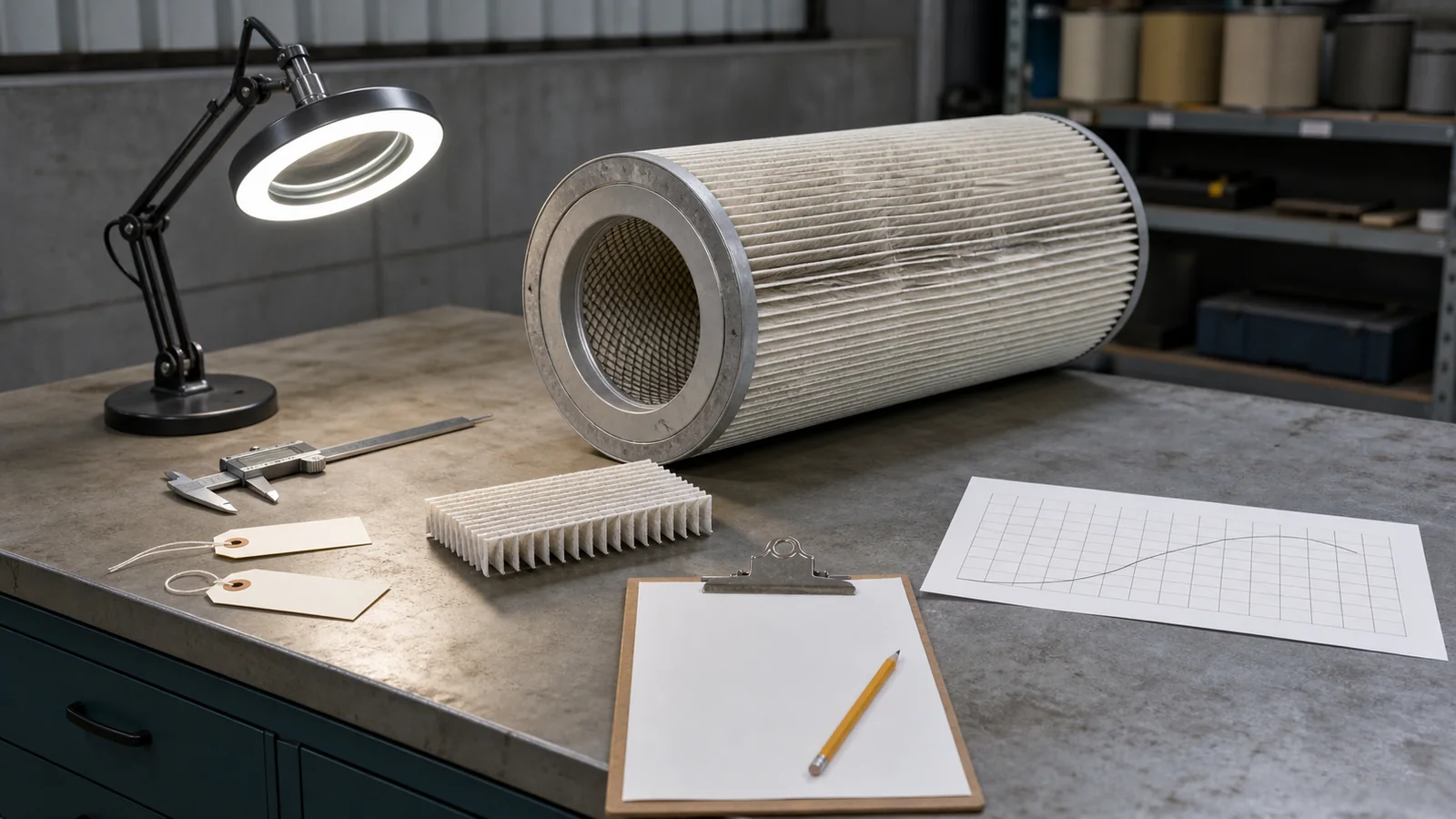
Replace the calendar guess with a traceable condition review that compares the site baseline, airflow or capture, cleaning recovery, leakage, filter condition, and process history.
Direct answer
There is no universal calendar answer to “how often should I change dust collector filters?” Replace them when collector-specific condition evidence shows that the filter set can no longer support the required airflow, capture, cleaning recovery, or emissions performance—or when inspection finds damage or loss of seal integrity. Establish a site baseline, compare like operating states, verify the complete system, and use the exact collector manual before planning changeout.
Scope, limits, and safe-maintenance boundary
Use this guide to organize evidence for industrial fabric bags, dust-collector cartridges, and rigid pleated elements that operate in a collector with an established manual and maintenance program. It is not a universal operating standard, a permit interpretation, a media-selection calculation, a confined-space procedure, or an energy-control procedure. Covered servicing can expose workers to electrical, mechanical, pneumatic, chemical, thermal, and stored energy. OSHA requires employer energy-control procedures where its hazardous-energy standard applies. [10] Follow the exact collector manual, employer procedures, contaminant controls, permit conditions, and qualified safety direction before opening, inspecting, testing, or changing filters.
Build the replacement decision from condition evidence
Work through the evidence in sequence. Do not let one pressure reading, dirty appearance, remembered age, or cross-reference decide the changeout. Record measurements, observations, changes, checks, and unknowns.
1. Establish the collector-specific baseline
Start with the exact collector and controller manuals, commissioning record, current filter specification, and known acceptable operation. Record differential pressure, airflow or capture, fan or damper state, process rate, dust, temperature context, cleaning mode, and filter-set identity. EPA lists pressure differential, exhaust flow, cleaning-mechanism operation, fan current, temperature, and outlet particulate evidence as possible fabric-filter performance indicators. [1] A useful baseline is a group of related observations, not a number copied from another collector. If it is missing, document a provisional reference only after the site team verifies acceptable operation.
2. Compare differential-pressure trends under like conditions
Trend the reading across comparable production states and note startup, shutdown, cleaning, fan, damper, and process changes. A rising differential-pressure trend can reflect dust loading, compressed-air interruption, failed cleaning, sensing problems, airflow change, moisture, sticky dust, or hopper issues. A current Donaldson manual for one named cartridge collector says its operating resistance depends on air volume and dust characteristics and directs operators through collector-specific checks before replacement. [4] Its values and schedule apply to that equipment only. A07 adopts the diagnostic sequence, not the numbers: confirm sensing, context, cleaning, dust discharge, and airflow before calling the element spent.
3. Verify airflow and capture performance separately
A pressure trend is not a substitute for effective source capture. Observe whether the hood, enclosure, or pickup controls the contaminant in the intended operating state, using the site’s approved indicator. HSE treats local exhaust ventilation as a system of hood, duct, air mover, air cleaner, and records; its FAQ describes pressure and airflow evidence. [2] [3] This UK guidance supports the evidence method, not a U.S. compliance conclusion or universal airflow target. If capture deteriorates, investigate ducts, hoods, dampers, fan, blockages, leaks, process changes, and filters together.
4. Ask whether the specified cleaning cycle still recovers the system
For a collector designed to clean in service, compare the condition before and after the manual-specified cleaning sequence. Does pressure return toward the established band? Does airflow or capture recover? Does the controller continue pulsing without reaching its programmed stop condition? Donaldson’s on-demand cleaning guidance explains that controllers use their programmed high and low points and that continued pulsing without pressure recovery is diagnostic evidence. [5] Do not copy its settings or change controller values from this article. Confirm the pressure tubing, controller, electrical supply, solenoids, diaphragm valves, blowpipe alignment, air manifold, and dust discharge before treating poor recovery as a filter-only problem.
5. Use pulse demand and compressed-air condition as evidence
A shorter time between cleaning events, longer cleaning operation, or increased compressed-air demand may show that the system is working harder, but it does not by itself prove end of filter life. Log the controller mode, pulse response, air availability, leaks or restrictions, moisture or oil evidence, valve condition, and whether demand changed with production or dust. Camfil APC’s maintenance guidance groups solenoids, diaphragm valves, controller operation, air settings, line leakage, header moisture, connections, and pipe alignment in the cleaning-system check. [8] Follow the actual collector and controller manuals for settings. Raising pressure or increasing frequency without root-cause review can waste compressed air or damage components and media.
6. Treat emissions or clean-side dust as a separate response path
Do not wait for a pressure trend or planned change date when clean-side dust, an outlet plume, a leak-detector change, or other emissions evidence appears. EPA identifies outlet particulate concentration, bag-leak detection, opacity, pressure differential, exhaust flow, and related parameters as monitoring options, and its bag-leak best-practices document describes parametric records and dye testing as parts of some programs. [6] Use the site’s permit and response procedure. The path may involve torn media, poor seating, a reversed gasket, missing hardware, a tubesheet or housing leak, or another bypass. Donaldson’s leak guide recommends examining the installed filters, seals, hardware, clean-side dust location, housing, and pulse correlation before assuming media alone caused the leak. [7]
7. Inspect damage by filter family and preserve the cause evidence
For bags, map holes, tears, seams, top attachment, bottom wear, cage contact, cage roughness, and tubesheet seating. For cartridges, inspect pleats, end caps, gaskets, compression, support, hardware, and orientation. For rigid pleated elements, record the pleated pack and baghouse-style attachment. Photograph the location before cleaning or disposal, retain a representative failed element when procedures allow, and tag its position. Abrasion, degradation, tears, buildup, failed seals, and installation damage support replacement review and a cause review. Reordering without checking support, cleaning, inlet loading, moisture, temperature, chemistry, or fit can repeat the failure.
8. Account for dust and process changes
Compare the current process with the baseline: dust type and loading, production rate, particle behavior, moisture or condensation, oil or sticky material, temperature and upset history, chemistry, sparks or hot particles, and any airflow or collector modification. EPA’s pulse-jet fabric-filter fact sheet identifies particulate characteristics, loading, cleaning method, temperature, moisture, and chemistry as variables in fabric-filter behavior. [9] It does not authorize a media choice or operating limit for this project. A recent process change can make the old baseline incomparable or expose a specification mismatch. Escalate application and hazard questions to the collector manufacturer, process owner, EHS function, and other competent parties instead of solving them with a calendar replacement.
9. Decide whether to monitor, correct the system, or plan changeout
Continue documented monitoring when capture and emissions evidence remain acceptable, the trend is stable for comparable conditions, cleaning recovers as intended, and inspection finds no damage or seal problem. Correct the system first when sensing, fan, damper, duct, cleaning, compressed-air, hopper, seal, or operating changes explain the symptom. Plan changeout when the collector-specific review shows persistent loss of required airflow or capture, failure to recover after verified cleaning and system checks, damaged media or seals, confirmed leakage, or an application change that makes the current filter unsuitable. Record who made the decision, the governing manual or site reference, the evidence reviewed, and remaining uncertainties.
10. Plan the changeout and the new baseline together
Before the outage, confirm filter family, part number or replacement evidence, dimensions, ends or top and bottom, gasket or snap-band details, media record, quantity, whether the scope is a full set or selected positions, and which failed samples must be retained. Coordinate access, lifting, isolation, contaminant containment, waste handling, cleaning of sealing surfaces, hardware or cage correction, spare stock, and restart responsibility under site procedures. After installation, verify seating and orientation, follow the collector-specific startup or conditioning method, inspect for leaks, and record the new differential-pressure, airflow or capture, cleaning, fan, and process baseline. A changeout closes only when the cause and restart evidence are documented—not when the old elements leave the collector.
Use a multi-signal replacement decision
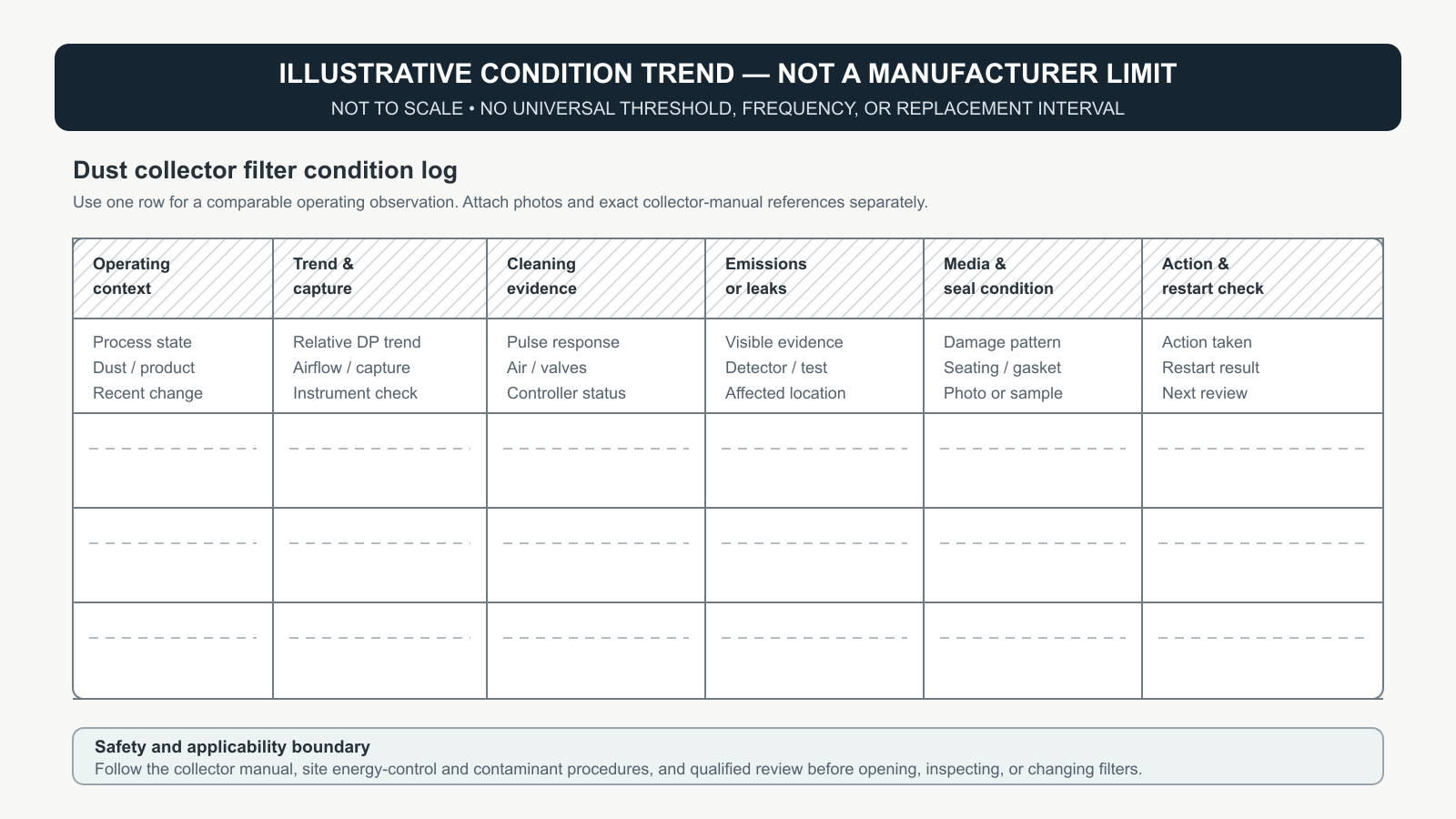
The table and diagrams organize the decision without inventing a limit. Each visual is illustrative, not to scale, and not a manufacturer instruction. Compare like operating states, use the exact collector manual, and keep pressure, airflow, cleaning, emissions, damage, and process evidence together.
Scroll table horizontally
| Evidence pattern | Next check or action | What it does not prove |
|---|---|---|
| Trend changed; capture still acceptable | Verify sensing, operating state, airflow, cleaning, dust discharge, and process changes | The filters must be changed now |
| Cleaning demand increased | Inspect controller, air supply, valves, leaks, moisture, blowpipes, dust, and hopper | More pulsing is the correct fix |
| Pressure remains elevated after verified system checks | Compare capture, cleaning recovery, inspection findings, and the exact manual; plan changeout if evidence converges | One shared pressure limit applies |
| Clean-side dust or emissions evidence | Follow the site response path; locate media, seal, seating, hardware, housing, or bypass evidence | All elements are loaded or the media grade is wrong |
| Tear, abrasion, failed seal, or collapsed support | Preserve the location and sample, correct the cause, define replacement scope, and verify restart | Replacing the same part alone prevents recurrence |
| Dust, moisture, temperature, chemistry, or process changed | Re-establish applicability and baseline with the responsible technical parties | The historical interval remains valid |
On narrow screens, scroll horizontally to inspect the full-size diagram.
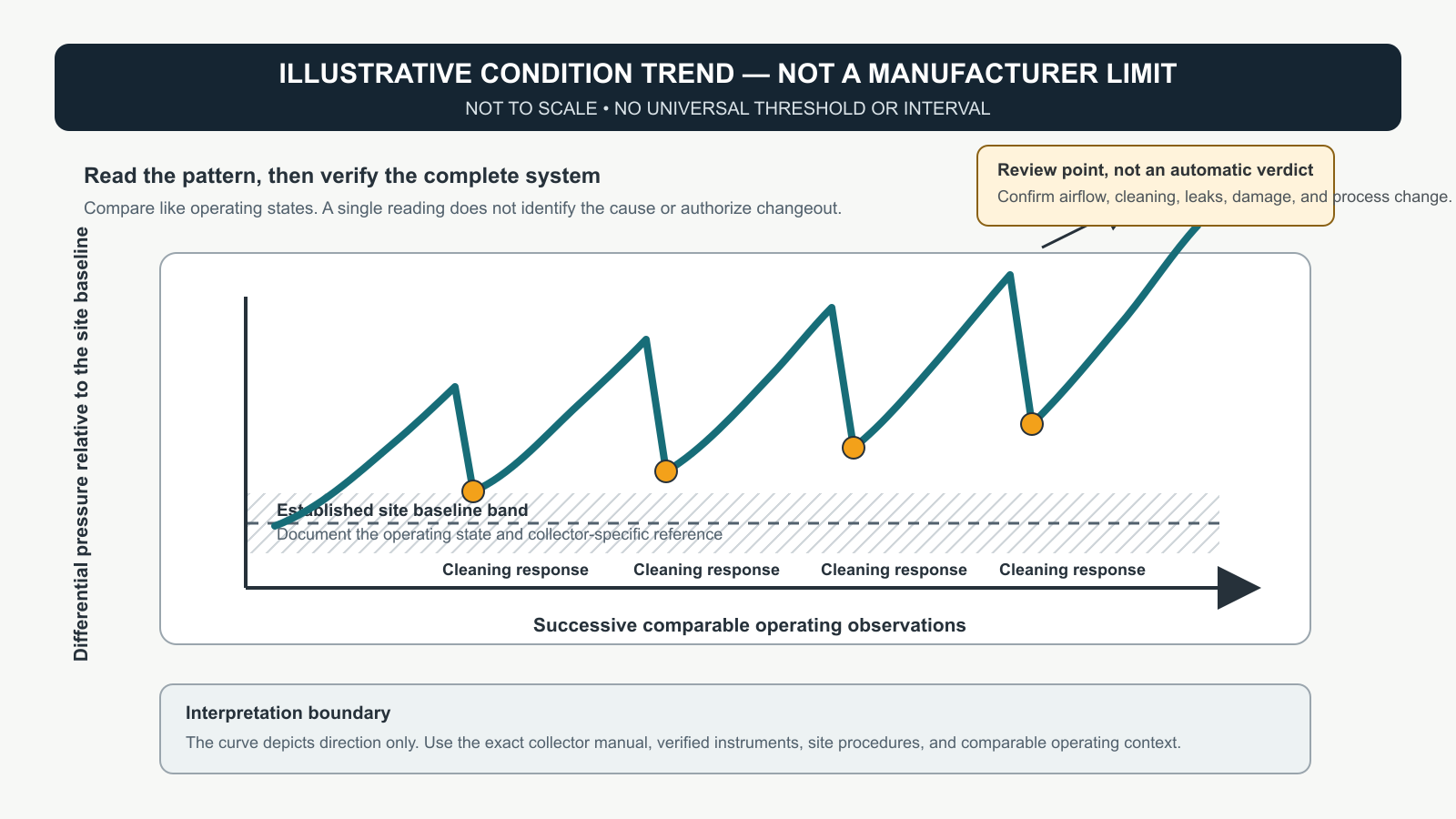
On narrow screens, scroll horizontally to inspect the full-size diagram.
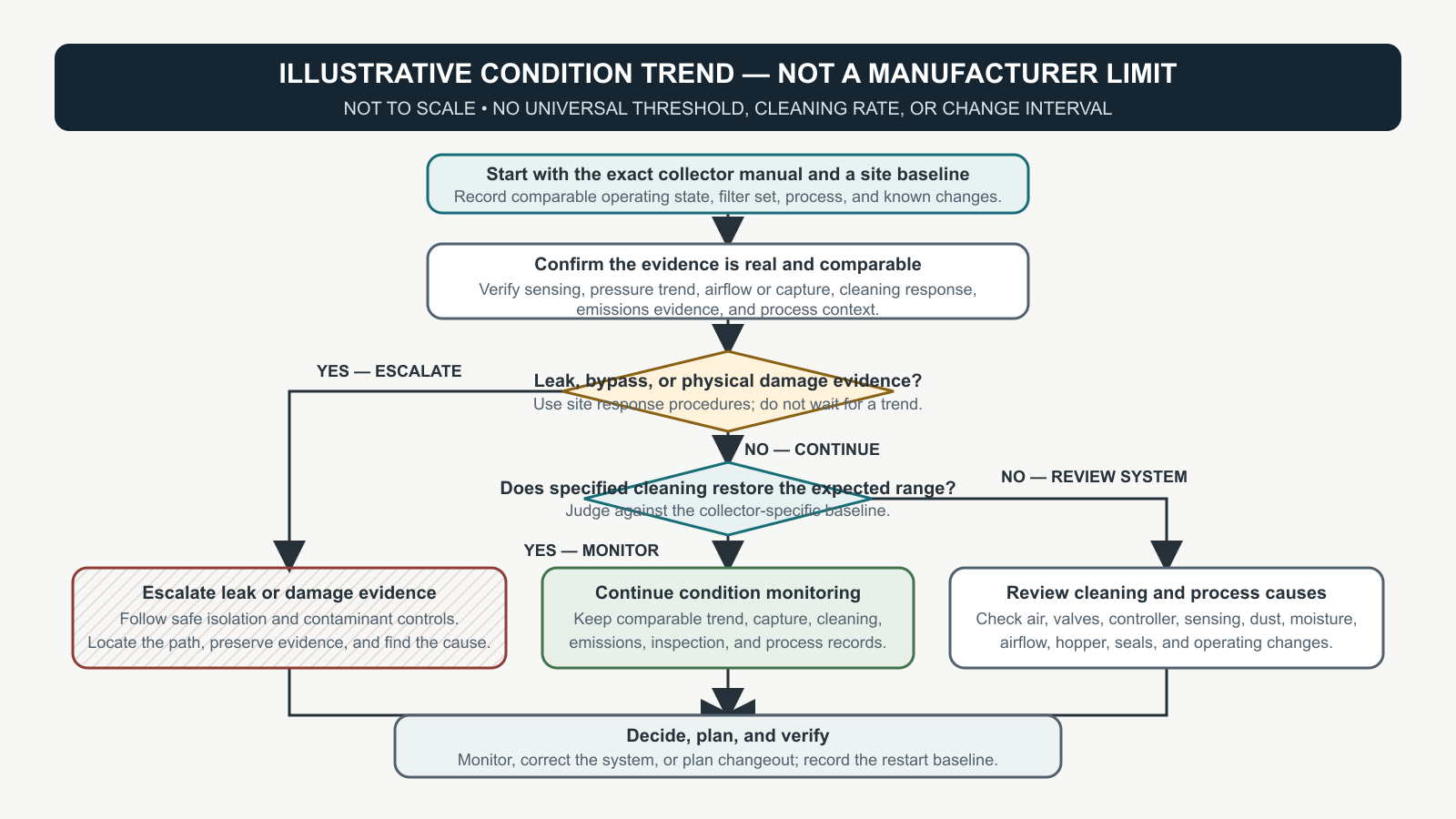
On narrow screens, scroll horizontally to inspect the full-size diagram.
Common replacement-timing mistakes and red flags
Stop treating timing as routine when the observation suggests leakage, unsafe access, a process hazard, or a system fault that must be controlled first.
- Using a remembered calendar age, another plant's experience, or an online value as the change rule.
- Comparing pressure readings from different fan, damper, production, or cleaning states.
- Calling a dirty-looking filter failed without checking capture, emissions, recovery, and physical condition.
- Increasing pulse pressure or frequency without the collector and controller manuals or a cause review.
- Ignoring clean-side dust, an outlet plume, a detector change, or a damaged seal until the next planned outage.
- Replacing filters while leaving failed valves, blocked sensing lines, full hoppers, rough cages, dirty sealing surfaces, or process changes unresolved.
- Discarding the only failed element before its location, orientation, damage, and surrounding hardware are documented.
- Opening or entering equipment without the site's energy-control, access, contaminant, and permit procedures.
Quote-ready condition and changeout checklist
Send a traceable evidence package, not only a filter age or one pressure reading. Label copied records, field observations, assumptions, and unknowns.
- Collector manufacturer, model, serial information, controller, compartment, and exact manual reference when known.
- Filter family, current part number or identification evidence, media record, dimensions, ends or attachment, seal, support, installed orientation, quantity, and set age when documented.
- Dated site trend with operating state, fan or damper state, process rate, dust, cleaning mode, and instrument-check notes.
- Airflow or source-capture observation and the approved indicator or measurement method used by the site.
- Cleaning response, controller mode, pulse demand, compressed-air condition, valves, moisture, leaks, and checks already completed.
- Visible emissions, leak-detector or test evidence, clean-side dust location, affected positions, and permit or site response already followed.
- Full-filter and close-up photos of tears, abrasion, seams, gaskets, end caps, snap bands, cages, tubesheet, hardware, or bypass evidence.
- Dust and process, loading or production change, moisture, sticky material, temperature history, chemistry, sparks or abrasion, and recent maintenance changes.
- Requested scope: full set, selected positions, spare stock, retained sample, outage window, access, containment, disposal, packaging, labeling, and restart verification.
- Decision goal: restore capture, investigate leakage, correct recurring damage, address process change, or plan routine stock—plus every unresolved question.
Product path
- Replacement dust collector filtersUse the replacement path after the condition record, filter identity, cause review, quantity, and changeout scope are documented.
- Dust collector filter bagsUse the bag path when top, bottom, seam, dimensions, cage relationship, media record, and operating evidence are available.
- Dust collector cartridge filtersUse the cartridge path when both end caps, gasket, support, mounting geometry, dimensions, orientation, and condition evidence are clear.
Frequently asked questions
How often should dust collector filters be replaced?
There is no universal calendar interval. Use the collector manual and a site condition record that compares differential-pressure trend, airflow or capture, cleaning recovery, emissions or leak evidence, physical condition, and process changes under comparable operating states.
What differential pressure means a filter must be changed?
No one pressure value applies to every collector. Use the exact manufacturer's limit and diagnostic sequence for the installed equipment. First verify sensing, airflow, fan or damper state, cleaning, compressed air, dust discharge, process conditions, and recovery after the specified cleaning cycle.
Does high differential pressure always mean the filters are worn out?
No. It can accompany filter loading, but it can also follow a blocked pressure line, cleaning-system fault, compressed-air interruption, airflow change, moisture, sticky dust, hopper problem, or process change. Diagnose the complete system before assigning the cause.
Can low differential pressure mean the filters are healthy?
Not by itself. Review airflow and fan state, damaged or missing media, seal bypass, incorrect installation, sensing faults, and emissions evidence. A pressure reading is meaningful only with the collector configuration, operating context, capture result, and other condition evidence.
Should cleaning frequency be increased to extend filter life?
Do not change cleaning settings from generic advice. Increased demand can be evidence of loading or a system fault, while excessive cleaning can consume air and stress components or media. Follow the collector and controller manuals and verify valves, supply, moisture, leaks, dust, and process conditions.
Do filter bags and cartridges use the same replacement signs?
They share system evidence such as pressure trend, airflow or capture, cleaning recovery, emissions, and process history. Inspection differs: bags require top, bottom, seams, cage contact, and tubesheet review; cartridges require pleats, end caps, gaskets, support, hardware, and orientation review.
What should be recorded after new filters are installed?
After following the collector-specific startup procedure, record filter-set identity, process state, differential pressure, airflow or capture, fan or damper state, cleaning behavior, leak or emissions check, seating or orientation verification, and any corrective work. That becomes the comparison baseline for later decisions.
Sources
- U.S. EPA: Monitoring by Control Technique — Fabric Filters
- HSE: Controlling Airborne Contaminants at Work — HSG258
- HSE: Local Exhaust Ventilation Frequently Asked Questions
- Donaldson DFPRE1/2/3 Installation, Operation and Maintenance Manual
- Donaldson: Troubleshooting Dust Collector On-Demand Cleaning Systems
- U.S. EPA: Best Practices for Bag Leak Detection Systems in Clean Air Act Permitting
- Donaldson: Troubleshooting for Leaking Dust Collectors
- Camfil APC: Dust Collector Servicing — Preventative Maintenance
- U.S. EPA: Fabric Filter — Pulse-Jet Cleaned Type Fact Sheet
- OSHA 29 CFR 1910.147: The Control of Hazardous Energy
Request a filter review
Send the collector and filter identification, comparable trend, airflow or capture evidence, cleaning-system checks, leakage or damage photos, dust and process changes, quantity, and planned outage scope. State which observations are confirmed and which remain unknown. Use the exact collector manual and site procedures to define the changeout and restart checks.
Request a quote