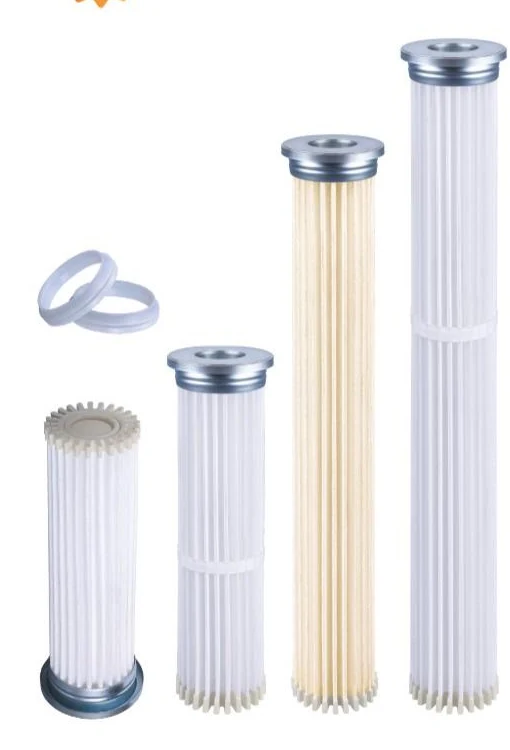
Cartridge fit and component guide
For MRO buyers, maintenance engineers, distributors, and cartridge sourcing teams
Reviewed by FilterBagWorks Technical Team
How to Select a Replacement Dust Collector Filter Cartridge
Select a replacement dust collector cartridge by matching its outside profile, length endpoints, end caps, gasket, mounting, media, cleaning direction, and collector details. Photos and an old part number help identify the element, but they do not replace a fit review.
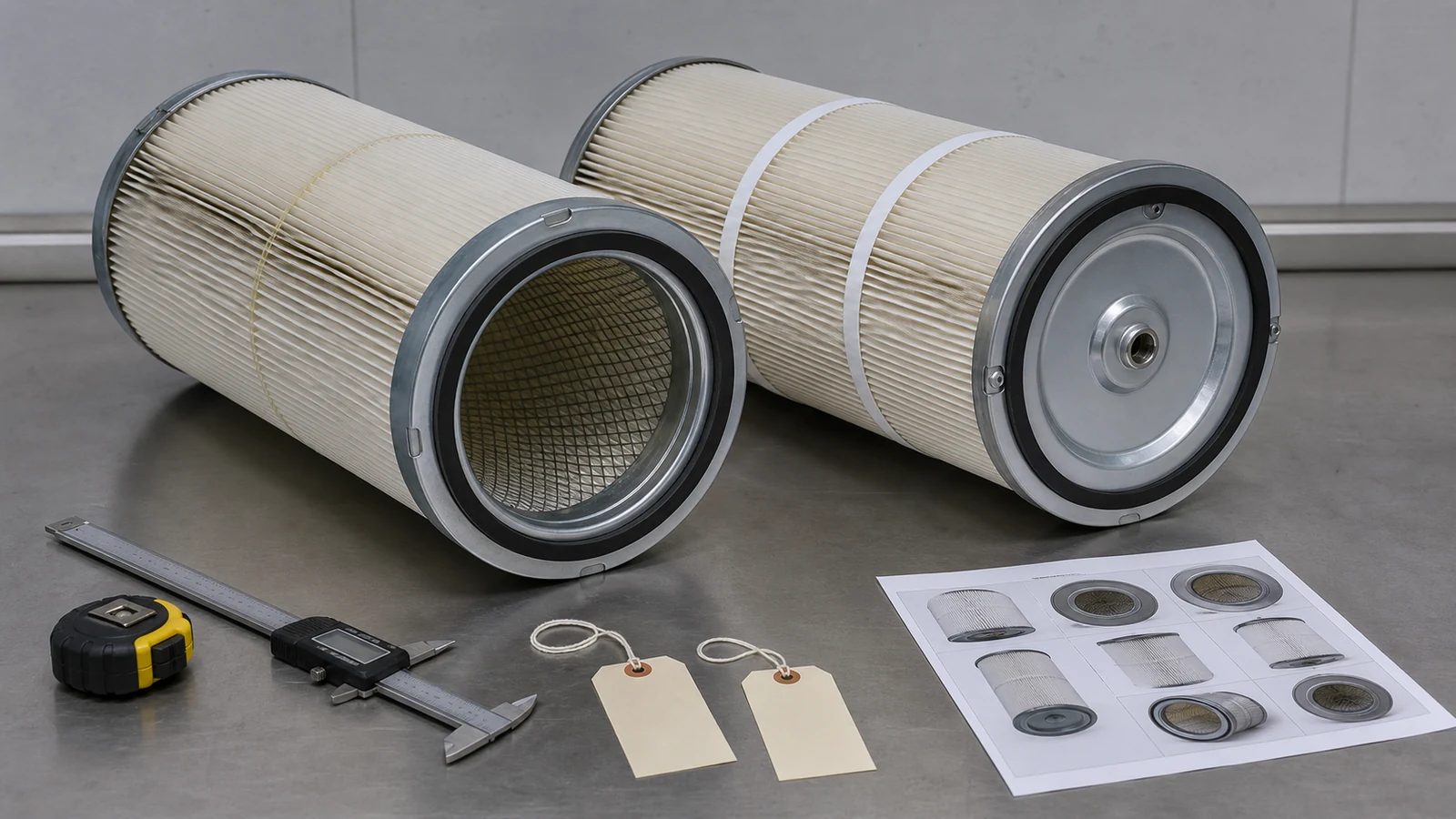
Direct answer
Select a replacement dust collector filter cartridge by reconciling the installed collector, cartridge shape, measured OD or outside profile, inner openings, defined overall-length endpoints, both end caps, mounting, gasket and sealing face, documented media, pleat/support construction, cleaning direction, and operating conditions. The same nominal size is not enough. Treat every brand or part number as identification evidence only, then hold the order until fit-critical unknowns are verified.
Scope, safety boundary, and evidence status
This guide organizes safely removed cartridge evidence, current records, accessible collector details, and operating history. It does not authorize collector entry, energized access, defeated isolation, uncontrolled dust disturbance, or live trial fitting. OSHA’s hazardous-energy rule defines the servicing boundary; the collector manual and employer procedure govern isolation, stored energy, PPE, contaminant handling, lifting, and disposal. [1] Mark fields M measured, C copied from an identified record, O observed, A assumed, or U unknown. Keep condition separate from intended geometry. A or U remains a hold, never an ordering value.
Select a replacement cartridge in this fit-first sequence
Create one evidence index before comparing candidates. Give the removed cartridge and collector position neutral IDs, keep original units beside any conversion, and link each measurement to a photo. Record the old label exactly, but start geometry review from the physical part and controlling collector records. Preserve conflicts between drawings, records, and field measurements for review.
1. Identify the collector, position, and installed cartridge family
Record collector maker, model, serial, drawing/manual revision, cartridge quantity and position, access direction, installed orientation, airflow path, support, and retention. Photograph the external position before removal when procedures permit, then photograph every side of the removed element. Note whether it is round, oval, triagonal, conical, or another profile. Donaldson's DFE description shows a non-round end-cap profile engaging a named support yoke. [2] That equipment-specific example demonstrates why round OD alone cannot describe every mounting relationship.
2. Use brand and part numbers as identification evidence only
Photograph the label and copy every character, suffix, revision, brand, collector model, invoice code, and record date. A manufacturer index may search by part number or brand, but also separates outer/inner diameter, length, medium, end cap, temperature, and options. [6] A lookup result identifies a candidate record. It is not authorization, affiliation, an as-built specification, or a guaranteed cross-reference. Do not claim a direct replacement until the candidate drawing, collector requirements, physical evidence, and approval path agree.
3. Record OD or outside profile with locations and orientation
For a round cartridge, measure undamaged outer reference surfaces at named locations and state what the tool contacts. For oval, triagonal, tapered, or other shapes, record both principal dimensions, profile evidence, and orientation. Repeat readings where loading, dents, or distortion are possible. Donaldson’s round Series 200 and Series 324 drawings label outer diameter, while its DFE product uses a shaped element. [3] [4] Do not average damage or infer a universal point, clearance, or tolerance.
4. Define the overall-length endpoints before measuring
Write and photograph both endpoints before entering length. State whether the reading includes gasket, flange, pan, handle, stud, thread, or another projection. Do not press the old seal to obtain a preferred number. Manufacturer sheets and indexes use a length field, but supplier endpoints may differ. [3][4][6] Compare values only after definitions match. If the element is bowed, loaded, swollen, or damaged, report condition separately and seek a supported intended dimension.
5. Measure each inner opening as a separate feature
Record top and bottom openings independently. Name reference edges, shape, clear passage, and any liner, cone, venturi, yoke, rod, or recess. Photograph each end square-on and in profile. Donaldson drawings list inner diameter while illustrating liners; Camfil's index separates outer and inner end-cap diameters. [3][4][6] Do not call a liner, mounting clearance, venturi, or gasket edge the cartridge ID unless the controlling drawing does. A matching opening does not establish mounting or cleaning fit.
6. Document both end caps and every mounting feature
Describe each end: open, closed, center hole, flange, recess, pan, hook, profile, stud, bolt holes, tabs, indexing, and retained hardware. Measure hole patterns and profiles from named references; copy threads only from supported evidence. Donaldson publishes two-open-end and open/closed-with-hole examples. [3] [4] Parker’s DFE instructions distinguish a gasket-first open/open element from an open/closed element with a threaded-rod path. [11] These examples prove variation, not interchangeability.
7. Map gasket location, sealing face, and observed compression evidence
Photograph the gasket from the end and side, then record which end and face it occupies, profile, free-state width and thickness as found, splice, seating surface, contact band, uneven imprint, cuts, tears, permanent set, deposits, and clean-side dust nearby. Donaldson’s DFPRE manual says to clean the sealing surface, insert the seal end first, compress the seal, avoid overtightening, and replace damaged seals. [5] Its leak guide asks about torn or improperly compressed gaskets, orientation, and hardware. [10] Neither source authorizes a universal compression percentage, squeeze, force, final thickness, latch setting, or torque. Witness marks are diagnostic evidence only.
8. Separate media identity from surface treatment and appearance
Copy media name, substrate, test reference, treatment, temperature/chemistry limits, conductivity instructions, and revision only from a current record tied to the part. Photograph labels and surfaces, but do not identify media from color or feel. Donaldson’s selector distinguishes branded cellulose, polyester, spunbond, antistatic, flame-retardant, and higher-temperature options using temperature, moisture, static, agglomerative dust, and chemical-resistance questions. [8] It includes an application disclaimer. A12 prescribes no media, surface treatment, flame behavior, conductivity, washability, efficiency, or limit.
9. Record pleat pack, liners, bands, spacers, and support
Photograph pleat faces and ends; record depth/spacing method, liners, bands, straps, spacers, cones/secondary packs, and blocked channels, collapse, abrasion, separation, or repair. Donaldson identifies media pack and liners as distinct components. [3] Camfil describes pleat-spacing beads and an inner cone on OptiCone, which it limits to specified Gold Series collectors. [7] Do not generalize pleat count, spacing, support, media area, pulse distribution, performance, or fit.
10. Confirm normal airflow and pulse-cleaning direction from the collector
Draw the dirty-air path, clean-side opening, installed orientation, and cleaning-pulse entry from the actual collector manual or approved record. One Donaldson DFPRE manual describes flow toward the element center and an inside-outward pulse that removes outside-surface dust. [9] That direction belongs to the named equipment. A12 prescribes no filtration direction, pulse pressure, duration, interval, nozzle, venturi, or controller setting. Shape cannot answer this field.
11. Add dust, process, temperature, moisture, and chemistry evidence
Record process and dust source, particle form, loading, abrasiveness, fibrous/sticky/agglomerative behavior, oil or mist, sparks/hot particles, combustible-dust review status, normal and upset temperature at a named location, humidity or condensation, water ingress or washdown, and acids, alkalis, solvents, oxidizers, or process changes. Donaldson’s selector uses several of these variables before media review. [8] EPA also explains that particle characteristics, gas-stream conditions, fabric characteristics, and cleaning method influence fabric-filter selection and operation. [12] Neither source approves a cartridge for the site. Do not infer hazard classification, exposure control, emissions compliance, fire/explosion protection, performance, or universal limits from a dust name.
12. Preserve damage and failure evidence before disposal
Map dents, distorted end caps, cracked or collapsed media, liner damage, torn or missing gasket, dust on the clean side or inside the cartridge, abrasion, heat or chemical evidence, and every affected position. Photograph the whole element and close views with a neutral location marker. Parker warns against handling damage and keeps its named replacements boxed until installation. [11] Donaldson’s leak guide treats damaged media or assemblies, installation, orientation, hardware, gasket condition, operating history, and process excursions as investigation fields. [10] Damage may explain a symptom but cannot supply intended geometry or a universal root cause. Do not copy a distorted value into a replacement drawing or install a suspect candidate on this article’s authority.
13. Validate the candidate drawing, sample, and release decision
Build a side-by-side record for the installed evidence and proposed candidate: shape, OD/profile, length endpoints, both openings, both end caps, mounting, gasket/sealing face, media/treatment record, pleat/support, airflow/cleaning direction, and operating limits. Attach current supplier drawing revision and unresolved questions. When geometry is unusual, records conflict, or the old element is damaged, request a retained known-good sample, controlled supplier sample review, or an equipment-specific fit-verification plan. A physical sample is evidence, not permission to copy an unknown construction. A safe trial fit cannot authorize media, cleaning, performance, process limits, or a bulk order. Release quantity only through the buyer's approved technical and purchasing controls.
Cartridge measurement and fit-validation assets
Use the three editable diagrams to keep endpoints, end-cap/gasket categories, and release evidence visible. Profiles are representative and blanks are buyer-entered. The not-to-scale visuals require buyer photos and dimensions and establish no compatibility, compression, media, cleaning, performance, or operating rule.
Scroll table horizontally
| Release layer | Evidence that must agree | Hold condition |
|---|---|---|
| Identity | Collector position, complete label/code, record revision, photo index | Code is partial, obsolete, conflicting, or untraceable |
| Geometry | Shape, OD/profile, named length endpoints, both inner openings | Any fit-critical value is assumed, damaged, or uses unclear endpoints |
| Ends and mounting | Both end caps, holes/studs/hooks/yoke, orientation, retained hardware | A silhouette or family name substitutes for mating details |
| Seal | Gasket location/profile, sealing face, witness evidence, damage, candidate record | Compression, torque, latch, or seal adequacy is guessed |
| Construction | Exact media/treatment record, pleat pack, liners, bands, spacers/support | Appearance substitutes for supplier data |
| System | Normal airflow, cleaning direction, dust/process, temperature, moisture, chemistry | Another collector's manual or limit is being copied |
| Validation | Candidate drawing, known-good sample or controlled review, open-question closure | Brand/part number is being treated as authorization or a guaranteed cross-reference |
On narrow screens, scroll horizontally to inspect the full-size diagram.
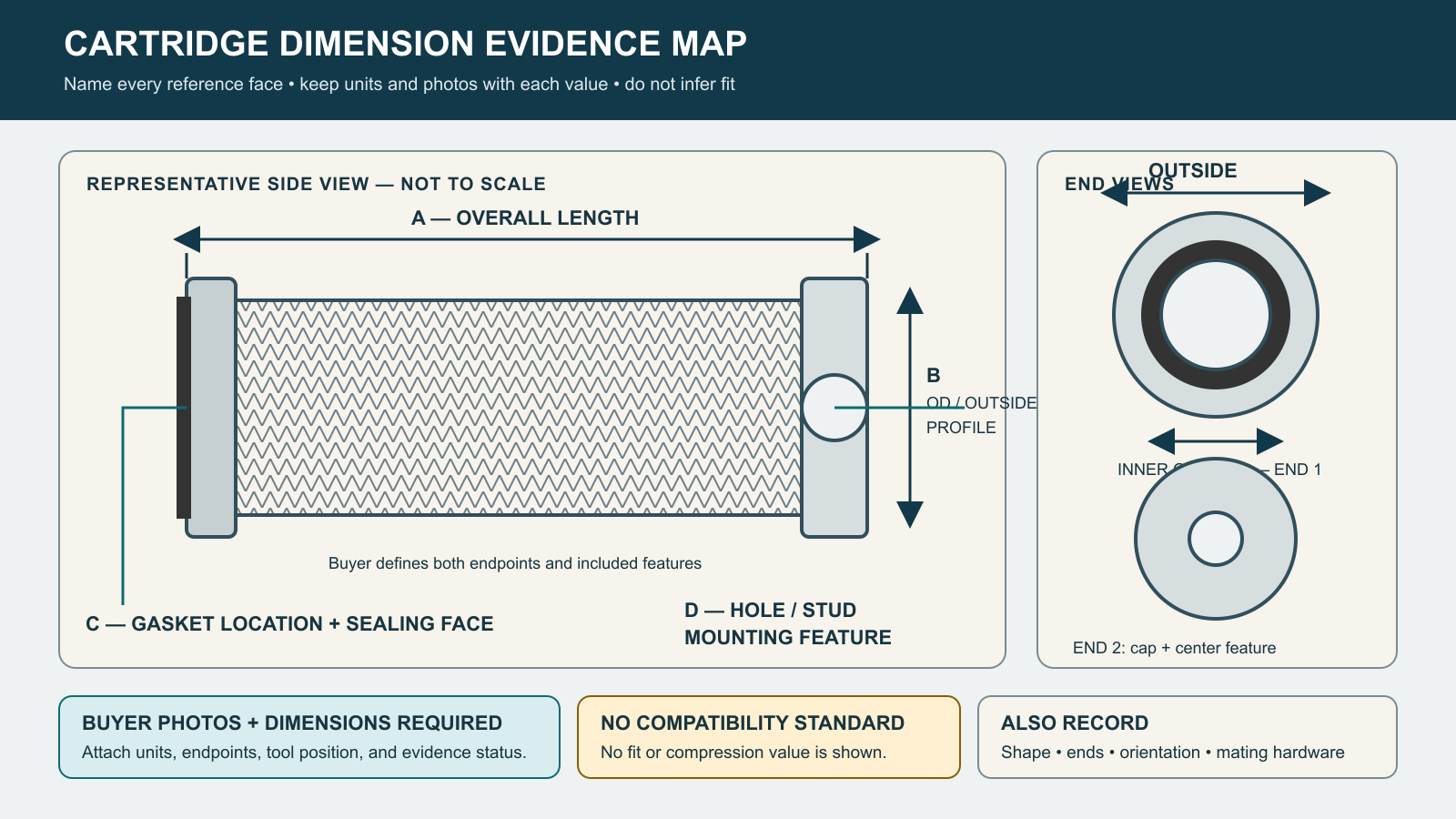
On narrow screens, scroll horizontally to inspect the full-size diagram.
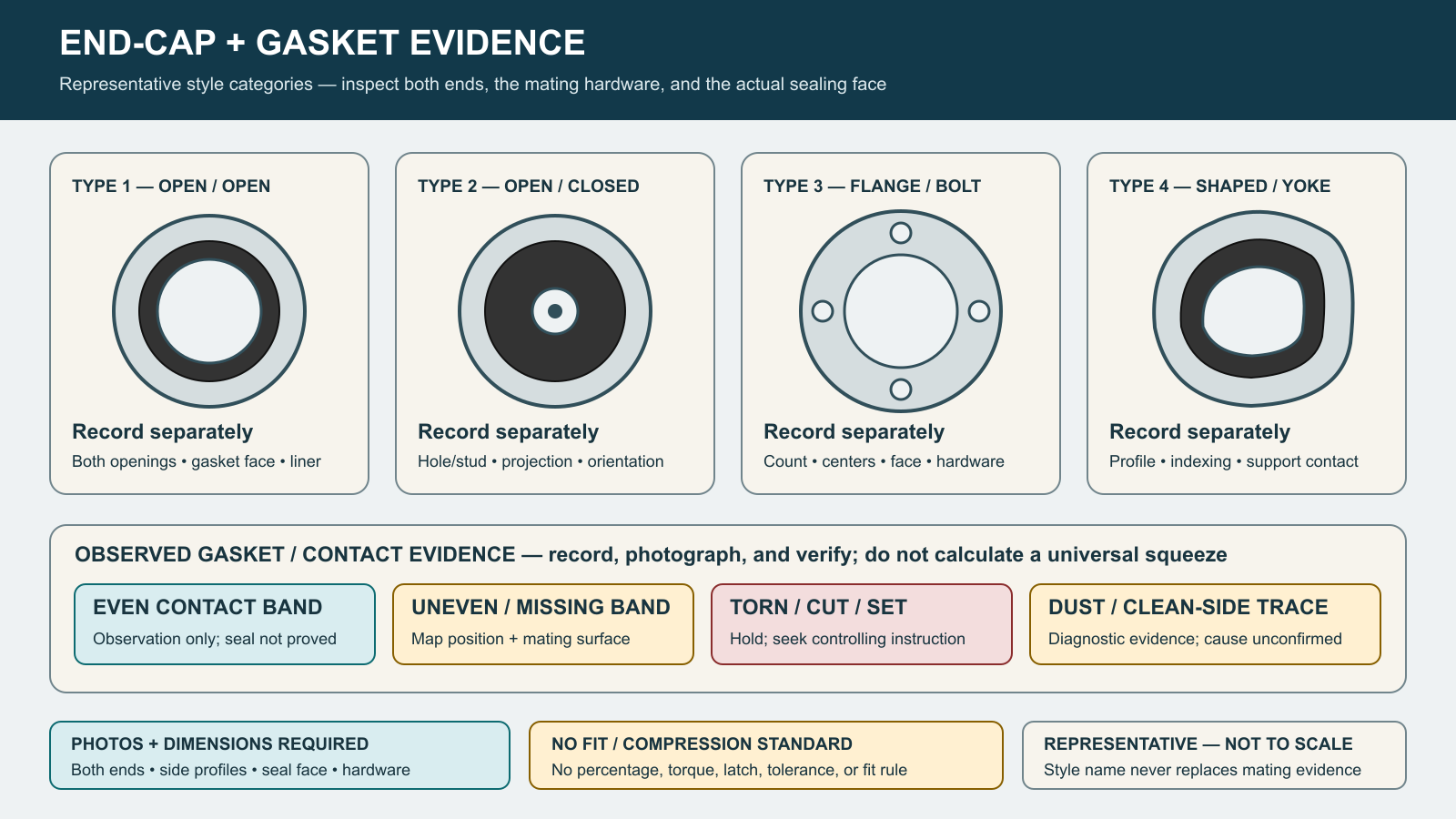
On narrow screens, scroll horizontally to inspect the full-size diagram.
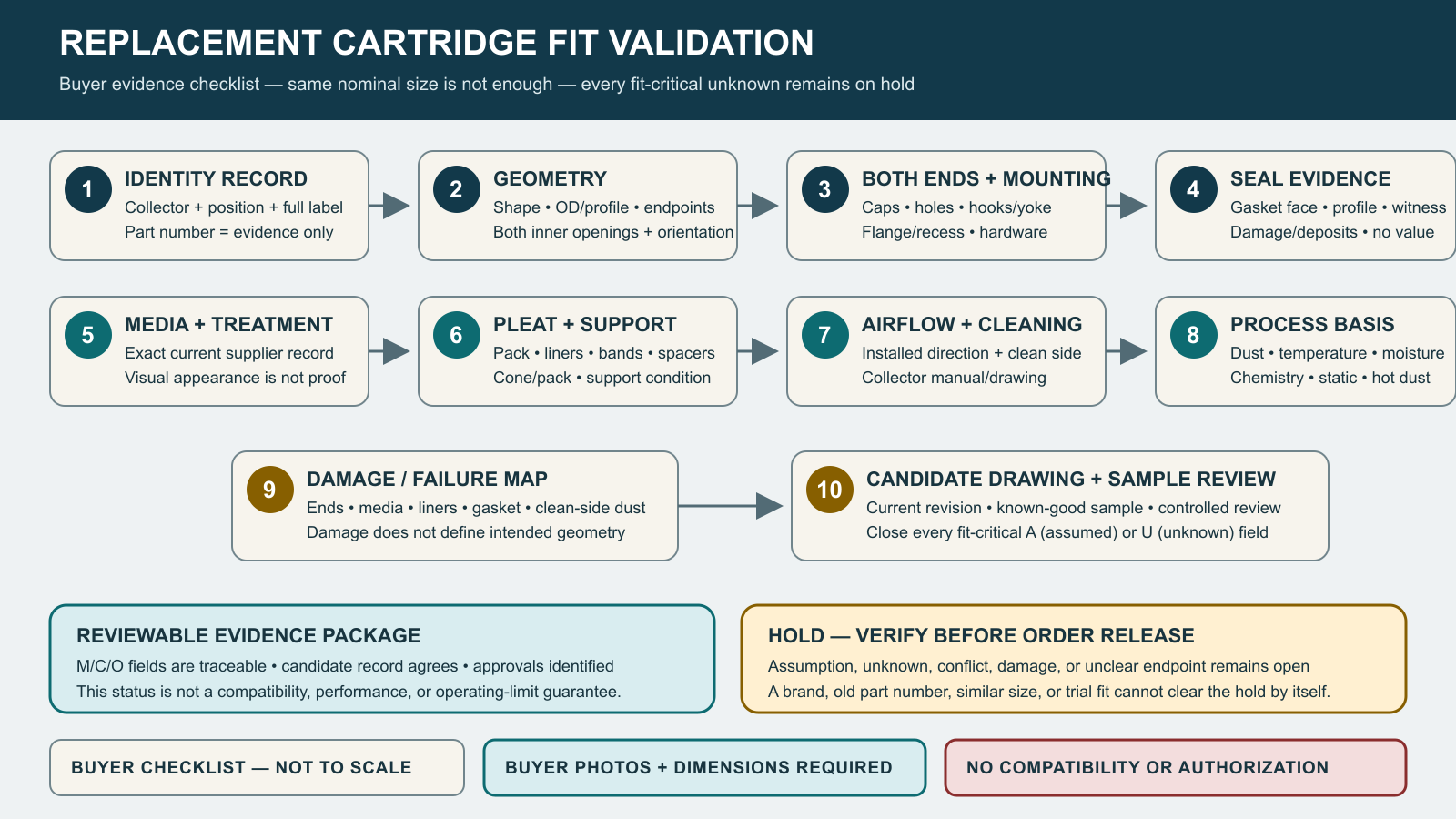
Common replacement-cartridge mistakes and red flags
Stop a size-only comparison at any of these conditions. Close the field through a controlling record, sample, collector manual, supplier drawing, or competent review.
- Calling two cartridges interchangeable because OD and length look close. [2][3][4] Limit: named manufacturer examples, not a fit standard.
- Using a brand or part number as authorization, affiliation, or a guaranteed cross-reference. [6] Limit: manufacturer index fields identify candidates only.
- Comparing overall lengths that use different endpoints or gasket conditions. [3][4] Limit: product-specific drawing fields.
- Ignoring the second end cap, center hole, stud, bolt pattern, hook, yoke profile, or indexing feature. [2][4][11] Limit: named-equipment examples.
- Prescribing a gasket compression percentage, torque, or latch setting from appearance. [5][10] Limit: no universal value in the cited sources.
- Identifying media or a surface treatment from color, texture, or an old marketing name. [6][8] Limit: current supplier evidence is still required.
- Copying pleat count, spacers, inner cone, liner, or support from another cartridge family. [3][7] Limit: product-specific constructions.
- Assuming normal airflow or pulse direction from cartridge shape. [9] Limit: direction applies to the named collector manual.
- Copying a temperature, moisture, chemistry, static, or dust limit from a selector without application review. [8][12] Limit: no site approval.
- Using a damaged old cartridge or uncontrolled trial fit as the intended drawing. [10][11] Limit: observed condition is not design geometry.
Quote-ready replacement-cartridge checklist
Use the active dust collector filter RFQ checklist as the cover sheet, then add this cartridge-specific evidence. Mark each field M, C, O, A, or U and keep the photo filenames beside the values. Any fit-critical A or U item remains a pre-order hold.
- Collector maker, model, serial, drawing/manual revision, position, cartridge count, installed orientation, and access direction.
- Complete brand and part-number strings, suffixes, label photos, prior purchase record, and record dates—identification evidence only.
- Round OD or full outside profile at named undamaged locations; both axes/orientation for a non-round element.
- Overall length with written endpoints and explicit inclusion/exclusion of gasket, flange, pan, stud, handle, or projection.
- Top and bottom inner openings with shape, reference edges, and liner/cone/yoke/rod obstructions.
- Straight-on and profile photos of both end caps plus observed material and condition.
- Bolt holes, center holes, studs, hooks, yoke engagement, indexing, flange/recess, thread record, and retained hardware.
- Gasket end, face, profile, free-state dimensions as found, splice, sealing surface, witness/contact evidence, damage, and deposits.
- Exact media, substrate, treatment, efficiency/test record, conductivity/grounding record, flame behavior, temperature and chemistry data—or unknown.
- Pleat depth/spacing method, inner and outer liners, support bands, straps, spacers or glue beads, cone/secondary pack, and condition.
- Normal dirty-air path, clean-side opening, cleaning direction and method, and manual/drawing source; no copied settings.
- Dust/process, loading, abrasiveness, sticky/fibrous behavior, oil/mist, sparks/hot particles, hazard-review status, and reason for replacement.
- Normal/upset temperature location, moisture/condensation, water ingress, humidity, and chemical constituents or process changes.
- Damage map, clean-side dust, previous life, pressure/cleaning history, old sample condition, known-good sample availability, and candidate drawing revision.
- Requested and installed quantity, full or partial changeout, packaging/labeling needs, required-by target, open questions, and release approver.
Product path
- Dust collector cartridge filtersUse the cartridge product path after shape, buyer-entered dimensions, both ends, mounting, gasket, media record, pleat/support, cleaning, and operating evidence are ready for review.
- Replacement filter programUse the replacement path to reconcile part-number, photo, dimension, drawing, and old-sample evidence without treating a candidate record as guaranteed compatibility.
- Request a cartridge quoteSubmit the indexed evidence package and keep every assumed or unknown fit-critical field visible for pre-order review.
Frequently asked questions
Are the same cartridge OD and length enough to confirm a replacement?
No. The same nominal size is not enough. Two cartridges can differ in shape, length endpoints, inner openings, both end caps, mounting profile, hole or stud, gasket location, seal face, media, pleat/support construction, installed orientation, and cleaning direction. Manufacturer examples document several of these differences, but they do not create a universal fit rule. [2][3][4][11]
Does an OEM or supplier part number guarantee a cross-reference?
No. Record the complete number, suffix, label photo, collector model, and dated record. Use them to locate a candidate drawing, then reconcile physical and process fields. Brand and part numbers do not authorize FilterBagWorks.com, establish affiliation, or guarantee fit, compatibility, performance, media, limits, or an as-built specification. [6]
What gasket compression should I specify?
A12 gives no universal percentage, squeeze, force, thickness, torque, or latch setting. Record gasket location/profile, free-state dimensions as found, sealing face, witness band, uneven imprint, damage, deposits, orientation, and candidate data. The named Donaldson manual requires compression but warns against overtightening; its instruction is collector-specific. [5][10]
Can cartridge media be identified by color or surface appearance?
No. Color and texture can be photographed as observations, but they do not prove substrate, nanofiber/fine-fiber layer, membrane, treatment, conductivity, flame behavior, washability, efficiency, or operating limits. Copy the exact current media and treatment record tied to the part, or mark it unknown and provide dust, temperature, moisture, chemistry, static, and cleaning context for review. [6][8]
Is pulse-cleaning direction always inside to outside?
Do not assume it. One cited Donaldson manual describes an inside-outward pulse for its named DFPRE collector, with dust collected on the outside of the element. That is an equipment-specific example, not a universal direction or setting. Confirm normal airflow, clean side, installed orientation, nozzle or pulse entry, and cleaning direction from the actual collector manual or approved drawing. [9]
When should a physical sample be used?
Use a retained known-good sample when labels are missing, geometry is unusual, end-cap or mounting details are hard to document, records conflict, the installed element appears modified, or the removed cartridge is damaged. Index the sample, photos, collector position, measurements, and drawing revision. A used sample is still evidence, not automatic permission to copy unknown or unsuitable construction.
Does a successful trial fit approve the replacement cartridge?
No. An authorized fit check addresses only evaluated features. It cannot approve media, treatment, cleaning, efficiency, pressure drop, dust release, process limits, combustible-dust controls, emissions, exposure control, life, or quantity. Close those fields through current supplier data, collector requirements, process evidence, and the buyer's review path.
Sources
- OSHA 29 CFR 1910.147: The Control of Hazardous Energy
- Donaldson: Downflo Evolution DFE Cartridge Dust Collector
- Donaldson Replacement Elements: Series 200, Two Open End Caps
- Donaldson Replacement Elements: Series 324, Open/Closed with Hole
- Donaldson DFPRE 4 Dust Collectors Installation, Operation and Maintenance Manual
- Camfil APC Dust Collector Filters Search
- Camfil APC: OptiCone Filter Cartridges
- Donaldson Cartridge Filter Media Selector
- Donaldson DFPRE Large Installation and Operation Manual
- Donaldson: Troubleshooting for Leaking Dust Collectors
- Parker: BHA Replacement Dust Cartridges for DFE Collectors — Installation Instructions
- U.S. EPA: Fabric Filter — Pulse-Jet Cleaned Type Fact Sheet
Request a filter review
Send collector and position records, label photos, dimensions with endpoints, both end caps, mounting and gasket evidence, media and support records, airflow and cleaning direction, process conditions, damage history, candidate drawing, sample status, quantity, and unresolved fields. FilterBagWorks.com can review that replacement package; the buyer's technical and purchasing controls must approve release.
Request a quoteCatalogue-to-selection bridge
Use catalogue families to route the cartridge review, not to assume fit.
Visible construction and family labels can narrow the review path. Final replacement selection still requires exact dimensions, end-cap and seal details, mounting, current label or part number, dust, operating conditions and cleaning method.
Pleated and easy-clean constructions are shown with visible end-cap, support and sealing components.
High-temperature, oil-mist, antistatic, oil/water-resistant, flame-retardant, wood-pulp and polyurethane families are presented separately.
First-party source: Guanlin product catalogue, pp. 15-19. No exact value or performance result is transferred.