Condition-first media review
Dust Collector Filter Media & Application Selection Guides
Organize dust and process evidence before comparing material names, surface treatments, membrane options, high-temperature media, or welding-fume replacement cartridges.
Direct answer
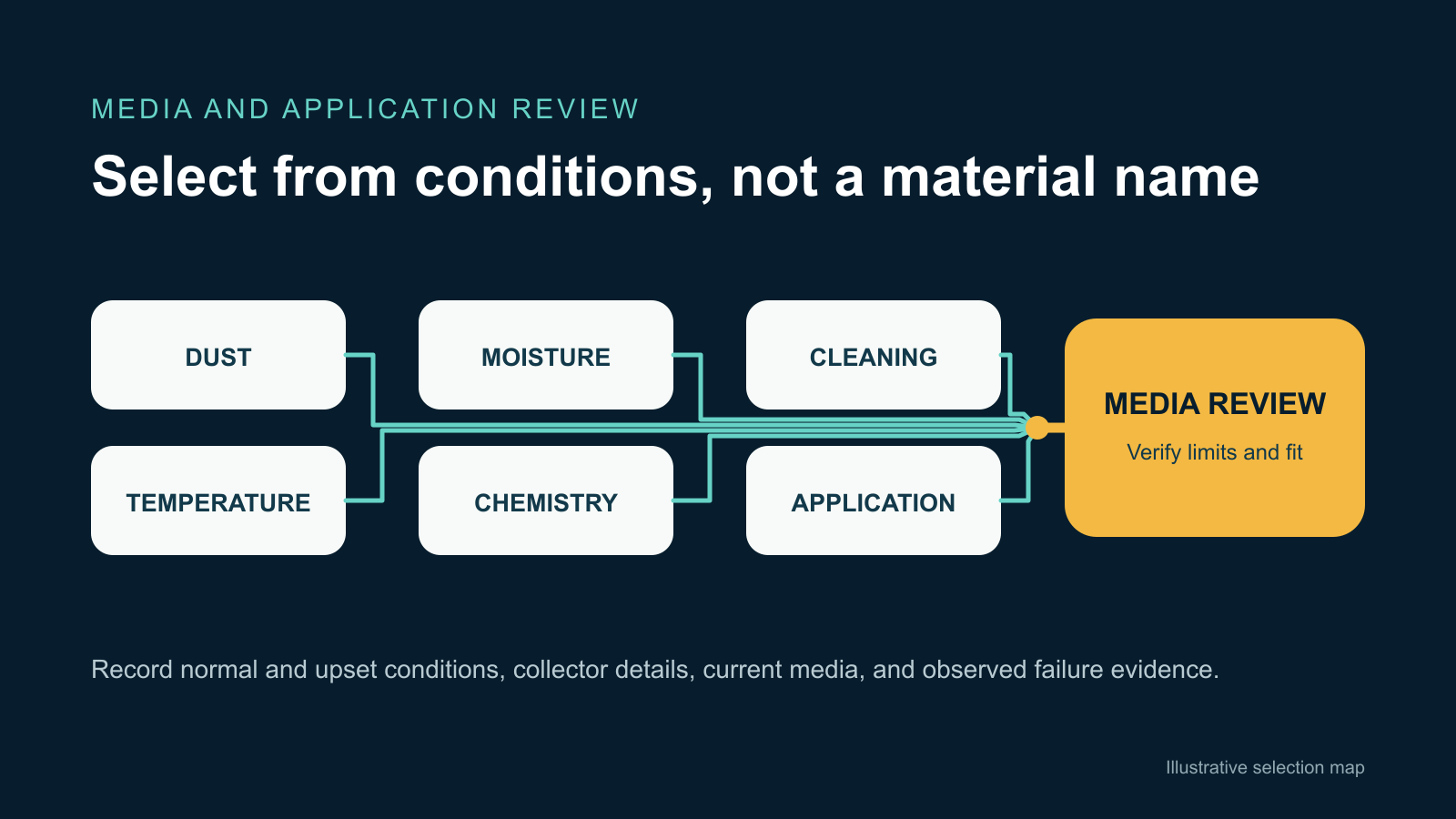
Select dust collector filter media from the actual dust, gas, temperature, moisture, chemistry, cleaning method, collector geometry, operating history, and application requirements—not from one material name or industry label. Record normal, peak, startup, shutdown, and upset conditions where relevant, plus current media and failure evidence. Verify candidate limits against authoritative technical data and the collector design. For welding fume, begin with exposure control and source capture; a filter alone is not a complete control solution. See HSE guidance on controlling welding-fume risk and capture at source.
Define the selection variables
- Dust: particle behavior, loading, abrasion, stickiness, oil, fines, and any known hazard information.
- Temperature: normal, peak, transient, startup, shutdown, and upset evidence at the relevant location.
- Moisture: humidity, condensation, dew-point concerns, washing, steam, and liquid carryover.
- Chemistry: gas composition and process constituents that may affect media, finish, seams, seals, or hardware.
- Cleaning and collector: pulse, shaker, reverse-air, or other arrangement; geometry, supports, airflow, and operating history.
- Application and decision: current problem, required review, exposure-control context, maintenance goal, and available evidence.
Guides in this collection
- What Filter Should You Use for Welding Fume Extraction?Connect source capture and the complete control system with process, hot-particle, collector, cartridge, cleaning, and maintenance evidence.
Comparison snapshot and application paths
Use the matrix to decide what must be verified, not to approve a material. Exact limits and compatibility depend on the specific construction, supplier data, collector, process, and operating envelope. The welding-fume path must be reviewed as part of the complete control system; see the official HSE WL3 Welding Fume Control guidance.
- General media path: define all selection variables, confirm the current construction and observed failure, then compare candidate data for the actual operating envelope.
- High-temperature path: do not select by temperature alone; include oxygen or oxidation exposure, moisture, acids or alkalis, abrasion, flexing, startup, shutdown, and upset conditions.
- PTFE membrane or fine-dust path: document particle behavior, emissions concern, cake release, cleaning behavior, moisture and chemistry, pressure history, and the risk of membrane damage.
- Welding-fume path: begin with source capture and the complete exposure-control system; document welding or thermal process, collector, spark or hot-particle controls, cartridge fit, cleaning, and changeout evidence.
- Engineering-review path: send the operating envelope, dust or process information, collector and filter details, current media, failure evidence, and the specific decision that needs confirmation.
Scroll table horizontally
| Review path | Evidence required | Do not conclude from |
|---|---|---|
| Base media | Dust, temperature, moisture, chemistry, cleaning, collector, current media | Fiber name or industry alone |
| High temperature | Normal and upset temperatures plus gas, moisture, chemistry, abrasion, and mechanical context | Temperature rating alone |
| PTFE membrane / fine dust | Dust behavior, cleaning, pressure history, moisture, chemistry, current emissions concern | Membrane label alone |
| Welding fume | Process and capture method, collector, hot-particle controls, cartridge geometry, media, cleaning, safety review | A replacement cartridge as a complete exposure control |
Request a filter review
Request an engineering review with the collector and filter identification, photos and dimensions, current media or construction, dust and process description, normal and upset temperatures, moisture and chemistry evidence, cleaning method, operating history, failure photos, quantity, and the application decision you need to make. For safety-sensitive applications, include the responsible site's control requirements and competent-party review.
Request a quoteFrequently asked questions
Can filter media be selected from temperature alone?
No. Temperature is one input. Review moisture, condensation, gas chemistry, oxidation exposure, dust and abrasion, cleaning method, mechanical construction, startup and shutdown, upset conditions, and the collector-specific operating envelope.
When should PTFE membrane be reviewed?
Review it in the context of dust behavior, fine-particle or emissions concerns, cake release, cleaning response, pressure history, moisture and chemistry, existing performance, construction, and the risk of membrane damage. A membrane label alone does not establish suitability or value.
Which information is needed for a high-temperature media review?
Send normal, peak, transient, startup, shutdown, and upset temperature evidence at the relevant location; gas composition, oxygen or oxidation context, moisture and condensation, acids or alkalis, abrasion, cleaning, collector details, current media, and failure observations.
Is a welding-fume filter cartridge a complete exposure-control solution?
No. Welding-fume decisions begin with the process, source capture, ventilation and the complete exposure-control system. Cartridge selection also requires collector geometry, media, cleaning, spark or hot-particle controls, maintenance evidence, and competent safety review.
How should an unknown current media be handled?
Do not infer it from color or appearance alone. Send labels, purchase records, sample information, construction photos, operating history, dust and process details, and failure evidence; mark the media as unknown until supported.
Related collections
Return to the main filter guide hub, scope the purchase in replacement buying guides, investigate failure evidence in maintenance and troubleshooting, or verify mating geometry in fit and component guides.