Technical procurement checklist
For strategic sourcing teams, plant buyers, and industrial distributors
Reviewed by FilterBagWorks Technical Team
How to Choose a Dust Collector Filter Supplier: A Technical Procurement Checklist
Compare supplier types, specification control, repeatability evidence, technical response, commercial exceptions, and project holds before allowing price to decide the award.

Direct answer
Choose a dust collector filter supplier by requiring evidence that each bidder can review the application, control the approved specification, reproduce fit-critical construction, identify material and batch records requested for the project, inspect defined characteristics, disclose deviations, protect and label the shipment, and support investigation of nonconformance. Compare buyer-entered evidence and commercial exceptions in one scorecard. Do not let price, a certificate, a sample, a cross-reference, or an estimated lead time stand alone as proof of fit, consistency, or suitability.
Scope
Use this guide to screen and compare manufacturers, converters or fabricators, distributors, and sourcing partners for replacement dust collector filter bags, cartridges, cages, and related components. It is a buyer-owned procurement workflow, not an audit standard, certification decision, legal opinion, factory inspection, product approval, or supplier endorsement. Requirements should reflect the actual collector, process, risk, quantity, receiving plan, and purchase terms. A certificate or quality-system claim may be one evidence item, but it does not replace configuration-specific review, drawing or sample reconciliation, inspection evidence, or written exceptions.
Supplier qualification workflow for dust collector filters
Build the evaluation from the project requirement outward. Separate what the supplier says it can do from what it has documented for this quotation, and separate a representative sample from the controls intended for the production order. Give every required item an owner, evidence reference, and state: accepted for this project, partial, unknown, or exception.
1. Match the supplier type to the work you need
A manufacturer may make a complete element or certain components. A converter or fabricator may cut, pleat, sew, assemble, or finish purchased materials. A distributor may stock items or carry the commercial relationship while another organization manufactures. These labels do not establish quality. Ask who owns application review, drawing release, raw-material purchase, production, inspection, packing, change notification, and nonconformance response. Record the legal seller and actual manufacturing source when required. If responsibilities cross organizations, define how revisions and exceptions reach each responsible party.
2. Require an application review before comparing price
Give each candidate the same controlled package: collector and component family, dimensions and measurement points, ends, gasket and support, current media evidence, dust/process, cleaning, operating records, quantity, destination, and open questions. The NIST MEP Supplier Scouting form separates manufacturing process, dimensions, tolerances, performance specifications, materials, certifications and regulations from volume, delivery, packaging, drawings, photos, and specifications. [3] It is not a filter specification; it supports making technical and business inputs explicit before capabilities are matched. Ask the supplier to return its interpreted configuration and questions, not only a part number and price.
3. Define how samples, drawings, and revisions become the approval basis
A retained sample can expose seams, cuffs, bands, end caps, gasket footprints, and layers that photos miss, but it may be worn, contaminated, deformed, modified, or incorrect. A drawing is useful only when revision, units, tolerances, notes, and approval status are controlled. ASQ lists quotations with specifications and testing requirements, supplier assessment, quality-system confirmation, and sample or validation evaluation among selection methods. [4] Ask which record controls when sample, buyer drawing, supplier drawing, prior number, and field measurement conflict. Require written buyer disposition; do not let production silently choose a reference.
4. Ask for project-specific material identity and traceability evidence
Define what must be identified: media designation, finish or treatment, membrane when specified, thread, band or end-cap material, gasket, cage material or finish, adhesive where applicable, and approved alternatives. Ask what links the received item to those inputs: supplier code, purchase record, lot reference, required certificate, traveler, label, or inspection report. ISO describes ISO 9001:2015 as a quality-management-system standard for meeting customer requirements and notes documented information, variation control, performance data, and evidence-based improvement. [1] Certification alone does not reveal traceability depth for this filter. Specify the required record chain, retention, access, substitution approval, and change notice.
5. Convert fit and construction into inspectable characteristics
List the characteristics that must be controlled and how the buyer will recognize them. For bags, this may include body diameter or flat width, overall length, top attachment, bottom construction, seam, reinforcement, rings, loops, and cage relationship. For cartridges, include outer and inner dimensions, length, open/closed ends, end-cap geometry, gasket location/profile, flange or hook pattern, liner, and support. A Donaldson cartridge data sheet, for one specific series, identifies outer and inner diameter, length, pitch diameter, gasket, top quick-fix end cap, media pack, straps, liner, and closed bottom end cap. [7] It demonstrates why construction fields belong on a controlled drawing; its values are not universal. Agree measurement endpoints, units, limits, method, equipment, sampling, and record format before production.
6. Evaluate batch consistency from records, not a golden sample
A first article shows one submitted unit; it does not prove how later lots will be controlled. Ask the supplier to define a batch, inspection stages, characteristics and sample plan, result-to-shipment linkage, and release authority for an out-of-requirement result. As a federal-procurement example—not a rule for private filter purchases—the FAR fixed-price inspection clause covers raw materials through end products and requires inspection records and outcomes under the specified contract system. [6] Use it only to understand evidence categories. Your contract must define its own records, acceptance rights, retention, deviations, and receiving checks.
7. Test lead-time and capacity statements against a defined order
Do not score “fast lead time” or “large capacity” without a basis. Give the exact configuration, quantity, approval status, packaging, destination, documents, and requested window. Ask whether the estimate includes drawing review, material availability, sample approval, production, inspection, packing, or transit. Record dependencies, validity date, recovery path, and change-notification trigger. NIST MEP describes supplier scouting as matching production and technical capabilities, capacities, and business interest to a stated need; its guidance also treats forecasting, operations planning, inventory visibility, metrics, and critical-path lead time as related work. [2] [5] Those sources supply no lead time or capacity for any filter supplier.
8. Examine the nonconformance and failure-analysis response path
Ask what happens when receiving finds a wrong label, damaged carton, dimensional conflict, construction difference, or repeated field symptom. Separate containment from investigation: identify quantities, preserve samples and records, document observations, compare approved requirements with production evidence, test competing causes, communicate status, and obtain buyer disposition. ASQ defines root-cause analysis as approaches, tools, and techniques used to uncover causes of problems. [8] An RCA template does not prove that a filter caused an event or that a supplier can analyze every failure. Score intake, evidence needs, ownership, escalation, corrective-action records, and boundaries; keep cause unknown until supported.
9. Specify packaging, labels, and receiving evidence
Translate “standard packing” into required protection and identification. State any sleeves, separators, sealing-face protection, orientation, moisture protection, carton limits, pallet constraints, or segregation by line, collector, material, revision, or lot. Define label fields: buyer project, purchase order/line, supplier item, description, quantity, units, revision, required lot reference, carton count, and destination. The NIST MEP scouting form treats delivery and packaging requirements as explicit business inputs. [3] Request a sample label or pack plan when receiving accuracy is material. Packaging evidence does not prove filter performance.
10. Put commercial exceptions beside the technical offer
Normalize currency, unit, quantity breaks, tooling or sample charges, freight boundary, taxes or duties where applicable, payment terms, quote validity, cancellation terms, requested delivery window, and warranty language only as written. Then list every technical deviation, exclusion, alternative, buyer dependency, minimum order, split-shipment assumption, document charge, and change-notice term. Do not bury “equivalent,” “or similar,” or supplier-standard construction in a footer. The FAR quality-assurance rules are specific to federal procurement, but they illustrate why nonconformance, correction, acceptance, and written rationale are separate decisions rather than a silent price adjustment. [9] Private buyers should use their own approved terms and legal review. A cheaper offer with an open fit or material exception is not yet a comparable offer.
11. Use a pilot or first-order gate only when it answers defined questions
If the buyer uses a sample, first article, pilot quantity, or staged release, state the questions it must answer. Identify configuration, sample count/source, checks, documents, fit review, installation authority, observation period, acceptance criteria, failed-evidence disposition, and whether production may begin before approval. Do not use a pilot to bypass site safety, collector guidance, process-hazard review, emissions obligations, or purchasing authority. A visually acceptable sample does not prove batch controls, and a short observation does not prove service life. Release only the accepted scope.
12. Score evidence, preserve holds, and record the decision
Set weights before opening commercial offers when practical, with purchasing, maintenance, engineering, quality, operations, and safety or compliance roles appropriate to the project. ASQ recommends cross-functional supplier-selection criteria and includes past performance, quality-system sophistication, capacity, delivery, financial stability, technical support, and total cost among common considerations. [4] NIST MEP likewise identifies supplier metrics or scorecards as tools for measuring performance and supporting supplier decisions. [5] The worksheet below intentionally supplies no weights or passing score. Define mandatory gates separately; a high subtotal must not cancel a missing required fit, material, safety, legal, or acceptance item. Record evidence references, exceptions, closeout owners, approvers, and the reason for the final selection.
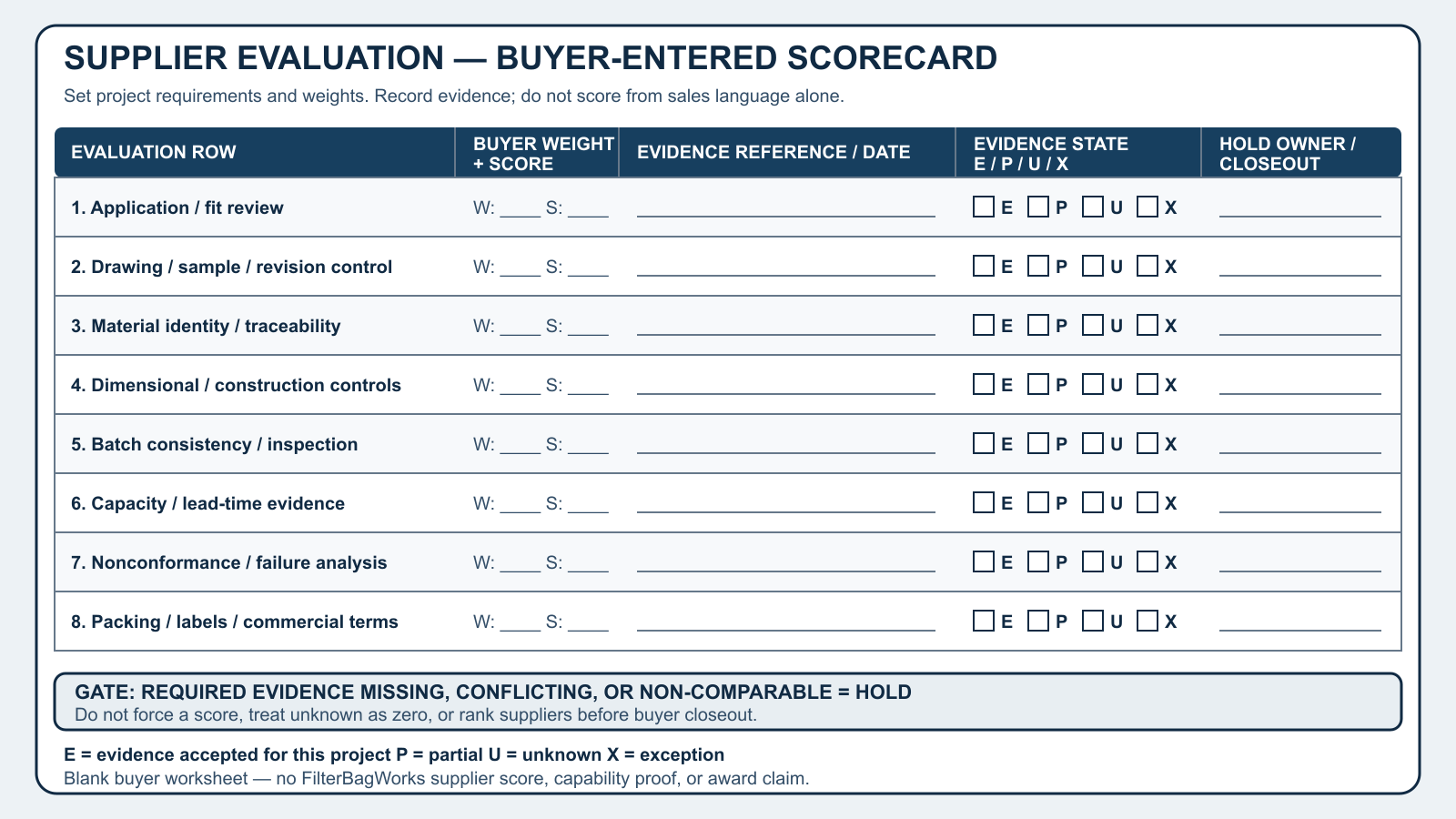
Blank buyer-entered supplier evaluation scorecard
Use one copy for each candidate against the same project package. Enter buyer-approved weights and scores, cite the evidence reviewed, mark E for evidence accepted for this project, P for partial, U for unknown, or X for exception, and assign every hold. Do not average away a mandatory gate or treat an unknown as zero. The worksheet neither evaluates FilterBagWorks nor defines a universal passing score.
Scroll table horizontally
| Evaluation row | Buyer weight / score | Evidence reference | State | Hold / closeout |
|---|---|---|---|---|
| Application and fit review | Buyer enters | Quote, review note, drawing, sample | E / P / U / X | Owner and action |
| Drawing, sample, and revision control | Buyer enters | Approval basis and conflict log | E / P / U / X | Owner and action |
| Material identity and traceability evidence | Buyer enters | Required record chain | E / P / U / X | Owner and action |
| Dimensional and construction controls | Buyer enters | Characteristics and inspection plan | E / P / U / X | Owner and action |
| Batch consistency and inspection evidence | Buyer enters | Lot, results, release and deviations | E / P / U / X | Owner and action |
| Capacity and lead-time evidence | Buyer enters | Basis, constraints, milestones | E / P / U / X | Owner and action |
| Nonconformance and failure-analysis support | Buyer enters | Intake, containment, cause and action | E / P / U / X | Owner and action |
| Packaging, labeling, and commercial exceptions | Buyer enters | Pack plan, label, quote exceptions | E / P / U / X | Owner and action |
On narrow screens, scroll horizontally to inspect the full-size diagram.
Supplier-evaluation red flags that require a hold or follow-up
A red flag is not automatically a rejection; it is a reason to stop scoring, request evidence, narrow the scope, or obtain the buyer's authorized risk disposition.
- The quote uses a cross-reference, photo, or nominal size as the only fit evidence.
- No one can state which drawing, sample, revision, or specification controls production.
- The supplier describes a material as equivalent but does not identify the difference or approval path.
- A certificate is offered as proof of configuration-specific traceability, inspection, capacity, or delivery.
- A perfect sample is shown, but production-lot definition, sampling, records, and release authority are unclear.
- Fit-critical characteristics have no agreed endpoints, units, limits, or measurement method.
- A lead-time or capacity statement has no configuration, quantity, assumption, validity date, or constraint basis.
- Subcontracted manufacturing, inspection, or packing responsibility changes without disclosure when disclosure is required.
- Packaging and labeling are called standard even though receiving and storage requirements are not defined.
- Technical deviations appear only in boilerplate, footnotes, or an unlinked email thread.
- A complaint response jumps from field observation to filter cause without preserving samples, records, and competing causes.
- The scorecard produces a winner while a mandatory fit, material, safety, compliance, or acceptance item remains unknown.
Quote-ready supplier qualification package
Start with the active dust collector filter RFQ checklist, then add the evaluation and acceptance fields below so every supplier receives the same controlled request.
- Project reference, buyer contacts, collector asset/model/location when known, component family, requested quantity, destination, and required-by window.
- Current drawing, sample, photos, part-number evidence, measurement sheet, revision status, controlling-document rule, and conflict list.
- Bag, cartridge, cage, or accessory fit characteristics with endpoints, units, limits, construction, seals, supports, and orientation.
- Dust/process, cleaning method, current construction evidence, normal and upset operating records, observed issue, and project-specific safety/compliance boundaries.
- Material, finish, treatment, membrane, gasket, end-cap, thread, cage, adhesive, or other identity fields required for the line item.
- Requested traceability depth, lot/batch linkage, certificate or inspection records when contractually required, retention period, and access method.
- Characteristic inspection list, measurement method, equipment expectation, sampling, first-article or pilot gate, release authority, and receiving checks.
- Production quantity and schedule basis, approval dependencies, material status, milestones, constraint notice, split-shipment rule, and transit boundary.
- Packaging protection, sleeve/separator/cap needs, carton/pallet limits, segregation, label fields, packing-list fields, and sample label when required.
- Nonconformance intake, containment, sample and record preservation, investigation boundary, interim communication, corrective-action record, and disposition authority.
- Configured price, quantity breaks, tooling/sample/document charges, freight and tax/duty boundaries, validity, payment, cancellation, and written warranty terms if applicable.
- Every deviation, exclusion, alternative, assumption, sub-supplier disclosure requirement, substitution/change-notice term, hold owner, and approval authority.
Product path
- About FilterBagWorksUse the company context as one input, then qualify the actual project through written specifications, evidence, exceptions, and buyer approval.
- Custom dust collector filtersUse the custom path when the project needs drawing, sample, fit, construction, material, quantity, and operating evidence reviewed together.
- Replacement dust collector filtersUse the replacement path when existing part-number, dimensional, construction, collector, and operating evidence can define the inquiry.
Frequently asked questions
Should the lowest-price dust collector filter supplier win?
Not before the offers are technically and commercially comparable. Confirm the configured specification, evidence, inspection and record scope, packaging, exceptions, and acceptance plan. Then use the buyer's approved cost and risk method rather than assuming price proves fit, quality, consistency, life, or total cost.
Does ISO 9001 certification prove a supplier can make my filter?
No. Certification can be relevant quality-system evidence when the buyer requires it, but it does not by itself confirm the quoted filter's fit, material, construction, traceability depth, inspection records, capacity, lead time, or suitability. Verify the certificate as required and review configuration-specific evidence separately. [1]
Is an approved sample enough to release a production order?
Only if the buyer's plan says what the sample proves and how production will reproduce it. Link the sample to a controlled specification, critical characteristics, material records, batch definition, inspection plan, deviations, and release authority. A sample alone does not prove future consistency or service life.
What if the supplier will not disclose every sub-supplier?
Decide what disclosure is actually required by the project, contract, risk, or regulation. At minimum, establish who owns specification flowdown, material and change controls, inspection, packing, and corrective response. If a mandatory disclosure remains unavailable, record the exception and route it to the authorized buyer decision.
How should a buyer verify a supplier's lead time?
Ask for an estimate tied to the exact configuration, quantity, approval status, materials, documents, packaging, destination, and quotation date. Record included stages, dependencies, constraints, milestones, and change-notification triggers. Treat the answer as planning evidence, not a guarantee unless the contract creates one.
What should happen when supplier evidence is missing?
Mark it partial, unknown, or exception; name the closeout owner and action; and decide whether it is a mandatory gate. Do not enter zero, invent a favorable assumption, or let unrelated high scores cancel a required fit, material, safety, compliance, or acceptance item.
Can FilterBagWorks be scored from this article?
No. The scorecard is blank and buyer-entered. This article provides no FilterBagWorks audit result, certification, traceability record, inspection result, capacity, lead time, warranty, performance result, or supplier score. A buyer must define project requirements and review actual evidence and written commercial terms.
Sources
- ISO 9001:2015 — Quality management systems — Requirements
- NIST Manufacturing Extension Partnership: Supplier Scouting
- NIST MEP Supplier Scouting Opportunity Synopsis
- ASQ: What Is Supplier Quality?
- NIST Manufacturing Extension Partnership: Supply Chain Management
- Federal Acquisition Regulation 52.246-2 — Inspection of Supplies—Fixed-Price
- Donaldson Replacement Elements — Cartridges Series 325 Quick Fix 3 Hook
- ASQ: What Is Root Cause Analysis?
- Federal Acquisition Regulation Part 46 — Quality Assurance
Request a filter review
Send the controlled RFQ package, drawings or sample evidence, fit and material requirements, operating context, quantity, packaging and labels, required records, acceptance plan, requested schedule, and open exceptions. FilterBagWorks.com can review the filter inquiry; the buyer retains supplier qualification, site safety, compliance, evidence acceptance, scoring, risk disposition, and award authority.
Request a quote