Industrial filter resource center
Dust Collector Filter Guides for Industrial Buyers
Start with the decision in front of you: identify an unknown replacement, investigate a maintenance symptom, measure a baghouse component, or review media for an application. These guides organize the evidence an industrial buyer or maintenance team should collect before comparing products or requesting a quote. They do not replace the collector manual, an application review, or site safety procedures. If drawings or part numbers are unavailable, use photos, dimensions, labels, operating conditions, and an old sample to create a reviewable starting point.
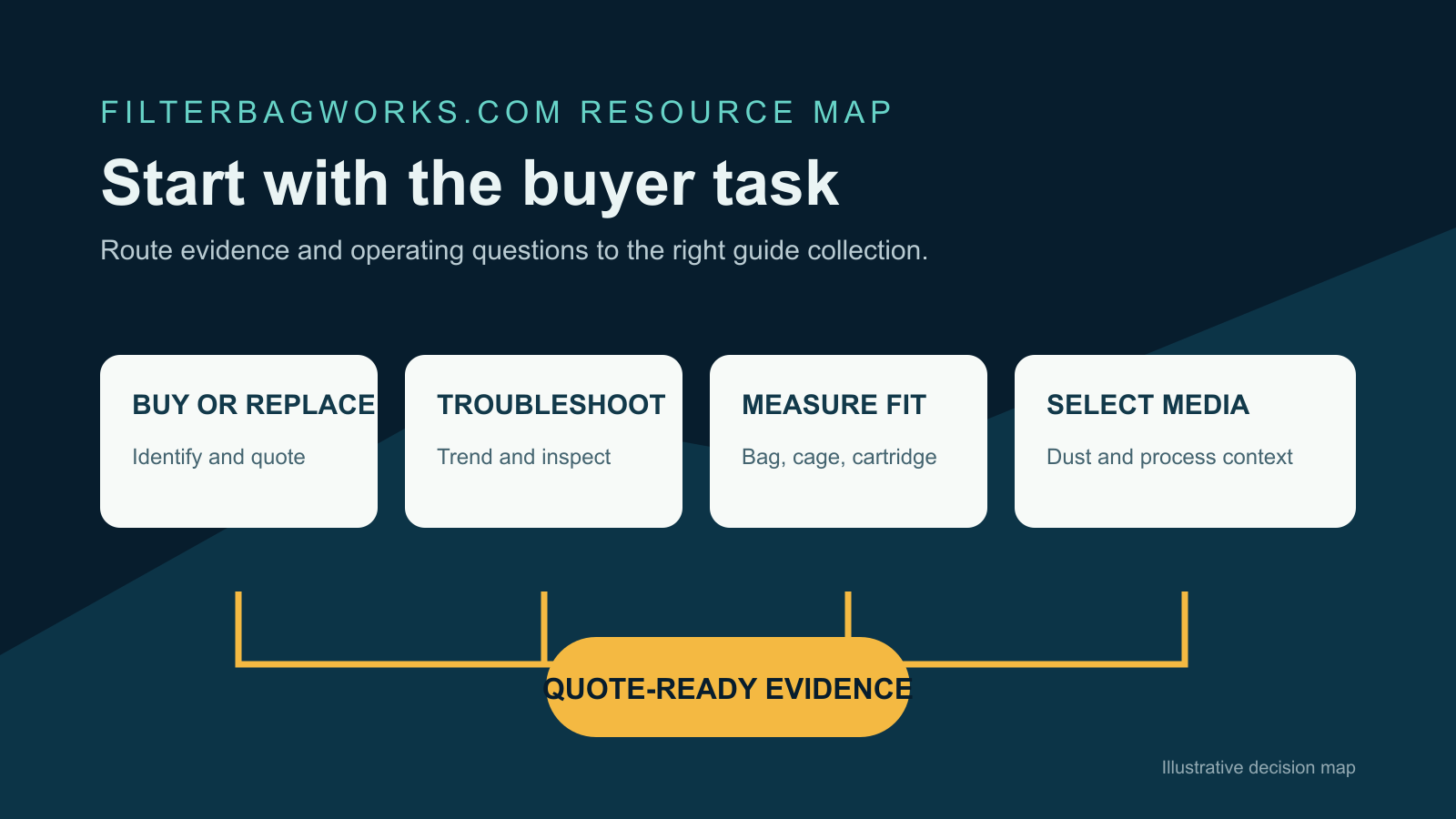
Choose by task
Select the route that matches the evidence you have and the decision you need to make.Buy or replaceIdentify the filter family, document the existing part, and prepare a comparable inquiry.TroubleshootReview trends, installation evidence, cleaning behavior, leakage, and process changes before blaming the filter.Measure or retrofitRecord fit-critical dimensions and component relationships before selecting a replacement form.Select media or applicationBegin with dust, temperature, moisture, chemistry, cleaning method, and collector details.
Four buyer decision collections
Replacement filter buying guidesIdentify unknown parts, prepare RFQs, and compare replacement decisions.Maintenance and troubleshootingOrganize condition evidence for pressure, leakage, cleaning, failure, and replacement timing.Fit, cages, venturis, and retrofitsDocument cartridges, bags, cages, venturis, and pleated-element fit.Media and application selectionReview operating variables before discussing media or application suitability.
Featured guides
- How to Identify a Replacement Dust Collector Filter Without an OEM Part Number
- Dust Collector Filter RFQ Checklist: What Specifications Should Buyers Send?
- How to Measure a Baghouse Filter Cage and Match It to the Filter Bag
- What Filter Should You Use for Welding Fume Extraction?
- How Often Should Dust Collector Filters Be Replaced?
- How to Select a Replacement Dust Collector Filter Cartridge
- Can Pleated Filter Bags Replace Standard Filter Bags and Cages?
- Cheap vs Premium Dust Collector Filters: Which Has the Lower Total Cost?
Choose by problem
Use the symptom or uncertainty as a starting point, then verify it against collector and process evidence.
- Unknown part number: classify the component, photograph labels and construction, then measure fit-critical features.
- High differential pressure: compare with the established baseline and inspect airflow, cleaning, dust loading, moisture, and sensing.
- Dust leakage: check installation, seals, damaged media, hardware, and system bypass paths.
- Short filter life: retain failed evidence and review abrasion, heat, chemistry, moisture, cleaning, and fit.
- High temperature: document normal, peak, upset, gas, moisture, and chemistry conditions before reviewing media.
- Welding fume: treat the filter as one part of a source-capture and exposure-control system.
Request a filter review
Send the collector model if known, filter photos, dimensions, part numbers or labels, quantity, current media, dust and process details, normal and upset conditions, and the problem you are trying to solve. If the specification is incomplete, identify what is measured, what is assumed, and what still needs verification.
Request a quoteFrequently asked questions
Where should I start if I do not know the filter part number?
Start with the replacement buying collection. Identify whether the part is a bag, cartridge, pleated element, cage, venturi, or accessory; then gather overall and detail photos, dimensions, labels, collector information, and operating context.
Can I request a quote without a drawing?
Yes. Send the evidence available, such as photos, dimensions, a label or part number, collector model, quantity, current media, and dust or process details. Clearly mark uncertain dimensions and ask what must be verified before ordering.
Do these guides confirm that a replacement will fit?
No. The guides explain what evidence supports review. Final fit depends on the actual collector, component geometry, sealing arrangement, construction, media, cleaning method, and operating conditions.
Should maintenance teams replace filters on a fixed calendar?
Use the maintenance collection to build a condition record from the site baseline, trend, capture or airflow observations, cleaning behavior, leakage, inspection findings, and process changes. The collector manual and site procedures still govern the decision.
What should be included in an RFQ package?
Include identification evidence, dimensions and construction details, quantity, collector information, current media, dust and operating conditions, photos or drawings, observed problems, and any required packaging or labeling information.
Technical review and source policy
FilterBagWorks.com resource drafts separate general decision guidance from project-specific verification. Numerical, safety-critical, compliance-related, and application-bound claims in individual guides must be supported by visible primary or authoritative sources. When a specification cannot be supported, the guide should request the missing evidence or direct the buyer to the collector manual, OEM, or another competent party rather than guess.
- Use government and safety authorities, standards summaries, equipment manuals, and recognized technical publications where applicable.
- State the limits of illustrative diagrams and examples.
- Do not treat a guide, image, or material name as confirmation of compatibility.