Sequential diagnostic evidence guide
For maintenance, reliability, engineering, EHS, distribution, and procurement teams
Buyer-appointed technical review required
Why Does Differential Pressure Rise Quickly After Installing New Filters?
Validate the measurement and operating comparison first, then review installation, airflow, cleaning, process, moisture, discharge, and filter evidence without treating differential pressure as a root-cause diagnosis.
Direct answer
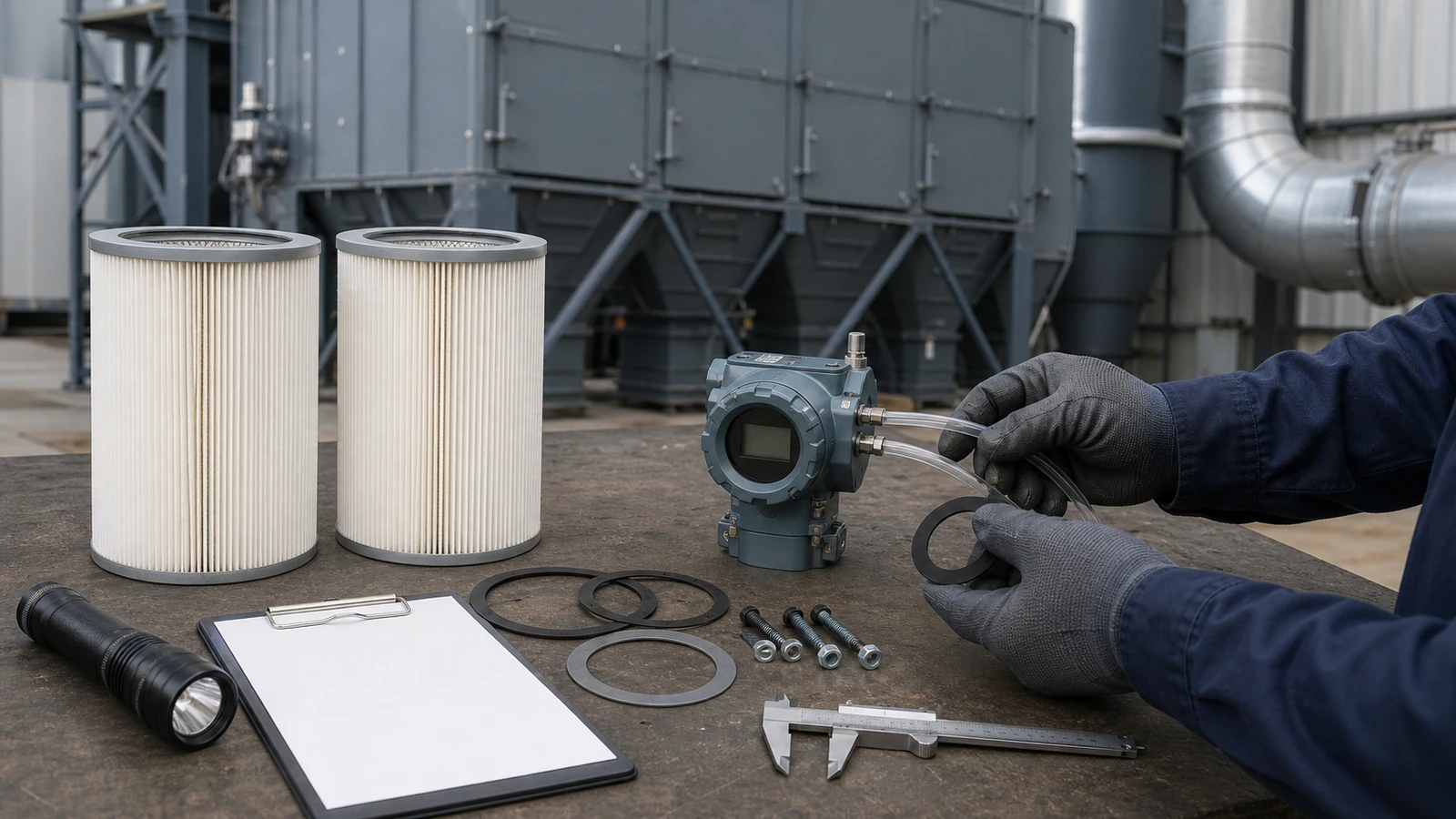
A quick rise after changeout is a signal to validate, not a diagnosis of the new filters. First confirm a safe, comparable measurement and synchronized operating state. Then review installation, airflow, cleaning, process loading, moisture, hopper discharge, and the exact filter configuration in sequence. High differential pressure alone does not prove blinded, wrong, or failed filters. Missing, conflicting, unsafe, or non-comparable evidence stays on HOLD.
Scope
This guide organizes evidence for dry industrial dust collectors after a filter change. Differential pressure is a pressure-difference observation across the selected sensing points; it is not a confirmed filter condition or root cause. Donaldson describes collector differential pressure as the combined resistance between dirty- and clean-side locations, including collector and filter-related resistance. [4] This guide sets no universal pressure threshold, no universal airflow or air-to-cloth value, and no universal pulse or alarm setting. It also sets no changeout value, clean-filter baseline, operating setpoint, commissioning instruction, or corrective action. Use only the exact collector, controller, instrument, filter, process, and site documents. The workflow is an illustrative diagnostic workflow; site-specific limits apply.
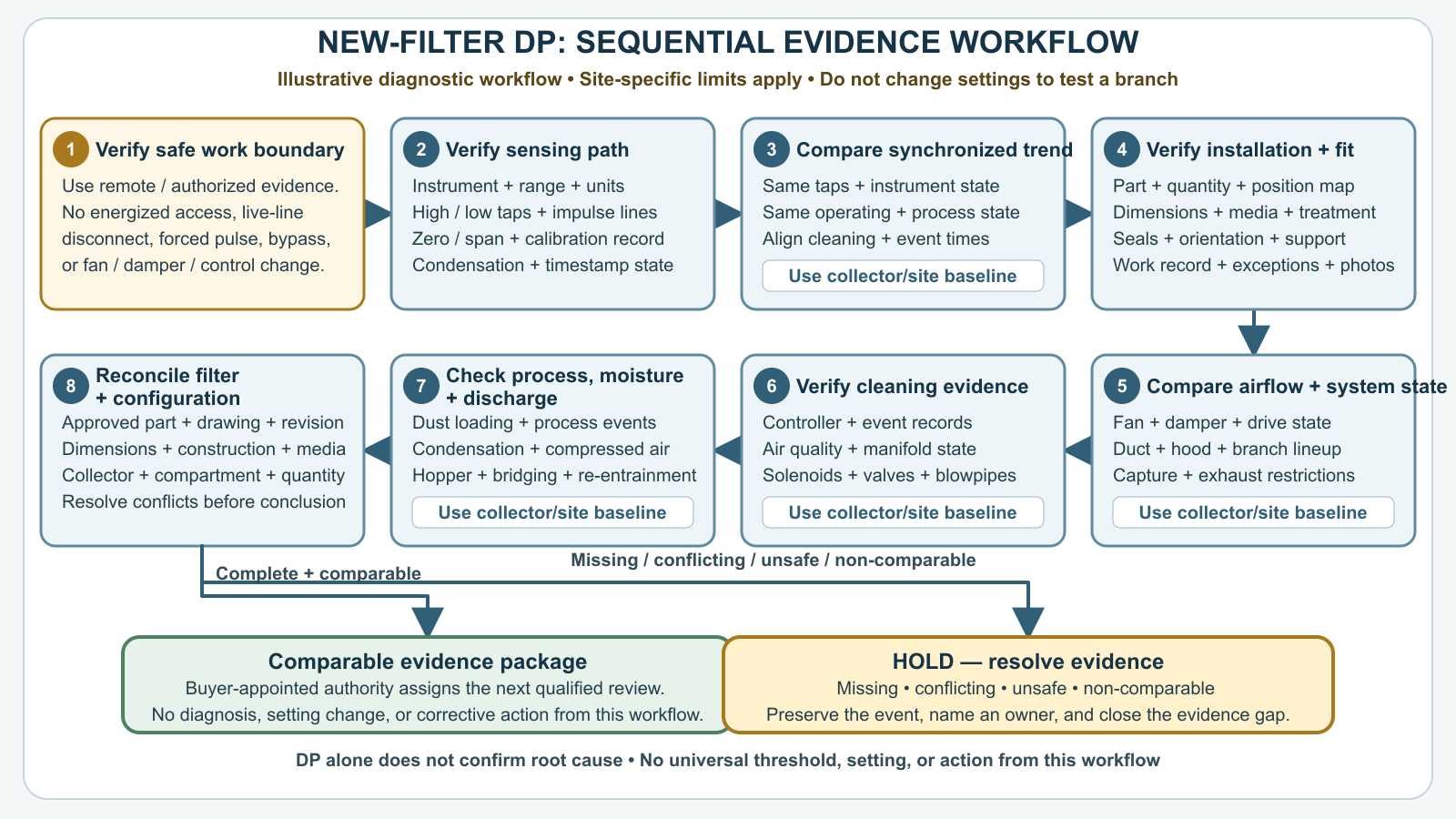
Sequential evidence workflow for high differential pressure after new filters
Preserve the original event before changing anything: who observed it, when it began, what was operating, what changed, and which records are synchronized. Complete each gate in order. A hypothesis can be logged for verification, but no branch confirms a root cause from differential pressure alone.
1. Establish the safe-work boundary before collecting evidence
Use remote displays, historian records, maintenance records, external observations, and other already-authorized sources first. Do not open or enter an energized collector, disconnect live lines, bypass interlocks, force pulses, defeat guards, or change fan, damper, controller, or cleaning settings for this workflow. OSHA’s hazardous-energy standard covers servicing and maintenance in which unexpected energization, startup, or stored-energy release could injure employees and requires an employer energy-control program within its scope. [1] The employer’s procedure, collector manual, hazard assessment, permits, and authorized personnel govern any inspection. If the needed evidence cannot be obtained safely, record the owner and route the item to HOLD — resolve evidence.
2. Verify the sensing path and impulse lines
Confirm the instrument manufacturer, model, range, configuration, high- and low-side tap locations, tubing route, connection state, displayed engineering unit, signal destination, zero and span history, and calibration status. Treat blocked, leaking, reversed, pinched, or moisture-affected impulse lines as evidence categories, not findings. The Dwyer Series 607 instructions are model-specific: they distinguish high and low pressure ports, warn that orientation can admit condensed moisture, and call for periodic calibration checks. [2] Apply those statements only to the named instrument. For any other device, use its current manual and qualified instrumentation personnel. If range, taps, line condition, time stamp, or calibration is uncertain, do not interpret the trend; HOLD.
3. Build a comparable baseline and synchronized trend
Compare like with like: the same sensing points, instrument configuration, fan and damper state, duct lineup, process rate, collector compartments, cleaning state, hopper state, temperature and moisture context, and time basis. Capture the pre-change record, post-startup record, cleaning events, process events, and any control or maintenance changes on one timeline. EPA lists pressure differential alongside inlet temperature, temperature differential, exhaust gas flow rate, cleaning mechanism operation, fan current, and outlet indicators; this supports a multi-indicator record rather than a differential-pressure-only diagnosis. [3] Use collector/site baseline. If the old and new observations were made under different operating states or unsynchronized clocks, label them non-comparable and HOLD.
4. Verify installation and fit evidence
Reconcile the work order, changeout checklist, filter count, position map, part or drawing, dimensions, media, end construction, gasket or seal orientation, seating, attachment hardware, cartridge support or bag-and-cage relationship, access-cover condition, and any installation exceptions. Review only records and safely available observations under the controlling procedure. Donaldson’s installation-oriented troubleshooting questions distinguish filter orientation, snap-band seating, cuffs, gaskets, and attachment hardware as separate evidence fields. [8] Those fields do not prove why differential pressure rose. Record filter seating, seals, orientation, support, and quantity; preserve photographs and a traceable spare or removed sample when the site permits. Unknown fit or mixed configuration routes to HOLD.
5. Compare airflow and system state
Record fan status, speed command or drive state, damper positions, duct and hood lineup, open or closed branches, process equipment online, capture observations, exhaust restrictions, recirculation configuration, and any control changes. Do not infer airflow from differential pressure alone and do not change system balance to lower a reading. Donaldson notes that collector differential pressure represents resistance to airflow and that an operating value depends on air volume and dust characteristics in its DFPRE manual context. [5] Compare fan, damper, duct, capture, and operating state against the collector/site baseline and design record. A missing airflow measurement or undocumented control change is an evidence gap, not proof of a filter problem.
6. Verify cleaning-system behavior without forcing a test
Use controller history, alarm and event records, maintenance logs, compressed-air quality records, manifold observations, and authorized functional-test results. Distinguish a controller demand from actual solenoid, diaphragm-valve, and blowpipe response. Donaldson’s on-demand cleaning article identifies the controller, timer board, solenoids, diaphragm valves, and compressed-air path as distinct components; its electrical troubleshooting steps require qualified personnel and are not reproduced here. [6] The DFPRE manual separately lists pressure connections, compressed-air supply, valves, controller, and dust-container seal in its model-specific checks. [5] Record controller, compressed-air quality, manifold, valves, and blowpipes. Use collector/site baseline; never invent pulse settings.
7. Correlate process and dust loading
Build an event log for production rate, material or formulation changes, start-stop pattern, upset events, dust concentration evidence, particle size or behavior, sticky or hygroscopic material, temperature, humidity, and any upstream equipment changes. EPA explains that dust accumulation increases pressure drop and that filter performance is affected by exposure conditions and cleaning frequency. [3] This establishes evidence categories, not a diagnosis for this collector. Compare dust rate, particle behavior, process changes, and event timing with the synchronized trend. A coincident event supports a question to verify; it does not prove causation. Preserve lot, batch, recipe, shift, maintenance, and weather records when relevant and site-approved.
8. Separate moisture and condensation evidence
Record process temperature, shutdown and startup sequence, ambient conditions, insulation or heat-trace status where applicable, compressed-air moisture records, drains or separators, visible wetness reported under authorized inspection, and whether the sensing lines share the same moisture event. EPA notes that condensation can affect fabric-filter casing and can contribute to bag blinding in relevant gas-stream conditions. [3] Dwyer’s named transmitter manual separately shows that condensation in tubing can affect the instrument installation. [2] Keep those two paths distinct: a wet sensing line is not proof of wet filters, and suspected wet media is not proof of an invalid transmitter. Obtain dew-point or condensation evidence before choosing either hypothesis.
9. Check hopper, discharge, and re-entrainment evidence
Review hopper-level history, dust-container state, rotary valve or screw-conveyor status, bridging observations, discharge interlocks, seal condition, disposal timing, and whether dust can contact the filter elements again. Donaldson states that a hopper is not intended as storage and links regular discharge to keeping accumulated dust away from filter elements. [7] Its DFPRE manual also includes dust-container level and seal checks in the named equipment’s maintenance and pressure-drop context. [5] Record hopper level, discharge equipment, bridging, and re-entrainment as separate questions. Do not clear a blockage or access a hopper under this article; unsafe or unavailable evidence remains on HOLD.
10. Reconcile filter and configuration evidence
Compare the purchase order, approved drawing, supplier part reference, collector model and compartment, installed quantity, dimensions, filter area documented by the manufacturer, media and surface treatment, pleat or bag construction, end caps or top and bottom style, gaskets, cages or supports, and any revision or substitution. Confirm whether the prior set was the same documented configuration before calling it a baseline. A different media, geometry, quantity, or support arrangement may change resistance, but the record must establish what changed and whether it is approved for the named collector. Record part, dimensions, media, treatment, and collector configuration. A photograph or nominal dimension alone does not prove identity, compatibility, performance, or root cause. Mixed or untraceable evidence routes to HOLD and a defined purchasing inquiry.
11. Verify the record or HOLD — resolve evidence
Assemble one evidence table with the observation, source, time stamp, operating state, comparison basis, document revision, evidence owner, unresolved conflict, and next authorized decision. The outcome is either a comparable evidence package for the buyer-appointed authority or HOLD — resolve evidence. Do not label a filter blinded, wrong, failed, compatible, corrected, or ready for service from differential pressure alone. Do not recommend a control change, filter change, or restart from this workflow. The buyer-appointed authority decides whether qualified instrumentation, collector OEM, system engineer, EHS, maintenance, process, or filter-supply input is needed. Preserve the unchanged trend and configuration record so later verification is possible.
New-filter differential-pressure evidence workflow
Follow the sequence rather than ranking causes. Establish the safe boundary, verify sensing, compare a synchronized collector/site baseline, reconcile installation, compare airflow, verify cleaning evidence, and then correlate process, moisture, hopper, discharge, re-entrainment, and filter configuration. Missing, conflicting, unsafe, or non-comparable evidence routes to HOLD — resolve evidence. Differential pressure alone does not confirm root cause.
Scroll table horizontally
| Gate | Evidence to attach | Route when incomplete |
|---|---|---|
| Safe boundary | Site procedure, authorized roles, remote or de-energized evidence plan | HOLD — do not create unsafe access |
| Sensing validity | Instrument model and range, taps, impulse lines, zero/span and calibration history | HOLD — reading not interpreted |
| Comparable trend | Synchronized DP, airflow, fan, damper, cleaning, process, temperature and hopper state | HOLD — label non-comparable |
| Installation and fit | Part, quantity, drawing, dimensions, seals, orientation, support and exceptions | HOLD — preserve photos and traceability |
| Airflow and system | Fan, damper, duct, hood, branch, capture and operating-state records | Use collector/site baseline |
| Cleaning behavior | Controller events, compressed-air quality, manifold, valves and blowpipes | Use collector/site baseline; do not force a pulse |
| Process and loading | Material, rate, particle behavior, process changes and event timing | Hypothesis only until verified |
| Moisture | Process and ambient temperatures, condensation, compressed-air and sensing-line evidence | Keep instrument and media hypotheses separate |
| Hopper and discharge | Level, discharge device, bridging, seals, disposal and re-entrainment evidence | HOLD if access or evidence is unsafe |
| Filter configuration | Approved part, dimensions, media, treatment, construction and collector revision | HOLD — defined filter inquiry |
| Verification | Evidence owner, revision, unresolved conflicts and buyer-appointed decision | No DP-only root-cause conclusion |
On narrow screens, scroll horizontally to inspect the full-size diagram.
Stop conditions for a new-filter differential-pressure review
Pause the interpretation or action when any required evidence is unsafe, missing, conflicting, unsynchronized, or based on a different operating state.
- Someone proposes opening or entering energized equipment, disconnecting live impulse lines, bypassing an interlock, forcing a pulse, or changing controls only to see whether the reading moves.
- The instrument model, range, engineering unit, high and low taps, tubing route, zero, span, calibration, or time stamp is unknown.
- The comparison mixes different fan, damper, airflow, process, cleaning, compartment, hopper, temperature, or moisture states.
- A numerical threshold from another collector, filter, controller, transmitter, manual revision, or site is treated as universal.
- Installation records do not reconcile filter count, positions, part identity, dimensions, media, seals, orientation, supports, hardware, or documented exceptions.
- A controller command is treated as proof that compressed air, solenoids, diaphragm valves, and blowpipes responded as intended.
- A process, material, moisture, or discharge event is correlated in time and immediately declared the root cause.
- A high reading alone is used to declare the new filters blinded, wrong, failed, incompatible, or ready for another changeout.
- A supplier photograph or nominal dimension is treated as proof of exact construction, fit, resistance, or collector compatibility.
- The record has no named buyer-appointed authority, evidence owners, unresolved-conflict field, HOLD route, or verification plan.
Quote-ready evidence package for the filter inquiry
Use the active condition-based replacement guide and clean-versus-replace evidence guide to organize the site-owned record. Submit the defined inquiry through the RFQ path only for filter identity, construction, quantity, and purchasing questions; the buyer retains diagnosis, instrumentation, system balance, controls, maintenance, safety, and operating authority.
- Collector manufacturer, model, serial or configuration record, compartment or position map, current manual revision, and site asset ID.
- New filter supplier part reference, approved drawing, purchase order, quantity, dimensions, media and treatment, end construction, seals, supports, cages, and substitution history.
- Changeout date, work order, installation checklist, traceable photos, exceptions, retained sample or spare identity, and the prior filter configuration record.
- Differential-pressure instrument manufacturer, model, range, engineering unit, high and low taps, impulse-line route, signal destination, zero/span and calibration evidence.
- Synchronized pre-change and post-change trends with fan, damper, airflow, duct and hood lineup, cleaning events, process state, temperature, moisture, and hopper state.
- Controller and cleaning-system records for compressed-air quality, manifold, timer or demand, solenoids, diaphragm valves, blowpipes, alarms, maintenance, and authorized tests.
- Material, process rate, recipe or batch changes, particle behavior, sticky or hygroscopic context, upset events, ambient conditions, and event timing.
- Hopper level, dust-container or discharge-device state, bridging observations, seals, interlocks, disposal timing, and any re-entrainment evidence.
- Named buyer-appointed authority, evidence owners, unresolved conflicts, applicable collector/site baselines, questions for each responsible party, and the requested replacement quantity.
Product path
- Replacement dust collector filtersUse the replacement path when the collector, filter identity, drawing or sample, dimensions, construction, media, quantity, and purchasing request are defined.
- Dust collector cartridge filtersOrganize cartridge diameter and length, end caps, gasket, mounting, media, pleat construction, support, collector, and quantity evidence.
- Dust collector filter bagsOrganize bag dimensions, top and bottom construction, media and finish, cage relationship, collector, location, and quantity evidence.
Frequently asked questions
Does high differential pressure after new filters mean the filters are wrong?
No. Validate the instrument, sensing path, operating comparison, installation, airflow, cleaning, process, moisture, discharge, and configuration evidence. DP alone does not establish compatibility or root cause. [2] [3] [4] [5]
Should we change a fan, damper, or cleaning setting to lower the reading?
Not from this workflow. Preserve the event and use the exact collector and control documents plus the buyer’s authorized technical process. An undocumented change can erase the comparison and introduce another variable.
Can a differential-pressure transmitter or impulse line create a misleading trend?
Instrument range, port mapping, tubing, condensation, zero, span, calibration, and signal handling can affect interpretation. The Dwyer statements cited here apply only to the named Series 607 manual; use the exact instrument document. [2]
Why compare airflow and process state with the DP trend?
Differential pressure represents resistance under a particular flow and operating state. EPA lists flow, temperature, cleaning operation, and fan current alongside differential pressure as monitoring indicators. Compare synchronized records rather than one number. [3] [4] [5]
Can a cleaning controller command prove the filters were pulsed?
No. The controller, timer, compressed-air supply, solenoids, diaphragm valves, and blowpipes are separate evidence points. Use authorized records or qualified testing under the applicable manual; do not force a pulse from this guide. [5] [6]
How should moisture be handled in the review?
Keep instrument-line moisture and collector or filter condensation as separate hypotheses. Compare process, ambient, compressed-air, temperature, and authorized inspection evidence before making either conclusion. [2] [3]
What should a buyer send with a filter inquiry?
Send collector and filter identity, drawings or samples, dimensions, construction, media, seals, quantity, installation records, photos, and the unresolved fit or configuration questions. The buyer retains system diagnosis and operating authority.
Sources
- OSHA 29 CFR 1910.147 — The Control of Hazardous Energy (Lockout/Tagout)
- Dwyer Series 607 Differential Pressure Transmitter — Installation and Operating Instructions
- U.S. EPA: Monitoring by Control Technique — Fabric Filters
- Donaldson: What Is Differential Pressure?
- Donaldson DFPRE1/2/3 Dust Collectors — Installation, Operation and Maintenance Manual
- Donaldson: Troubleshooting Dust Collector On-Demand Cleaning Systems
- Donaldson: 6 Tips to Properly Maintain Your Dust Collector
- Donaldson: My Dust Collector Is Leaking
Submit a defined filter inquiry
Send the collector and new-filter identity, approved drawing or part reference, dimensions, media and treatment, end construction and seals, quantity, installation records, traceable photos, and the buyer’s unresolved fit or configuration questions. Submit the defined inquiry through the RFQ path. The buyer retains differential-pressure diagnosis, instrumentation, airflow, cleaning, process, moisture, discharge, site safety, maintenance, and operating authority.
Request a quote