Maintenance evidence guide
For maintenance, reliability, EHS, engineering, distribution, and procurement teams
Buyer-appointed technical review required
Can Dust Collector Filters Be Cleaned, or Should They Be Replaced?
Separate in-collector cleaning from removed-filter reprocessing, then route the used element through identity, manufacturer, media, process, hazard, condition, and post-clean acceptance evidence.
Direct answer
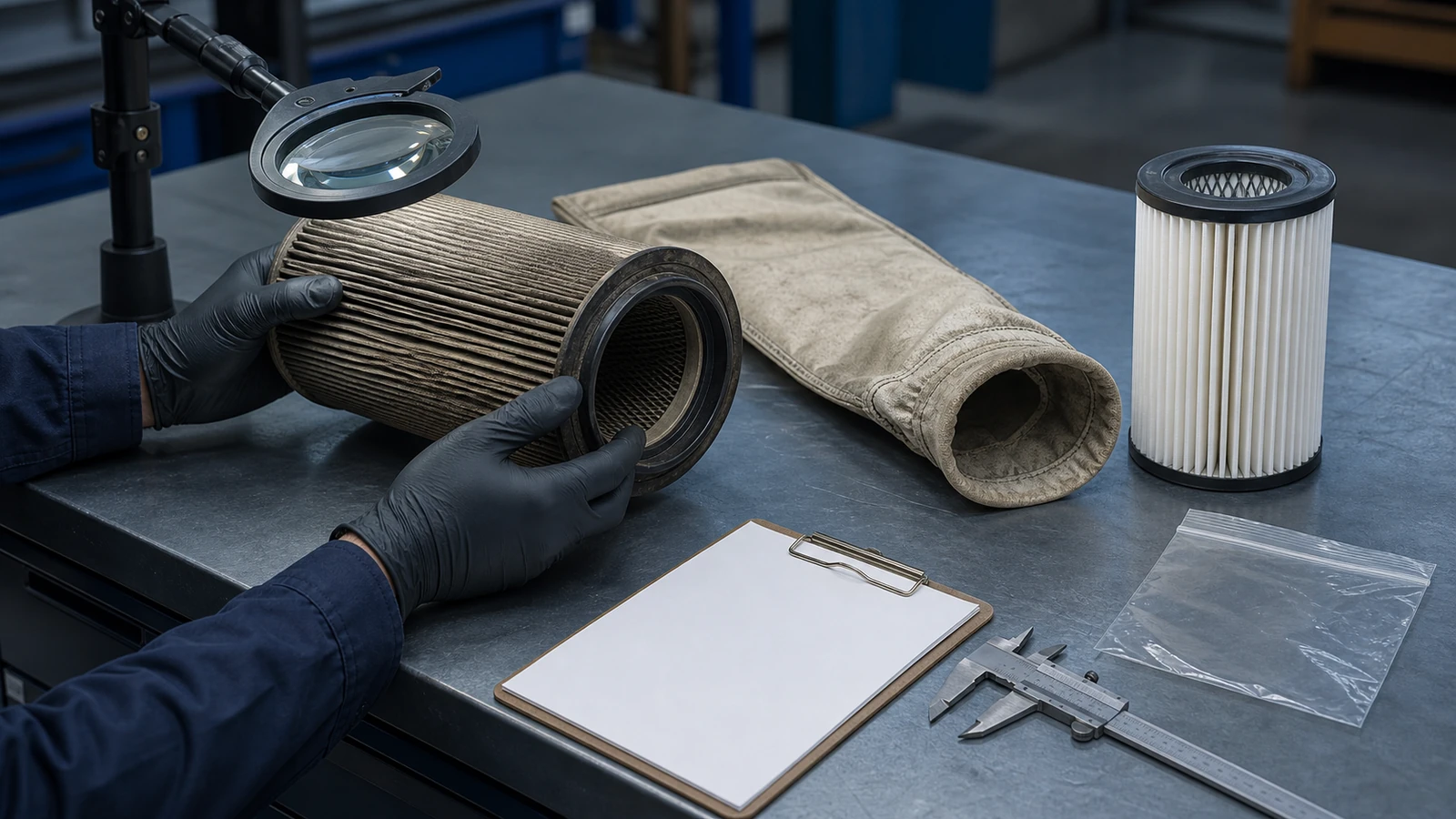
There is no universal clean-or-replace answer. Treat a used filter as a documented cleaning-evaluation candidate only when the exact OEM, media, and process documentation permits evaluation, site hazard controls permit handling, disqualifying condition evidence is absent, and applicable post-clean acceptance evidence exists. Otherwise choose replacement or HOLD — obtain applicable evidence. This is not a cleaning instruction; reinstallation remains a separate site-controlled decision under the controlling procedure.
Scope
This buyer- and site-owned framework applies to removed industrial dust collector filter bags and cartridges. It does not set a cleaning method, pressure, distance, duration, frequency, temperature, chemistry, acceptance threshold, expected recovery, service-life extension, savings result, or reinstallation permission. In-collector pulse, reverse-air, or shaker operation is a different maintenance subject controlled by the exact collector documents. The collector and filter manufacturer instructions, media documentation, site energy-control procedure, hazard communication program, permits, warranty terms, contamination controls, and authorized personnel govern. OSHA 29 CFR 1910.147 covers hazardous-energy controls for servicing within its scope, and OSHA 29 CFR 1910.1200 addresses classification and communication of workplace chemical hazards, including combustible dust. [1] [2] The decision aid is an illustrative workflow; site-specific review required.
Evidence gates for dust collector filter cleaning vs replacement
Keep observation, permission, hazard control, technical eligibility, acceptance, and purchasing decisions separate. A candidate state means only that a buyer-appointed authority has enough applicable evidence to evaluate the documented route; it is not a cleaning or reinstallation authorization.
1. Identify the exact filter and collector before comparing options
Record the collector manufacturer, model, serial or configuration evidence, current manual revision, filter part number or approved drawing, dimensions, top and bottom or end-cap construction, gasket or seal, media, membrane or surface treatment, support arrangement, installation location, and service history. Preserve photos and a traceable removed sample when the site permits. If the filter identity, construction, or governing revision is unknown or mixed, route the decision to HOLD — obtain applicable evidence. Nominal size, color, pleat count, or appearance cannot establish cleanability, compatibility, or acceptance criteria.
2. Establish the site-owned safe-work and contamination boundary
Before any handling decision, identify the collected material, process additives, hazardous decomposition products, cross-contamination concerns, exposure controls, combustible-dust status, containment, transport, waste, and emergency requirements. OSHA’s Hazard Communication standard requires covered employers to communicate chemical hazards through a workplace program, labels or other warnings, safety data sheets, and training. [2] That rule does not determine whether a filter can be cleaned. It supports the boundary that an unknown or uncontrolled dust hazard is a HOLD condition and that the employer’s applicable controls govern non-routine work.
3. Separate collector-designed cleaning from removed-filter reprocessing
Many collectors use a designed in-place cleaning system to release part of the surface dust cake while the filter remains installed. Donaldson’s cleaning-technology article describes mechanical, reverse-air, and pulse concepts as collector technologies whose behavior depends on equipment and filter design. [3] That does not authorize removing an element for washing, compressed-air cleaning, vacuuming, chemical cleaning, or third-party processing. Record whether the observed issue occurred despite normal collector operation and whether collector, hopper, airflow, pulse, moisture, or process evidence needs separate investigation before a purchasing decision.
4. Read the exact OEM statement; do not generalize across models
Manufacturer instructions can be deliberately different. The current Donaldson DFPRE 4 manual states that cartridges for that named series cannot be washed and reused. [4] A current Donaldson Downflo Evolution manual says cartridges generally cannot be washed and reused, while noting that some non-cellulose media may in some instances be considered only after contact with Donaldson. [5] These statements belong to their named equipment and revisions. Together they show why one OEM example cannot become a universal method or permission.
5. Treat media, membrane, treatment, and construction as controlled variables
Cellulose-based pleats, synthetic substrates, felts, woven fabrics, surface-treated media, and membrane-laminated constructions do not place dust or resist handling in the same way. Gore’s membrane-versus-non-membrane technical page distinguishes surface filtration at the membrane from dust entry into non-membrane depth media. [7] That construction explanation is not permission to reprocess a Gore or other membrane product. Obtain the exact media maker’s current statement for the named construction, including any exclusions for membrane, coating, antistatic feature, flame-retardant treatment, seam, adhesive, end cap, gasket, cage interface, or collected material. Unknown construction remains on HOLD.
6. Screen condition evidence without making a remote diagnosis
Record tears, holes, weak or abraded areas, deformed pleats, membrane separation, damaged seams, cracked or loose end components, compromised gaskets, corrosion, heat or chemical appearance, hardened deposits, wet or sticky contamination, clean-side dust evidence, and loss of traceability as evidence categories. These observations do not by themselves prove root cause. They can, however, support a replacement-only route when the applicable document or buyer-approved acceptance plan identifies the condition as disqualifying. If the criterion is not documented, preserve the observation and use HOLD rather than inventing a pass/fail rule.
7. Define the documented cleaning-evaluation candidate narrowly
Use the candidate state only when the exact OEM, media, and process documentation permits evaluation; the filter identity and history are traceable; the dust and contamination controls permit the proposed handling route; observed condition has been compared with applicable disqualifiers; the responsible parties and chain of custody are named; and applicable post-clean acceptance evidence exists. The record must identify the controlling document and revision, not paraphrase one manufacturer’s language into a plant-wide practice. Candidate means eligible for a controlled technical evaluation only. It does not select a cleaning provider, method, parameter, result, warranty position, or reinstallation outcome.
8. Treat external processing and transport as additional evidence gates
Offsite handling can add identity, packaging, shipping, contamination-segregation, substitution, damage, and return-documentation questions. Donaldson’s wet-versus-dry cleaning article describes tested-media damage and capacity concerns and also identifies cross-contamination, clean-side contaminant migration, transit damage, and substitution risks. [6] Its laboratory observations and commercial example are specific to the tested elements and stated protocol; this article adopts no percentage, life, cost, or performance result. The buyer should require traceable before-and-after identity and documented exceptions without assuming that an external service makes an element acceptable.
9. Keep post-clean acceptance separate from cleaning eligibility
Before a candidate leaves the review stage, define who owns acceptance, which exact manufacturer or buyer-approved criteria apply, what identity and chain-of-custody records must return, which condition and integrity evidence must be documented, how seals and construction are evaluated, which baseline is comparable, and what result forces HOLD or replacement. EPA’s 2023 bag-leak-detection best-practices document lists pressure differential, temperature, flow, fan current, opacity, particulate emissions, and leak detection as possible fabric-filter performance indicators. [8] EPA’s current fabric-filter monitoring page likewise emphasizes selecting appropriate indicators for the actual control context. [9] Neither source supplies a universal cleaned-filter acceptance test.
10. Record the buyer-appointed decision and preserve the HOLD route
The decision record should name the filter, governing documents, evidence reviewed, unresolved conflicts, hazard and contamination owner, warranty or permit questions, replacement basis, candidate basis, post-clean acceptance owner, and purchasing action. Replace when the controlling evidence prohibits evaluation or documents a disqualifying condition. Use HOLD — obtain applicable evidence when identity, permission, hazard control, comparability, condition, chain of custody, or acceptance is missing or conflicting. A successful evidence review does not authorize maintenance or restart. Reinstallation remains a separate site-controlled decision made by the buyer-appointed authority under the applicable procedure.
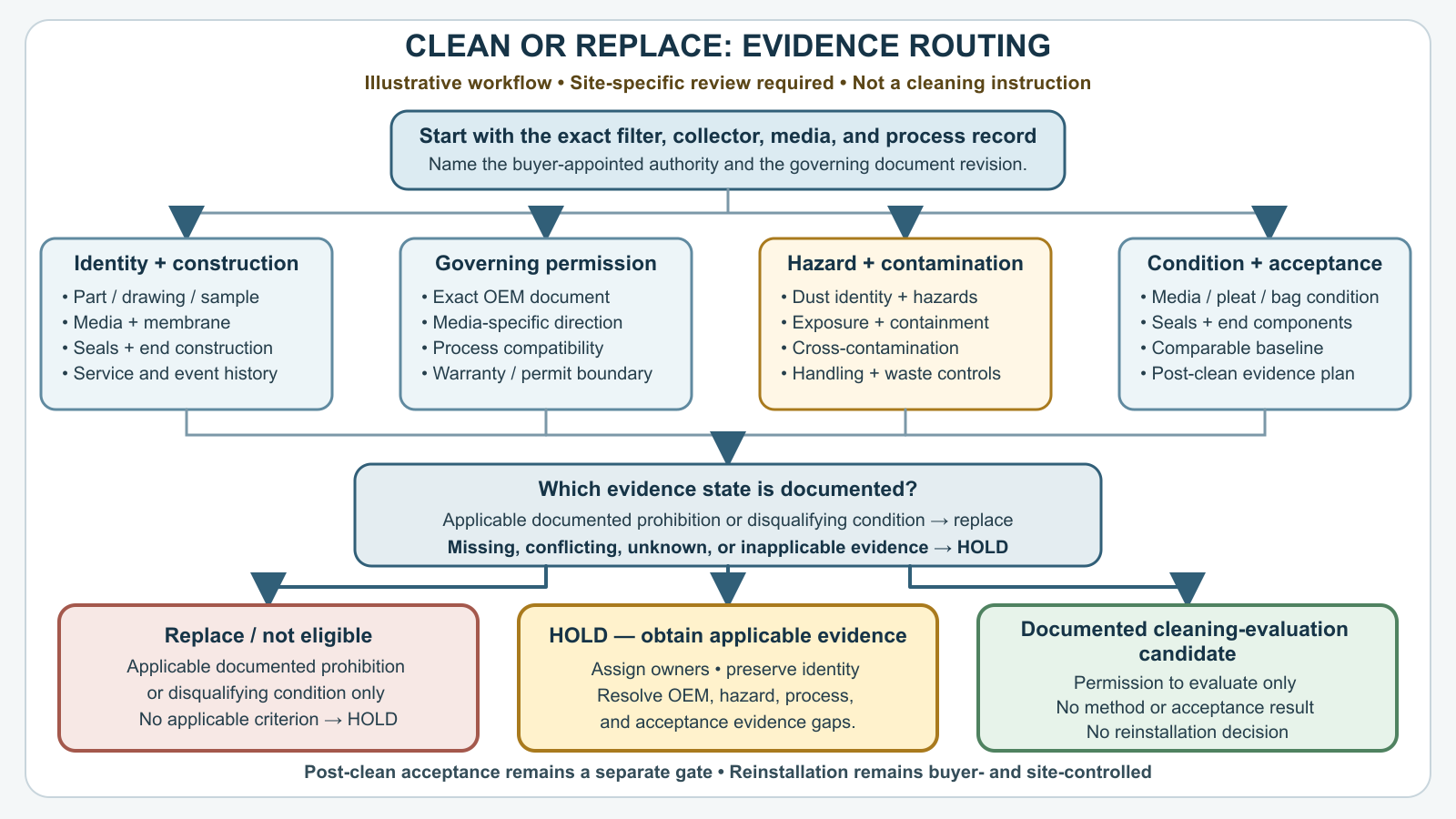
Clean-versus-replace evidence workflow
This illustrative workflow is a discussion aid; site-specific review required; not a cleaning instruction. Start with exact identity, governing OEM and media documents, process and hazard controls, observed condition, and a documented post-clean acceptance plan. Route an applicable documented prohibition or disqualifying condition to Replace / not eligible. Route missing, conflicting, unknown, or inapplicable evidence to HOLD — obtain applicable evidence. A Documented cleaning-evaluation candidate exists only when the exact OEM, media, and process documentation permits evaluation and applicable post-clean acceptance evidence exists. Post-clean acceptance and reinstallation remain separate site-controlled gates.
Scroll table horizontally
| Evidence gate | What to attach | Decision route if unresolved |
|---|---|---|
| Exact identity | Collector, part, drawing, media, membrane, treatment, seals, location, history | HOLD — obtain applicable identity evidence |
| Governing permission | Exact OEM and media document, revision, process scope, warranty or permit boundary | HOLD or Replace when the applicable direction does not permit evaluation |
| Hazard and contamination | Dust identity, SDS or hazard record, exposure, containment, cross-contamination, waste controls | HOLD — obtain site and EHS direction |
| Observed condition | Traceable photos and records for media, pleats or bag, membrane, seams, seals, end components | Replace only when an applicable documented criterion disqualifies; otherwise HOLD |
| Process compatibility | Collected material, moisture and chemistry history, normal and upset records | HOLD — do not infer compatibility |
| Chain of custody | Unique identity, packaging, handler, segregation, transport, substitution and exception records | HOLD — preserve identity and contamination control |
| Post-clean acceptance | Applicable criteria, evidence fields, comparison baseline, acceptance owner, rejection route | HOLD — eligibility is not acceptance |
| Buyer-appointed decision | Named authority, evidence version, replace/candidate/hold state, purchasing action | No maintenance or reinstallation authorization from this workflow |
On narrow screens, scroll horizontally to inspect the full-size diagram.
Clean-or-replace decisions that require HOLD or replacement review
Do not release a generic cleaning or reinstallation instruction when a mandatory identity, permission, hazard, condition, compatibility, custody, acceptance, or authority question remains open.
- The exact collector, filter part, media, membrane, treatment, seal, or document revision is unknown.
- A procedure for another collector, cartridge, bag, or media is treated as applicable without written evidence.
- Appearance or differential pressure alone is used to declare a filter cleanable, failed, restored, or acceptable.
- Tears, deformed pleats, membrane separation, damaged seams, compromised seals, end-component damage, or clean-side contamination lack an applicable disposition criterion.
- Dust identity, health hazard, combustible-dust status, process contamination, exposure control, containment, or disposal direction is missing.
- An external processor cannot preserve unique identity, segregation, chain of custody, construction, and documented exceptions.
- The proposed record has no applicable post-clean condition, integrity, seal, construction, or performance evidence.
- A laboratory or supplier statement has no named test specimen, method, comparison basis, or applicability to the returned filter.
- Warranty, permit, hygiene, emissions, contamination, or site maintenance rules independently prohibit or constrain reuse.
- The same record treats cleaning completion as automatic acceptance, reinstallation, restart, compliance, savings, or life extension.
Quote-ready clean-or-replace evidence package
Use the active condition-based replacement guide to organize the site history, then attach the fields below. Submit the defined inquiry through the RFQ path for a replacement-filter request; the buyer retains cleaning eligibility, method, acceptance, hazard control, reinstallation, and maintenance authorization.
- Collector manufacturer, model, serial or configuration evidence, current manual, compartment or location, cleaning-system type, and site asset ID.
- Filter family, part number, approved drawing or sample identity, dimensions, media, membrane or treatment, seams, top and bottom or end caps, seals, supports, and quantity.
- Installation and service history, order or lot reference when available, prior events, process changes, maintenance records, and reason for removal.
- Traceable photos of the used filter, media or pleats, seams, membrane or surface, seals, end components, cage or support contact, and clean-side evidence where safely available.
- Collected material, process description, normal and upset exposure, moisture or chemistry context, hazard documentation, contamination constraints, and site handling owner.
- Exact OEM and media documents, revision, stated eligibility or prohibition, application limits, warranty questions, and unresolved conflicts.
- For any external evaluation: unique identity, packaging, segregation, handler, chain of custody, substitution prohibition, exception reporting, and returned records required by the buyer.
- Applicable post-clean condition, integrity, dimensional, seal, construction, contamination, and performance evidence fields plus the buyer-appointed acceptance authority.
- Replacement quantity and timing context, approved alternative evidence, purchasing contact, HOLD items, and the questions the supplier must answer.
Product path
- Replacement dust collector filtersUse the replacement path when part number, dimensions, construction, media, collector, quantity, and operating evidence define the inquiry.
- Dust collector cartridge filtersReview cartridge dimensions, end caps, gasket, mounting, media, pleat construction, support, collector, and process evidence.
- Dust collector filter bagsReview bag dimensions, top and bottom construction, media, membrane or finish, cage relationship, collector, and application evidence.
Frequently asked questions
Can every dust collector cartridge filter be cleaned and reused?
No. Manufacturer directions differ. The current Donaldson DFPRE 4 manual prohibits washing and reuse for its named cartridges; the Downflo Evolution manual provides only a limited manufacturer-contact note for some non-cellulose media. [4] [5] Neither applies universally.
Does a dirty-looking filter need replacement?
No conclusion follows from appearance alone. Review the exact manufacturer instructions, site-approved performance history, process and hazard context, physical condition, and the active condition-based replacement guide. Conflicting evidence routes to HOLD.
Is pulse cleaning the same as sending a filter out for cleaning?
No. Collector-designed in-place functions are tied to the equipment and media. Removed-filter processing adds identity, hazard, contamination, transport, custody, condition, and acceptance questions. Donaldson describes the in-collector distinction. [3]
Can a membrane filter be evaluated like standard felt or cellulose media?
Not without exact construction evidence. Surface layer, substrate, treatment, seams, seals, and process exposure can change the applicable direction. Gore describes construction differences, not reprocessing permission. [7]
What conditions usually route the review to replacement or HOLD?
A controlling prohibition or applicable disqualifier supports replacement review. Unknown identity, permission, hazard, media, condition, contamination, custody, or post-clean acceptance evidence routes to HOLD — obtain applicable evidence.
Does completion of a cleaning process prove a filter can be reinstalled?
No. Processing completion is not acceptance. The buyer-appointed authority needs applicable criteria, identity, custody, condition, integrity, construction, baseline, rejection, and site-authorization evidence. EPA supplies no universal cleaned-filter acceptance test. [8] [9]
Can FilterBagWorks approve a filter-cleaning method or post-clean result?
No. This guide supports a defined replacement-filter inquiry only. The buyer, collector and media documentation, site EHS and maintenance procedures, permit and warranty requirements, and buyer-appointed technical authority control cleaning eligibility, method, acceptance, reinstallation, and restart.
Sources
- OSHA 29 CFR 1910.147 — The Control of Hazardous Energy (Lockout/Tagout)
- OSHA 29 CFR 1910.1200 — Hazard Communication
- Donaldson: Optimizing Dust Collector Filter Cleaning Technology
- Donaldson DFPRE 4 Dust Collectors Installation, Operation and Maintenance Manual
- Donaldson Downflo Evolution Dust Collectors Installation, Operation and Maintenance Manual
- Donaldson: Why Wet Cleaning Filters May Not Be Worth It
- Gore: Membrane Technology vs. Non-Membrane Media — Industrial Baghouse Filters
- U.S. EPA: Best Practices for Bag Leak Detection Systems in Clean Air Act Permitting
- U.S. EPA: Monitoring by Control Technique — Fabric Filters
Submit a defined filter inquiry
Send the collector and filter identity, drawings or manual references, photos and dimensions, media and membrane evidence, process and hazard context, observed condition, requested replacement quantity, and unresolved questions. Submit the defined inquiry through the RFQ path. The buyer retains cleaning eligibility, method, post-clean acceptance, reinstallation, site safety, compliance, warranty, and maintenance authority.
Request a quote