Baghouse retrofit decision guide
For plant engineers, maintenance managers, MRO buyers, OEMs, and distributors
Reviewed by FilterBagWorks Technical Team
Can Pleated Filter Bags Replace Standard Filter Bags and Cages?
Compare the existing bag-and-cage assembly with the proposed pleated element as a complete geometry, seal, support, cleaning, process, maintenance, and cost decision. A family name or added media area cannot approve a retrofit.
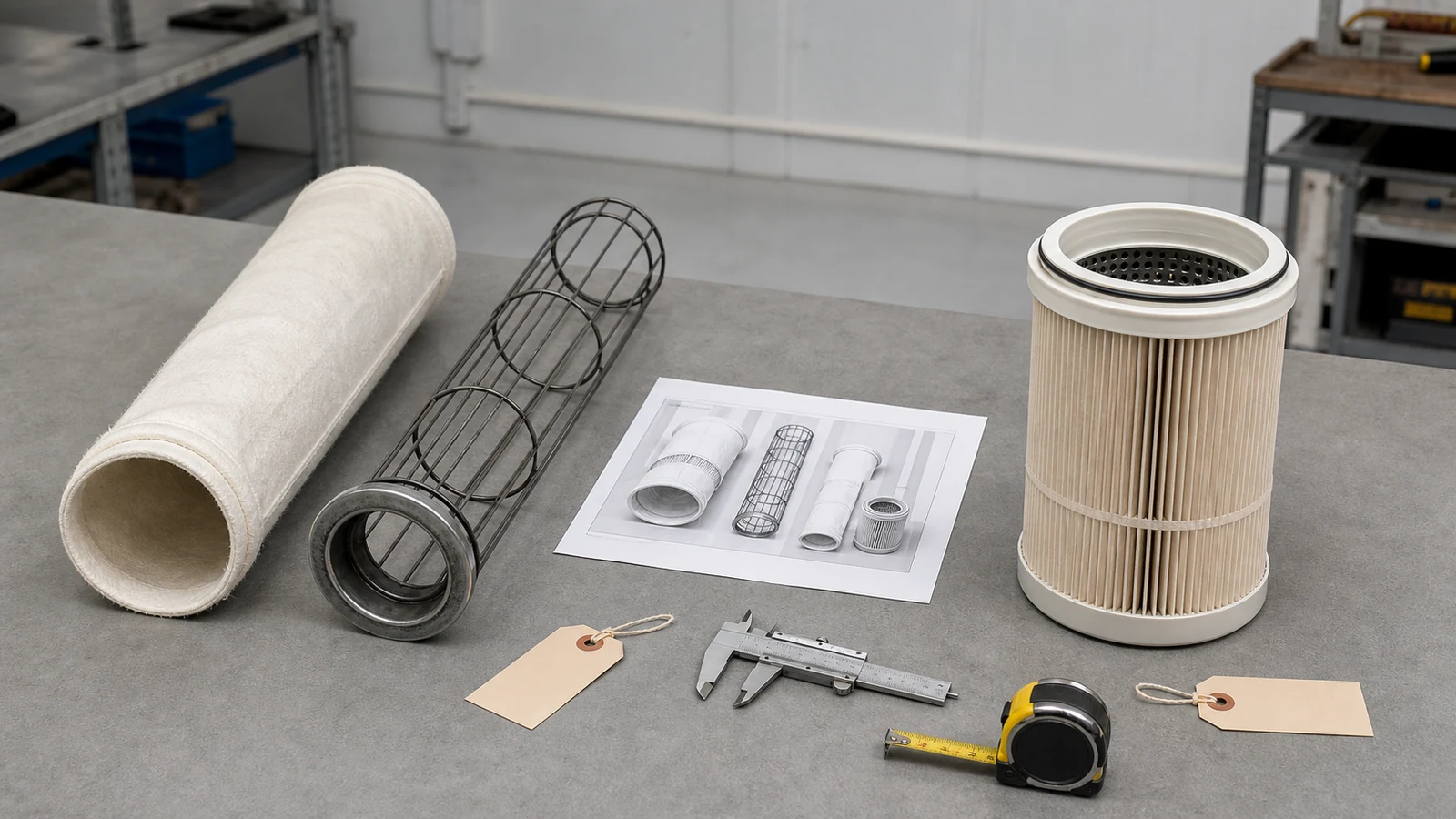
Direct answer
A pleated element is not automatically a drop-in replacement for every standard bag-and-cage assembly, and more media area does not guarantee lower total lifecycle cost. Approve a retrofit only after tube-sheet geometry, loading and sealing, length and clearance, support and venturi changes, cleaning energy, dust release, process limits, maintenance access, fan/system behavior, and buyer cost inputs agree with current drawings, measurements, photos, operating evidence, and a safe validation plan.
Scope, safety boundary, and evidence status
This guide organizes safely obtained evidence for an existing pulse-jet baghouse and a proposed pleated-element retrofit. It does not authorize collector entry, energized access, dust disturbance, trial fitting, fan or pulse-setting changes, or a production test. OSHA identifies electrical, mechanical, pneumatic, chemical, thermal, and other hazardous energy as servicing risks; the employer’s energy-control procedure, collector manual, contaminant controls, access plan, and competent safety review govern the work. [1] Mark each field M measured, C copied from a current identified record, O observed, A assumed, or U unknown. Any fit-, seal-, support-, cleaning-, process-, or safety-critical A or U field remains a hold.
Evaluate the retrofit in this evidence sequence
1. Define what a pleated element changes
Compare two evidence layers. The existing layer includes bag, cage, venturi, tube-sheet interface, retention, cleaning, length, and condition. The candidate includes pleated media, core, ends, seal, retention, pulse opening, bottom, and current drawing. Manufacturer-specific example: Donaldson shows round top-load, round bottom-load, and oval products with different boots, rings, bolt-in features, cores, and nozzle/venturi arrangements. [3] These named examples prove variation, not interchangeability. Every mating, support, cleaning, material, and operating field needs a disposition.
2. State the retrofit goal before comparing products
Write one primary goal and its acceptance evidence: address abrasion, access, damaged cages, a documented air-to-media problem, a diagnosed pressure-drop issue, or changeout burden. Keep symptoms separate from causes; pressure can also reflect loading, cleaning, moisture, re-entrainment, airflow, or sensing. A shorter element changes free space, and a one-piece element changes handling. Without a baseline, acceptance measure, and owner for unresolved collector, cleaning, or process defects, the proposal is not ready.
3. Verify tube-sheet opening, loading direction, and access
Record hole shape and reference dimensions, edge and seating condition, top- or bottom-load access, dirty and clean sides, and insertion/removal paths. Photograph the bag-top/cage relationship and overlay the candidate drawing. Round, oval, snap-in, and bolt-in names in manufacturer literature do not establish the actual opening or access. [3] Confirm every plenum, door, cell-plate, lower opening, and neighboring obstruction. Hold if nominal outside diameter is being used as proof of insertion, seating, retention, or removal. No universal tube-sheet size, tolerance, or loading conversion applies.
4. Reconcile the sealing and retention arrangement
Document the existing snap band, cuff, clamp, flange, gasket, seating face, top hardware, and retention. Obtain the candidate boot, ring, gasket, flange, bolt pattern, hardware, and installation drawing. Identify the sealing surface, loading side, restraint under airflow/pulsing, and inspection method. Manufacturer brochures show product-specific molded boots, snap rings, gaskets, tops, and bolt-in hardware. [3] They set no universal compression, insertion force, clamp, torque, or approval. A worn, repaired, coated, distorted, or undocumented tube sheet requires measured photos and sample or controlled fit review.
5. Check element length, bottom clearance, and every obstruction
Define both length endpoints before recording any value. Include or exclude top boot, gasket, flange, pulse nozzle, bottom puck, projection, and hardware explicitly. Then map the tube-sheet underside, inlet and baffle zone, hopper transition, braces, ledges, internal piping, rotary equipment boundary, neighboring elements, and minimum removal headroom. Manufacturer-specific examples: Donaldson and Parker describe shorter pleated elements in named applications, sometimes to create more open space below the filters. [4] [5] That does not prove a beneficial drop-out zone in another collector. Hold when the changed length could expose the pleats to inlet impingement, recirculation, obstructions, or an unverified maintenance path.
6. Decide what happens to the cage, venturi, and support system
Create a component disposition table: retain, remove, replace, integrate, or unknown. A conventional pulse-jet bag normally uses a separate cage; EPA’s general description also shows a venturi/nozzle cleaning relationship. [2] Some pleated products use an internal core and some incorporate a shaped pulse opening or venturi-like feature. [3][4] Neither statement authorizes leaving an old cage around a self-supported element, removing a collector-specific venturi, or copying a nozzle design. Verify core material and support, top hardware, grounding/bonding record where applicable, blowpipe and nozzle alignment, pulse entry path, and whether removed parts affect seating or maintenance. A proposed retrofit is no-go when two supports interfere, a required component is omitted, hardware can loosen into the collector, or the actual support/cleaning arrangement lacks an approved drawing.
7. Calculate media area and air-to-media implications without promising capacity
Use supplier drawing area for the exact candidate and the verified active element count. Record actual flow by operating condition, offline rows, leaks or bypasses, and whether the comparison uses total installed area or active online area. EPA defines air-to-cloth ratio as volumetric flow divided by fabric area and states that particulate loading, characteristics, and cleaning method affect selection. [2] If verified flow stays unchanged and usable area increases, the calculated ratio decreases. That arithmetic does not prove the pleat area will clean effectively, authorize higher airflow, resolve can velocity or inlet distribution, or establish collector capacity. Manufacturer statements about added area belong to their named elements and conditions. [3][4][5] Keep the comparison normalized and show every assumption; no universal area multiplier is used.
8. Put pressure drop in the fan and system context
Collect clean and seasoned pressure, airflow, production state, loading, fan speed/control, damper, cleaning state, duct changes, and sensor location. Compare matched flows and process states. Donaldson conditions energy benefit on whether the fan can be adjusted. [4] DOE explains that resistance and control move the operating point and field system effects can differ from laboratory behavior. [6] Lower media resistance or more area therefore guarantees neither lower collector pressure nor lower fan power, unchanged airflow, stable capture, or savings. Define a controlled before/after plan.
9. Validate pulse, nozzle, venturi, and cleaning conditions
Draw the cleaning path from header and valve through nozzle to element opening and pleats. Record alignment and geometry from current equipment/drawings plus header recovery, valve condition, controller logic, baseline frequency, and pressure response. EPA’s conventional pulse through a venturi/nozzle is not a pleated-element setting. [2] Parker requires cleaning-energy evaluation for its pleated application, while Donaldson shows product-specific spacing and pulse openings. [5] [3] Copy no pressure, duration, interval, valve, nozzle, venturi, or controller setting. Require supplier and collector approval of the cleaning review.
10. Test the dust-release case, especially sticky or difficult dust
Describe loading, cohesion, tackiness, fibers, oil/mist, hygroscopic behavior, abrasion, agglomeration, and upsets. Inspect old bags for cake, depth loading, blinding, re-entrainment, and clean-side evidence. Pleat valleys may bridge or retain difficult material. Manufacturer-specific example: Donaldson reports fibers packing into pleats at one wool-dust site before a specific combined remedy. [8] That case transfers neither problem nor remedy. Hold sticky, fibrous, oily, wet, or agglomerative dust without representative review, sample evaluation, or a controlled trial plan.
11. Recheck temperature, moisture, chemistry, and component materials
Record normal/upset temperature at a named location, cycles, condensation, water, humidity, oil, acids, alkalis, solvents, oxidizers, and process changes. Obtain exact-candidate limits for media/treatment, core, ends, adhesive, gasket, bands, fasteners, and grounding features. EPA identifies temperature as a fabric-selection variable; Donaldson also asks about moisture, agglomeration, static, and chemistry. [2] [7] These are inputs, not prescriptions. Media name, color, case study, or another product’s maximum cannot approve the complete assembly.
12. Compare maintenance access, handling, and changeout work
Map isolation, reach, retention release, lifting/support, access clearance, dust containment, seal inspection, installation, retention verification, and disposal. OSHA sets the hazardous-energy boundary, not the site’s procedure. [1] Manufacturer claims of easier changeout for named constructions are hypotheses. [3][5] A one-piece part may remove bag stripping and cage handling but change weight, grip points, headroom, breakage, disposal, storage, and training. Compare only the approved site work plan or a controlled sample change, not a marketing average.
13. Build the quote, cost model, and release decision from buyer inputs
Request the candidate drawing/revision, materials, seal, retention, core, area, cleaning requirements, mass, packaging, quantity, and exceptions. Buyer inputs cover installed quantity, strategy, labor, downtime, disposal, modification, fan/compressed-air measurements, life records, quality events, validation cost, comparison period, and ownership. Separate purchase price from lifecycle cost. Manufacturer pressure, pulse, changeout, or savings examples remain test- or site-specific. [3][4][5] Use no borrowed ROI. Release only when drawings, measurements, photos, process, safe access, baseline, open questions, and approval or sample-validation plan agree.
Pleated retrofit comparison and go/no-go assets
Use the normalized comparison to document which components change, then follow the evidence-gated flow. The diagrams are representative and not to scale. Buyer inputs are required, and neither visual is a dimension, fit, compatibility, pressure-drop, airflow, cleaning, performance, service-life, savings, or ROI standard.
Scroll table horizontally
| Gate | Evidence required for review | Hold or no-go condition |
|---|---|---|
| Geometry and access | Tube sheet, load direction, endpoints, obstructions, removal path, candidate drawing | Any fit-critical value is assumed, damaged, inaccessible, or uses unclear references |
| Seal and retention | Existing and proposed sealing faces, boot/gasket/flange, hardware, installation record | Seal or retention depends on a silhouette, nominal diameter, or copied universal setting |
| Support and cleaning | Cage/venturi disposition, internal core, nozzle alignment, pulse path, cleaning evidence | Component conflict or no equipment-specific cleaning review |
| Dust and process | Dust-release behavior, temperature, moisture, chemistry, material records, upset history | Sticky/difficult dust or process limit lacks representative validation |
| System operation | Verified flow, active area, pressure trend, fan/control state, before/after measurement plan | Area is being treated as capacity, pressure-drop, energy, or savings proof |
| Maintenance and cost | Safe access plan, handling, labor, downtime, disposal, modification, energy, life, validation inputs | Marketing claim or purchase price substitutes for buyer lifecycle data |
| Release | Closed questions, current drawings/manuals, approval path, sample or controlled fit validation | Any critical conflict remains or bulk release precedes approved validation |
On narrow screens, scroll horizontally to inspect the full-size diagram.
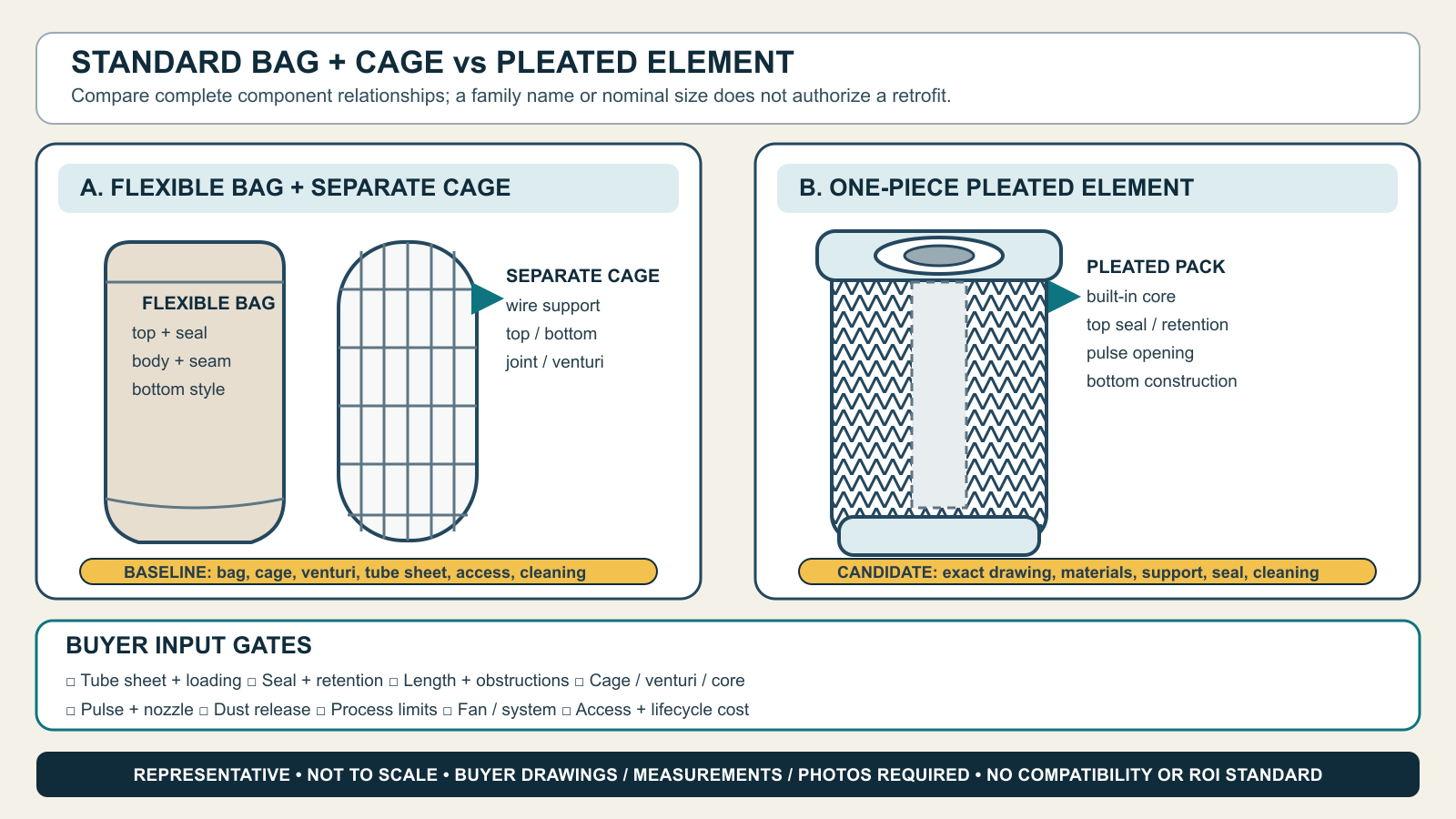
On narrow screens, scroll horizontally to inspect the full-size diagram.
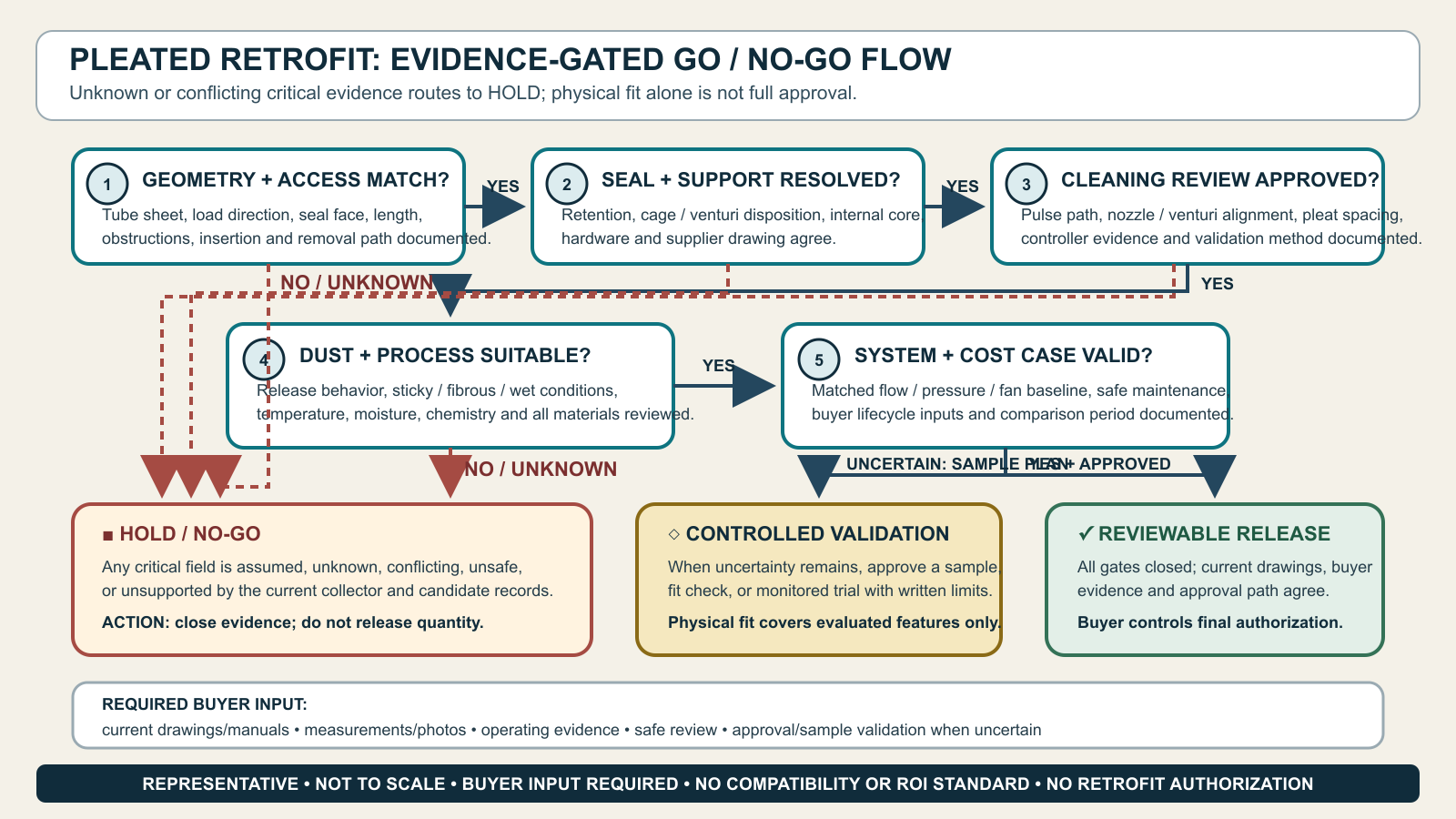
Common pleated-retrofit mistakes and red flags
Stop the retrofit release when any of these shortcuts replaces collector-specific evidence.
- Calling a pleated element drop-in because nominal diameter and length appear close. [3] Limit: named manufacturer styles show variation, not interchangeability.
- Ignoring top-load versus bottom-load access, tube-sheet seating face, or removal path. [3] Limit: product-specific loading examples.
- Assuming an existing cage or venturi is simply discarded, retained, or duplicated. [2][3] Limit: the support and cleaning arrangement must be approved.
- Using more nominal media area as permission to increase airflow. [2] Limit: loading, dust, cleaning, active area, and system conditions still govern.
- Promising lower pressure drop or fan energy without matched airflow, fan/control, and system-resistance evidence. [4][6] Limit: system operating point matters.
- Copying pulse pressure, interval, duration, nozzle, or venturi details from another collector. [2][5] Limit: cited conditions are not universal settings.
- Assuming pleats release sticky, fibrous, oily, wet, or agglomerative dust because another case succeeded. [8] Limit: one specific manufacturer case.
- Selecting media from temperature alone while ignoring moisture, chemistry, core, adhesive, gasket, or upset conditions. [2][7] Limit: full assembly review remains required.
- Treating shorter length as proof of improved drop-out, abrasion, access, or handling. [4][5] Limit: named applications only.
- Using purchase price, area, or a vendor ROI example as total lifecycle cost. [4][5][6] Limit: buyer inputs and an explicit comparison period are required.
Quote-ready pleated retrofit checklist
Use the active dust collector filter RFQ checklist as the cover sheet, then attach this retrofit evidence. Mark every field M, C, O, A, or U; any critical A or U remains a pre-order hold.
- Collector maker, model, serial/asset ID, current drawing/manual revision, compartment or row, installed and requested quantity.
- Top-load or bottom-load direction, dirty and clean sides, tube-sheet/hole profile, seating face, access opening, insertion and removal path.
- Existing bag top and bottom, snap band/cuff/clamp/flange, cage top/bottom/joint, venturi, retention, installed orientation, and condition photos.
- Candidate drawing with named length endpoints, outside profile, top seal/boot/gasket/flange, retention/hardware, bottom, projections, unit mass, and revision.
- Tube-sheet underside, baffle, inlet, brace, hopper, neighboring-element, and maintenance clearances with buyer-entered references and photos.
- Cage and venturi disposition; candidate internal core/support; blowpipe/nozzle alignment; pulse entry path; grounding or bonding record when applicable.
- Exact candidate media area and active element count; verified airflow and operating state; calculated air-to-media ratio with assumptions visible.
- Clean and seasoned differential-pressure trend, fan curve/speed/control, damper state, sensor location, cleaning frequency and response, compressed-air history.
- Dust source, loading and release behavior, sticky/fibrous/oily/wet/agglomerative evidence, abrasion, re-entrainment, and representative sample status.
- Normal/upset temperature location, condensation and moisture history, chemistry, water/oil ingress, and current material limits for every component.
- Safe access and isolation owner, handling route, lifting/support method, storage, disposal, training, trial quantity, and validation plan.
- Candidate price, labor, planned/unplanned downtime, disposal, modification, fan/compressed-air data, life history, quality events, comparison period, and approver.
Product path
- Pleated filter bagsUse the pleated-element product path only after tube-sheet, seal, clearance, support, cleaning, dust, process, maintenance, and system evidence are ready for review.
- Standard dust collector filter bagsKeep the standard bag construction as the baseline when comparing top and bottom details, media, length, cage relationship, cleaning behavior, and observed performance.
- Baghouse filter cagesDocument whether the existing cage, venturi, joint, top, bottom, and hardware are retained, removed, replaced, or integrated; do not assume a pleated core resolves every support relationship.
Frequently asked questions
Is a pleated element a drop-in replacement for any standard bag and cage?
No. Require approved disposition for tube-sheet opening, loading, seal, retention, length, obstructions, support, cage/venturi, pulse path, dust, process, and access. Family name or nominal size cannot authorize fit, cleaning, performance, or release. [2][3]
Does more pleated media area automatically lower the air-to-media ratio?
Only the calculation at unchanged verified flow and active count decreases when documented usable area increases. It approves no added airflow and proves no cleaning, dust release, pressure, distribution, capacity, or limit. Show flow, online area, assumptions, and process state. [2]
Will a pleated filter bag always reduce pressure drop and fan energy?
No. Compare matched airflow and production, clean and seasoned pressure, fan control, dampers, resistance, sensors, and cleaning. Manufacturer energy benefit is conditional on fan adjustment; DOE treats fan power as an operating-point and system question. [4][6]
Can I remove the cage and venturi when installing a pleated element?
Not without collector-specific disposition. Some elements have a core or pulse-opening feature; cages and venturis can perform support, seating, and cleaning functions. Mark each retain, remove, replace, integrate, or unknown, then obtain an approved drawing. [2][3]
Are pleated elements suitable for sticky, fibrous, or wet dust?
Do not decide from dust name alone. Pleat geometry, surface, cleaning, loading, oil, moisture, agglomeration, and shutdown matter. One manufacturer case reports fibers packing before a specific remedy; it is not universal. Require representative evidence and controlled validation. [8]
Does a shorter pleated element guarantee easier maintenance?
No. It may remove separate bag/cage handling, but mass, grips, headroom, opening, direction, retention, containment, disposal, storage, and access can change. Compare the approved task sequence or a controlled sample change, not a vendor average. [1][3][5]
What should be approved before ordering a full retrofit quantity?
Close current collector and candidate records, buyer measurements/photos, seal, clearance, support disposition, cleaning, dust/process, system baseline, maintenance, cost inputs, and open questions. When uncertainty remains, approve controlled sample validation first. Physical fit covers only evaluated features.
Sources
- OSHA: Control of Hazardous Energy (Lockout/Tagout)
- U.S. EPA: Fabric Filter — Pulse-Jet Cleaned Type (Baghouses)
- Donaldson: Pleated Bag Filters
- Donaldson: Pleated Bag Filters Solve Dust Collection Problems
- Parker Hannifin: Taking the Heat — High-Temperature Pleated Filters
- U.S. Department of Energy: Improving Fan System Performance — A Sourcebook for Industry
- Donaldson: Cartridge Filter Media Selector
- Donaldson: Ultra-Web SB Pleated Bag Filters on Fibrous Wool Dust
Request a filter review
Send the current collector drawing/manual, tube-sheet and loading evidence, old bag/cage/venturi record, candidate drawing, seal and clearance photos, cleaning and fan/system history, dust and process conditions, maintenance-access plan, buyer cost inputs, quantity, and every unresolved field. FilterBagWorks.com can review that evidence package; the buyer's safe technical and purchasing controls must approve any sample validation and quantity release.
Request a quote