Filter-bag construction comparison guide
For plant engineers, EHS, MRO, maintenance, reliability, procurement, OEM replacement, and industrial sourcing teams
Buyer-appointed technical review required
PTFE Membrane vs Standard Felt Filter Bags: When Is the Upgrade Worth It?
Compare a named membrane-laminated construction with a named unlaminated felt construction only after identity, duty, collector, cleaning, measured outcome, damage history, and full-period cost evidence share a comparable boundary. An upgrade is a purchasing hypothesis, not a result.
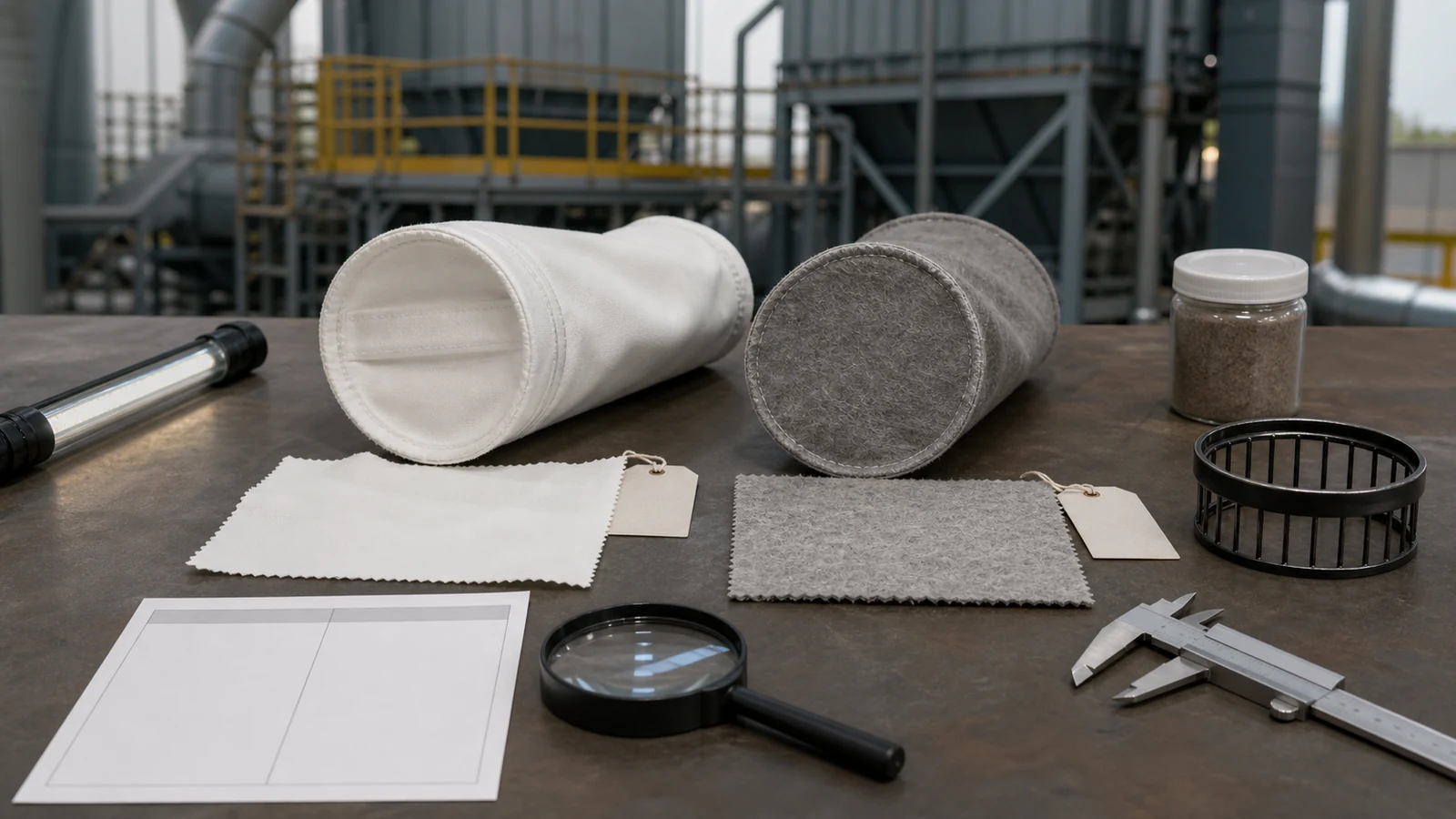
Direct answer
A PTFE membrane construction is worth considering only when a named, traceable candidate can be compared with a named unlaminated felt candidate under the same collector, dust, gas, cleaning, measurement, and cost boundaries. Surface-filtration claims from one manufacturer describe that manufacturer's construction; they do not prove the result at another plant. Efficiency, emissions, differential pressure, cleaning response, life, downtime, energy, cost, ROI, and compatibility remain HOLD until evidence is comparable, attributable, and reviewed by the buyer-appointed authority.
Scope, authority, and safety boundary
This guide organizes a controlled comparison of replacement filter-bag constructions. It is not microscopy, a product drawing, a laboratory report, a material approval, a fit or compatibility conclusion, a process-hazard review, an emissions finding, an operating instruction, or an ROI model. Not every PTFE membrane construction behaves alike; standard felt is not one universal construction. Surface appearance cannot verify ePTFE, a membrane, fiber, scrim, weight, finish, lamination quality, pore structure, or duty limit. No universal membrane-side orientation, cleaning setting, installation method, handling acceptance, or damage diagnosis is supplied. This guide does not authorize energized access, test pulsing, dust handling, hot handling, chemical contact, or setting changes. The employer’s hazardous-energy procedure governs servicing and maintenance; OSHA assigns control of unexpected energy to that employer-owned program. [1]
Compare exact constructions through one evidence gate
Use one row per candidate and preserve source, revision, test method, specimen, condition, location, date, owner, and status beside every field. Mark data documented, assumed, non-comparable, conflicting, unknown, excluded, or not applicable. Unknown is not zero and a favorable label does not release another row.
1. Identify both finished constructions before comparing them
Record the exact media, fiber, scrim, weight, finish, and membrane identity for each candidate. For the membrane candidate, add membrane side, lamination, and substrate, plus the bonding or production declaration and finished-bag revision. For the unlaminated felt candidate, record fiber blend, scrim, needling or forming description, basis weight, surface finish or treatment, seam, thread, end construction, and finished-bag revision. BWF’s page describes its own industrial filter media as layered fiber coatings and supporting scrim, with ePTFE membrane or treatment depending on application. [5] That manufacturer-specific description illustrates why the full construction record matters; it is not a universal felt or membrane definition. Preserve supplier, product family, grade, part number, drawing, lot or production reference, declaration date, and approved substitutions. Treat PTFE fiber felt, PTFE treatment, PTFE coating, ePTFE membrane laminate, and PTFE seam tape as different descriptions. Treat standard felt as incomplete until its actual construction is traceable. A photograph, texture, color, stiffness, price, or old invoice cannot supply the missing identity.
2. Separate named surface-filtration evidence from generic labels
Donaldson’s Tetratex brochure describes its named ePTFE membrane media as laminated to supporting substrates and presents surface filtration rather than traditional depth filtration for that product family. [3] Gore’s membrane-versus-non-membrane page likewise describes filtering at the surface and dust penetration behavior for GORE membrane constructions and its illustrated non-membrane comparison. [4] These are original manufacturer statements about named technologies, not proof that every membrane laminate shares the same membrane, substrate, pore structure, lamination, durability, pressure behavior, or outcome. They also do not define every unlaminated felt. Use the sources to request exact candidate documentation. Do not copy their diagrams or performance claims into an unidentified product comparison, and do not infer membrane presence from a visually smooth surface.
3. Hold the comparison until dust and gas duty match
Document dust size, shape, loading, and stickiness, together with composition sources, fines behavior, cohesiveness, abrasiveness, oil or liquid association, cake observations, process variation, and representative sampling limits. Record gas temperature, moisture, dew point, chemistry, and oxygen across normal, startup, shutdown, peak, upset, washdown, steam, ingress, and seasonal states. Include duration, frequency, measurement location, method, instrument status, and time-aligned process events. A membrane claim developed for one dust and gas condition is not transferable to a sticky, abrasive, condensing, chemically different, or differently loaded duty without relevant evidence. A felt history from another compartment is not automatically a baseline. Unknown chemistry, dust variation, dew-point relationship, or upset exposure remains HOLD. No candidate advances because it has one apparently favorable temperature or chemical-resistance entry.
4. Match collector, support, cleaning, and installation history
Capture collector make, model, asset, compartment, revision, airflow direction, filter dimensions, tube sheet, cage or support, spacing, inlet distribution, seal, venturi or blowpipe relationship where applicable, and installed quantity. Record collector geometry, support, cleaning method, and settings history without prescribing settings. Add cleaning controller events, valve or motion maintenance, compressed-air quality where applicable, differential-pressure basis, process rate, and changes during the comparison period. EPA’s baghouse chapter distinguishes shaker, reverse-air, and pulse-jet arrangements and connects cleaning and filter construction to system design. [7] It does not approve a membrane or felt candidate. Preserve installation, storage, packaging, and handling record, including cage condition, protected staging, bag orientation only from the exact manufacturer document, installer, date, and exceptions.
5. Define comparable performance evidence before reading the result
Write the buyer-defined filtration, exposure, product-quality, and economic boundaries first. For filtration or emissions, identify the governing requirement, sampling location, method, instrument, units, averaging basis, process state, conditioning, detection limit, and responsible authority. For pressure and cleaning, align airflow, production, dust loading, collector configuration, filter seasoning, cleaning control, measurement points, time window, and maintenance state. EPA lists outlet particulate concentration or leak indication, differential pressure, inlet temperature, flow, cleaning operation, and fan current as indicators, while warning that conditions affect fabric-filter performance. [2] A bench efficiency, permeability, residual pressure, or cleanability value becomes comparable only when the named finished constructions, method, dust, conditioning, face velocity, loading state, cleaning sequence, and reporting basis align. Otherwise preserve both numbers separately and mark the outcome non-comparable.
6. Use operating records without inventing attribution
Assemble differential-pressure and emissions records for the same operating boundary, then add gas flow, production, fan control, cleaning activity, downtime, maintenance, visible or instrumented events, and process changes. Separate baseline, startup, seasoning, steady operation, abnormal events, and end-of-service periods. A change after installation is temporal evidence, not proof that media construction caused it. Changes in dust, airflow, leaks, seals, cages, support, cleaning, ducting, hopper condition, production, instruments, or maintenance can affect the same records. Define comparison cohorts before selecting dates, and retain excluded periods with reasons. When candidate populations, collectors, methods, or duty differ, do not normalize them into an unsupported percent improvement. Keep efficiency, emissions, differential pressure, cleaning response, life, downtime, energy, cost, ROI, and compatibility as HOLD until the evidence is comparable, attributable, and site/OEM reviewed.
7. Protect construction-specific handling and damage evidence
Parker’s BHA Preveil instruction sheet tells users of that named ePTFE membrane product to protect bags during staging and installation and to inspect reused cages for roughness and burr-related fabric risk. [6] Keep those instructions confined to that product and the buyer’s approved procedure; they do not establish a universal membrane-side orientation, installation method, cage acceptance, or cleaning setting. For both candidates, map holes, tears, flex marks, abrasion, seam changes, scrim exposure, surface change, blistering, separation, delamination, deposits, and handling observations to exact positions and populations. Preserve unused controls and apparently unaffected filters where the site program permits. Damage appearance does not identify root cause or prove that membrane, felt, installation, cleaning, chemistry, temperature, support, or handling is responsible.
8. Compare service life and changeouts as histories, not promises
Build failure, damage, service-life, and changeout history for each traceable cohort. Record installation and removal dates, quantity, locations, duty, current status, removal reason, condition evidence, process changes, maintenance, cleaning, inspections, event investigations, and whether filters remain in service. A still-running cohort has not completed service life; a removed cohort may have been changed for reasons unrelated to media condition. Supplier life estimates remain assumptions unless their basis matches the project. Do not compare the longest membrane run with the shortest felt run, combine different collectors, or omit failed units. Use an approved population and time boundary. If failure cause is unresolved, show it as unresolved rather than charging it to one construction. The lower purchase price does not prove more changeouts; the higher purchase price does not prove fewer.
9. Build a blank, full-period buyer cost record
Define one buyer-selected period and quantity, then enter purchase and delivery, changeout labor, planned and unplanned downtime, attributable fan and compressed-air energy difference, service-life and changeout history, disposal and cleanup, and documented emissions or quality-event cost. EPA treats replacement, labor, utilities, maintenance, and dust disposal as distinct cost categories and says local current inputs should suit the specific system. [7] DOE’s fan sourcebook explains that operating point follows the fan and system resistance relationship, reinforcing that energy attribution requires aligned system conditions and measurements rather than a media label. [8] Use buyer records rather than either source’s examples. An event cost is included only after the buyer’s cause and allocation process supports attribution. A higher price or membrane label does not prove value; a lower price or standard felt label does not prove lower total cost. Blank, unknown, non-comparable, excluded, and measured zero are different states. Any material unresolved category keeps the economic result on HOLD; no partial subtotal becomes ROI, payback, savings, or a ranking.
10. Record the decision as a bounded purchasing hypothesis
Upgrade is a purchasing hypothesis, not a result. The buyer-appointed authority should record the collector and duty, candidate constructions, evidence sources and revisions, comparable methods, exclusions, assumptions, unresolved causes, site and OEM review, hazard-review owner, acceptance criteria, monitoring plan, economic boundary, and signed disposition. Use the active filter-media selection guide when the underlying fiber, scrim, temperature, moisture, chemistry, or mechanical duty is still unresolved. Use the active total-cost comparison guide to keep cost categories and holds visible. A conditional candidate is not approved performance, fit, compatibility, savings, compliance, or return to service. If one material field, outcome method, causal link, or full-period cost category remains material and unresolved, record HOLD and the owner of the next evidence action.
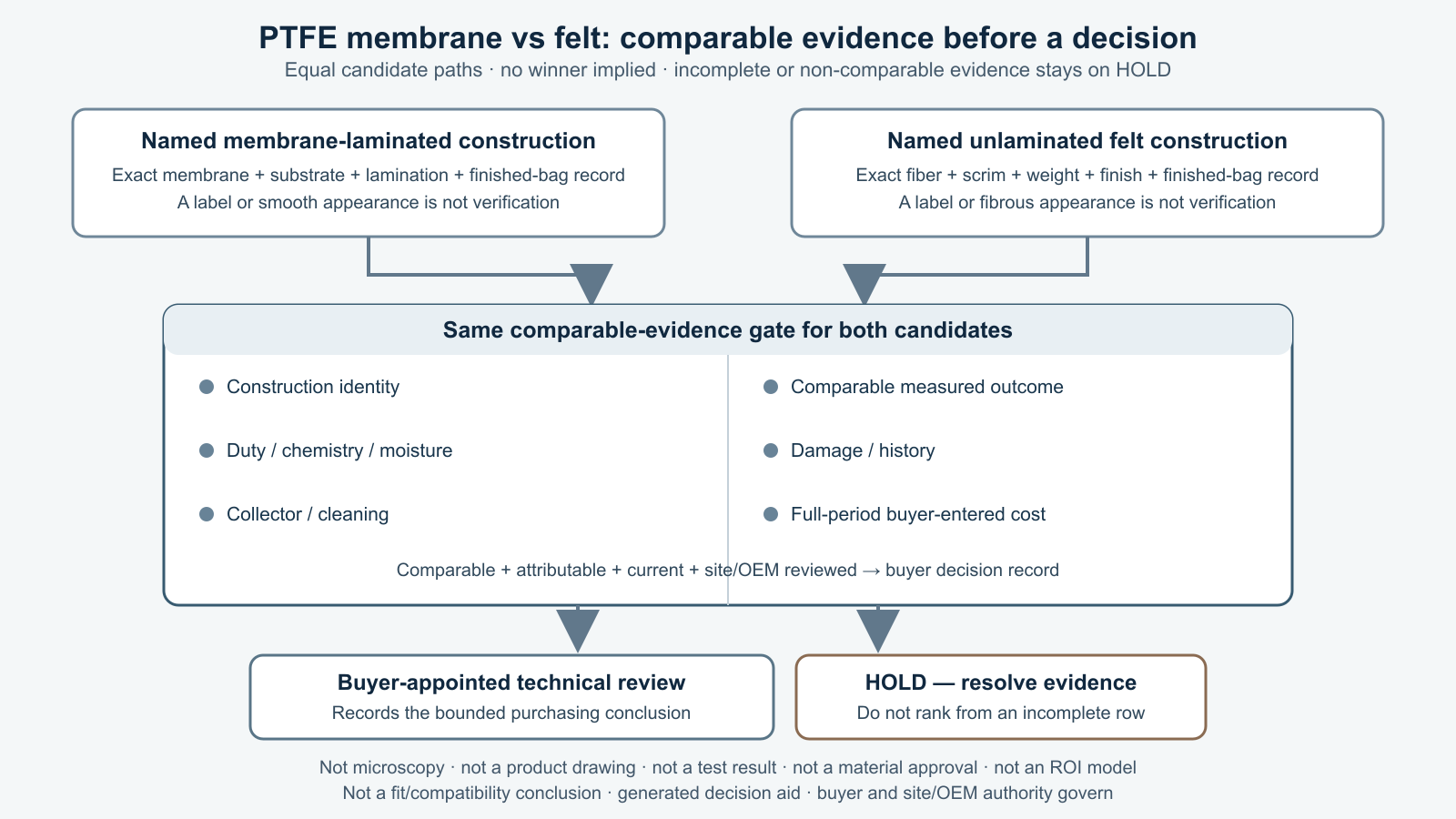
Equal-path evidence gate and blank buyer worksheet
The diagram gives the named membrane-laminated construction and named unlaminated felt construction equal prominence. Both feed the same evidence gate; neither receives a performance arrow or winner state. Use the blank worksheet for buyer-controlled inputs. It contains no FilterBagWorks test, result, savings claim, ROI, payback, or candidate ranking. Unresolved material categories remain HOLD.
Scroll table horizontally
| Buyer-controlled field | Named membrane-laminated construction | Named unlaminated felt construction | Comparable source / method / period | Status or HOLD reason |
|---|---|---|---|---|
| Buyer-selected comparison period | ____________ | ____________ | ____________ | ____________ |
| Purchase and delivery cost | ____________ | ____________ | ____________ | ____________ |
| Changeout labor and downtime | ____________ | ____________ | ____________ | ____________ |
| Attributable energy difference | ____________ | ____________ | ____________ | ____________ |
| Service-life and changeout history | ____________ | ____________ | ____________ | ____________ |
| Disposal and cleanup | ____________ | ____________ | ____________ | ____________ |
| Documented emissions or quality-event cost | ____________ | ____________ | ____________ | ____________ |
| Result | HOLD unless all material evidence is comparable | HOLD unless all material evidence is comparable | Buyer-appointed review | No ranking from a partial record |
On narrow screens, scroll horizontally to inspect the full-size diagram.
Stop conditions before calling one option an upgrade
- One candidate is identified only as PTFE, membrane, premium, standard felt, polyester, equivalent, smooth, fibrous, or higher efficiency.
- The membrane, substrate, lamination, membrane side, fiber, scrim, weight, finish, seam, or finished-bag revision is missing.
- Manufacturer performance statements are generalized beyond the named product, method, dust, conditioning, construction, or application.
- Efficiency, emissions, differential pressure, cleaning, life, energy, or cost records use different collectors, duty, methods, periods, or populations.
- A surface photograph, magnifier view, or texture is presented as microscopy, membrane verification, pore size, fiber identification, or lamination evidence.
- Observed damage is treated as membrane failure or felt failure without position, population, history, construction, support, process, and cause evidence.
- Installation or cleaning instructions for one named product are transferred to another construction or collector.
- Unknown, non-comparable, excluded, or causally unresolved cost categories are entered as zero or omitted from a claimed result.
- A partial subtotal, supplier estimate, higher price, lower price, or membrane label is presented as ROI, payback, savings, or a purchasing conclusion.
- Someone proposes energized access, test pulsing, uncontrolled dust sampling, hot handling, chemical contact, or settings changes to fill an evidence gap.
Quote-ready membrane-versus-felt evidence package
Submit the defined construction and duty evidence after the buyer-appointed authority marks assumptions, conflicts, non-comparable records, and HOLD items. The package supports a filter inquiry; it does not transfer selection, testing, safety, compliance, or acceptance authority.
- Exact media, fiber, scrim, weight, finish, and membrane identity for both finished candidates, with supplier, grade, part, drawing, revision, declaration, and approved substitution history.
- Membrane side, lamination, and substrate for the membrane candidate; fiber layers, scrim, forming, and surface treatment for the unlaminated felt candidate.
- Dust size, shape, loading, and stickiness, plus composition source, variation, abrasiveness, liquid association, cake behavior, representative-sample limits, and process changes.
- Gas temperature, moisture, dew point, chemistry, and oxygen across normal, startup, shutdown, peak, upset, washdown, steam, ingress, and seasonal states.
- Collector geometry, support, cleaning method, and settings history, including filter dimensions, tube sheet, cages, seals, airflow direction, inlet distribution, installed quantity, and revisions.
- Installation, storage, packaging, and handling record with date, installer, protected staging, cage evidence, exceptions, and the exact governing document.
- Differential-pressure and emissions records with airflow, production, dust loading, conditioning, cleaning, instruments, methods, locations, periods, and excluded events.
- Failure, damage, service-life, and changeout history with traceable populations, locations, process exposure, cause status, and still-running filters clearly identified.
- Disposal and cleanup, labor, downtime, attributable energy, event-cost, purchase, freight, quantity, comparison period, source, owner, and HOLD status.
- Buyer-defined filtration, exposure, product-quality, and economic boundaries, plus site/OEM review, hazard owner, acceptance method, decision owner, and exact unresolved question.
Product path
- PTFE Membrane Filter BagsUse the commercial membrane product path only after the exact construction, duty, test basis, fit, and review boundary are defined.
- Filter MediaConnect the comparison to documented fiber, scrim, weight, finish, membrane, treatment, and application evidence.
- Dust Collector Filter BagsConnect media evidence to finished-bag dimensions, ends, seams, seals, cage relationship, cleaning method, and quantity.
- Request a Filter QuoteSubmit the buyer-released evidence package, quantity, and exact unresolved purchasing question.
Frequently asked questions
Does a PTFE membrane label prove better performance?
No. It does not identify the membrane, substrate, lamination, finished construction, test basis, collector duty, or site result. Compare exact candidates using the same documented dust, gas, collector, cleaning, measurement, population, and period boundaries.
Is standard felt one consistent construction?
No. The label can hide different fibers, blends, scrims, weights, needling, surface finishes, treatments, seams, threads, end constructions, manufacturing revisions, and suppliers. Record the finished construction before comparing it.
Can surface texture confirm that a bag has ePTFE membrane?
No. Surface appearance cannot verify ePTFE, a membrane, fiber, scrim, weight, finish, lamination quality, pore structure, or duty limit. Use traceable declarations, drawings, part records, and an appropriate buyer-controlled verification method.
What evidence makes filtration or pressure results comparable?
Align the exact finished construction, test or monitoring method, dust, conditioning, face velocity or airflow, loading state, cleaning sequence, measurement location, instrument, process state, reporting basis, and time period. Unlike evidence remains non-comparable.
Does visible delamination or damage prove the membrane caused a failure?
No. Preserve position, population, unused and apparently unaffected comparisons, construction, support, installation, handling, cleaning, process, temperature, moisture, chemistry, and event history. Appearance is an observation, not a root-cause conclusion.
How should service life be compared?
Use traceable cohorts under comparable collector and duty boundaries, record every installed and removed unit, removal reason, cause status, changes, and filters still in service. Do not select only favorable runs or convert supplier estimates into observed life.
When is the membrane upgrade worth it?
Only when the buyer-appointed authority has comparable, attributable, site/OEM-reviewed evidence showing that the named candidate meets the defined technical and full-period economic boundary. Until then, upgrade remains a purchasing hypothesis and the result stays on HOLD.
Can a partial cost subtotal establish ROI or payback?
No. Purchase, labor, downtime, attributable energy, life and changeouts, disposal and cleanup, and attributable event costs must share a defined buyer period. Unknown, excluded, non-comparable, or unresolved material categories remain HOLD; no partial subtotal ranks candidates.
Sources
- OSHA — Control of Hazardous Energy (Lockout/Tagout)
- US EPA — Monitoring by Control Technique: Fabric Filters
- Donaldson — Tetratex Membrane Brochure
- GORE Membrane Technology vs. Non-Membrane Media: Industrial Baghouse Filters
- BWF Envirotec — Filter Media for Industrial Filters
- Parker — BHA Preveil ePTFE Membrane Fabric Filter Installation Procedures
- US EPA Air Pollution Control Cost Manual, Section 6, Chapter 1 — Baghouses and Filters
- US Department of Energy — Improving Fan System Performance: A Sourcebook for Industry
Submit a defined filter inquiry
Send both traceable finished-construction records, collector and filter drawings, dust and full gas-duty evidence, support and cleaning history, installation and handling records, comparable measured outcomes, damage and service populations, buyer-entered full-period cost fields, quantity, current supplier declarations, assumptions, exceptions, and HOLD items. State the exact purchasing question and buyer-appointed decision owner. The buyer retains material selection, engineering, testing, safety, compliance, acceptance, ROI, compatibility, and return-to-service decisions.
Request a quote