Maintenance evidence guide
For maintenance, reliability, engineering, EHS, procurement, and distributor teams
Buyer-appointed technical review required
Why Dust Collector Filters Fail Early
Preserve the as-found condition, map every observation to a location, and test competing hypotheses against operating, process, material, and installation evidence before anyone changes a filter specification.
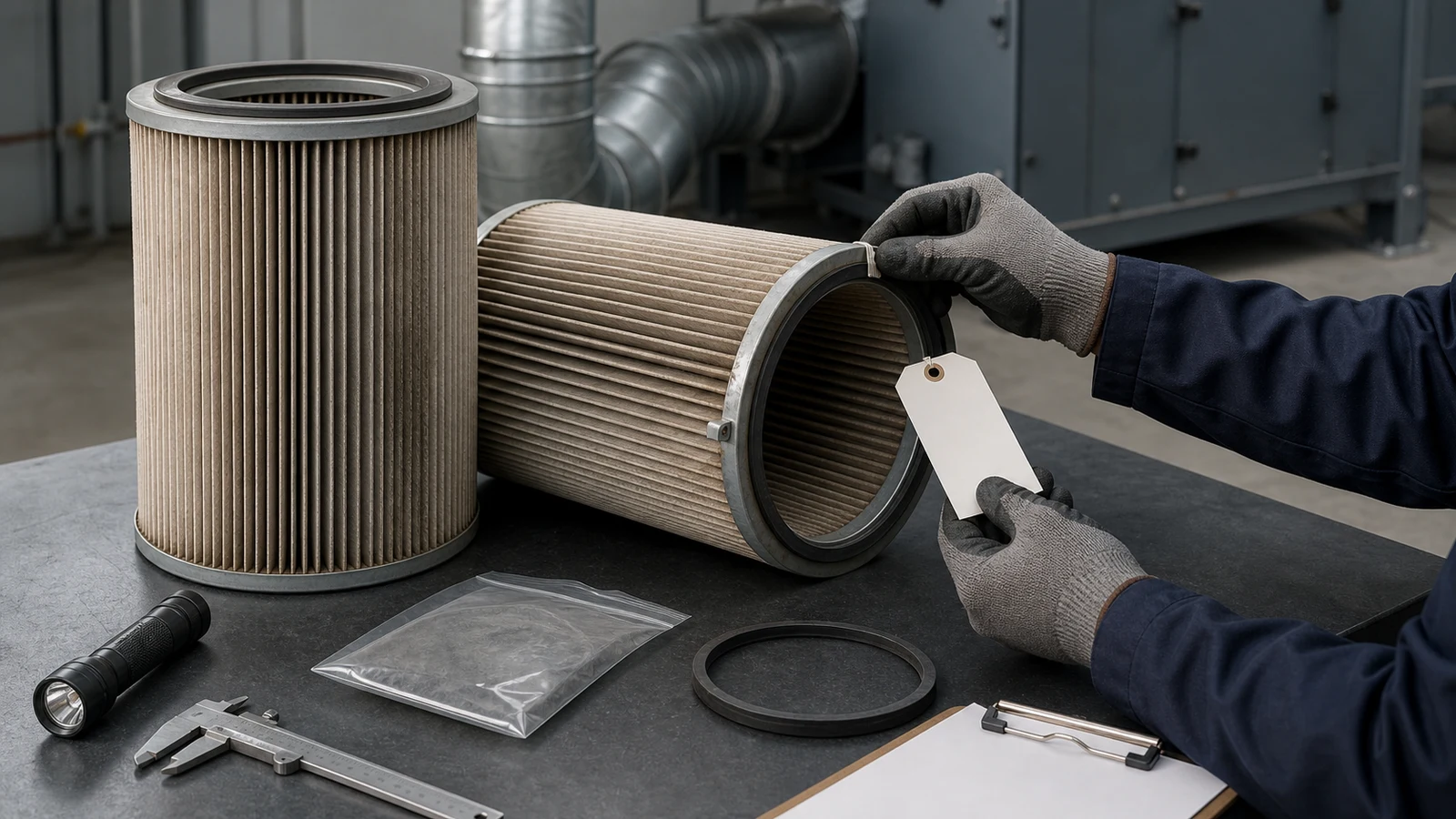
Direct answer
Early filter failure is not a diagnosis that can be read from one tear, color change, brittle area, sticky cake, or pressure trend. Preserve representative filters in their as-found condition, map observations to exact locations, and compare them with process, temperature, moisture, chemistry, airflow, cleaning, fit, and installation records. Appearance alone does not confirm a cause. Missing, conflicting, unrepresentative, unsafe, or non-comparable evidence stays on HOLD.
Scope
This guide covers dry industrial dust collector filter bags and cartridges that appear damaged, lose function, or require unexpectedly early attention. It is an evidence taxonomy, not a remote root-cause diagnosis, filter-life prediction, warranty decision, safety procedure, media recommendation, or corrective-action instruction. EPA identifies temperature, pressure differential, exhaust flow, cleaning operation, fan current, and outlet performance as separate fabric-filter indicators. [1] BWF Envirotec states that its laboratory analyzes fibres, textiles, assembled filter media, and used filter media and lists chemical-physical, mechanical-technological, microscopic, and procedural methods. That page documents BWF’s laboratory-service scope; it does not define this guide’s sampling workflow or establish a result for any buyer’s filters. [8] This page publishes no universal temperature, pressure, pulse, differential-pressure, airflow, or air-to-cloth value and no universal service-life, changeout, inspection, or acceptance value. No remote cause ranking is provided. The exact collector, filter, process, hazard, and site documents govern.
Build an early-failure evidence record
Start with a location-tagged observation and preserve the competing explanations. For each hypothesis below, attach evidence that could support it and evidence that could contradict it. A repeated pattern can guide the next qualified examination, but it does not make the conclusion. Specification changes require complete duty evidence and buyer-appointed, OEM, or material-authority review.
1. Preserve the as-found condition and chain of context
Before cleaning, cutting, brushing, discarding, or combining parts, retain representative filters and any relevant comparison sample as the site program permits. Assign each sample a collector, compartment, row or position, orientation, removal date, work order, part identity, and handler. Photograph the dirty side, clean side, seal or cuff, seam, end construction, cage or support contact, and surrounding hardware without implying a finding. Record which samples were selected and why; one dramatic part may not represent the population. This representative-sample and traceability workflow is buyer-owned. BWF states only that its laboratory analyzes used filter media and lists several laboratory methods; BWF does not define this page’s sampling plan, selection basis, chain of context, or conclusion. [8] Any destructive examination, microscopy, strength or other material test, chemistry work, or interpretation belongs to a qualified buyer-appointed, OEM, or material authority. If traceability is lost, mark the sample unrepresentative and HOLD.
2. Abrasion and wear hypothesis
Treat holes, scuffing, thinning, polished areas, frayed fibers, distorted pleats, or repeated contact marks as observations. Map their height, side, orientation, and relationship to inlet paths, baffles, cages, supports, adjacent filters, tube-sheet edges, and hardware. Compare dust particle characteristics, inlet distribution, airflow history, filter movement, clearances, tension or support, and prior location-specific failures. EPA’s fabric-filter O&M manual discusses abrasion in relation to installation, bag contact, inlet conditions, and dust loading, but those relationships do not prove the cause of a particular mark. [2] A tear alone does not prove abrasion, and abrasion-like damage does not identify which contact, particle, geometry, or operating condition was responsible. Resolve the location pattern and physical configuration before escalating the hypothesis.
3. Temperature and thermal-exposure hypothesis
Record discoloration, glazing, shrinkage, distortion, hardening, loss of flexibility, damaged finishes, or altered seams only as visual or tactile observations made under the authorized inspection plan. Assemble time-aligned inlet and outlet temperature history, process events, startup and shutdown history, upset and alarm records, sensor locations, instrument status, collector configuration, and the exact media and component documentation revision. EPA notes that fabric filters can be damaged by high temperatures and that temperature is a monitoring indicator. [1] The governing boundary is the exact media construction, finish, seam, seal, support, exposure chemistry, duration, and supplier documentation—not a generic table. Discoloration does not prove overheating, and the absence of obvious discoloration does not clear thermal exposure. Keep the conclusion on HOLD until a qualified authority reconciles material evidence with the operating record.
4. Moisture, condensation, and hydrolysis hypothesis
Document sticky or hardened cake, caking patterns, corrosion, damp areas, odor, softened or weakened material, powdering, or loss of toughness without naming the mechanism. Compare process moisture, ambient conditions, startup and shutdown history, temperatures and sensor locations, dew-point or condensation analysis, compressed-air quality, insulation and leakage history, chemistry, storage exposure, and exact media identity. EPA states that condensation can contribute to blinding and can accompany acid-gas concerns. [1] Lydall’s polyester page identifies hydrolysis susceptibility for that named polyester product family and warns that actual results depend on use; it is not a universal media rule. [7] Sticky cake does not prove moisture, and weakness does not prove hydrolysis. Chemistry and material testing, if needed, belongs to a qualified authority using traceable samples.
5. Chemical-compatibility hypothesis
Capture changes in process feed, fuels, additives, cleaning agents, contaminants, gas composition, dust chemistry, temperature, moisture, and upset events over the same period as the observation. Record swelling, embrittlement, softening, color change, finish loss, seam or seal change, and corrosion as observations only. Separate the fiber, scrim, membrane, coating, finish, thread, adhesive, gasket, cage coating, and hardware because they may not share the same compatibility envelope. Donaldson lists process chemical imbalance among operational upset categories that may damage filters, while also advising that underlying questions remain after damage is found. [4] Brittleness does not prove chemical attack, and a generic material-family label does not establish compatibility. Compare the exact formulation and exposure record with current manufacturer documentation or qualified material analysis; unresolved identity or chemistry remains HOLD.
6. Dust-cake and blinding hypothesis
Separate a surface observation from measured resistance and from a confirmed material mechanism. Preserve representative cake and dust samples when the site program permits, and map cake thickness, texture, distribution, clean-side deposits, pleat bridging, embedded material, and compartment pattern. Attach synchronized differential-pressure, airflow, fan, damper, cleaning, process rate, material, temperature, moisture, hopper, and discharge history. EPA describes dust cake as part of fabric filtration and lists several performance indicators; it does not make one cake appearance diagnostic. [1] Sticky cake does not prove moisture, a heavy cake does not prove a cleaning failure, and a pressure trend alone does not prove blinded media. Preserve the record before any cleaning or disposal alters it.
7. Cleaning-system energy and geometry hypothesis
Build an evidence chain from the controller command to the energy that actually reaches the filter. Depending on the exact collector, that may include controller configuration and event history, demand input, compressed-air quality and supply, manifold state, valves, diaphragms, solenoids, blowpipes or nozzles, alignment, venturis, supports, and the filter response. Map any damage pattern to rows or pulse positions and compare it with cleaning-event timing. Donaldson states that compressed-air requirements come from the collector manual and that supply above the manufacturer’s recommendation can damage a collector or filter. [5] This guide supplies no pressure, duration, frequency, sequence, or adjustment. A controller command does not prove delivered cleaning energy, and a localized mark does not prove pulse damage. Do not force pulses or change settings to test the hypothesis.
8. Seam, seal, and fit hypothesis
Inspect only under the site’s authorized safe-work process. Map seam opening, stitch or weld condition, cuff or gasket seating, snap-band shape, end-cap condition, support and cage contact, fasteners, tube-sheet openings, orientation, compression evidence, and clean-side dust location. Reconcile nominal part numbers with approved drawings, dimensions, revisions, quantity, hardware, and collector positions. Donaldson’s leak guide lists seating, snap bands, cartridge orientation, attachment hardware, and tube-sheet condition as separate inspection questions. [4] A gap or dust trail may identify where further review is needed, but it does not by itself establish whether the origin was manufacture, installation, geometry, movement, wear, or another system condition. Do not prescribe dimensions, compression, hardware torque, or a replacement construction without exact governing documents and complete duty evidence.
9. Handling, storage, and installation hypothesis
Reconstruct the path from receipt to startup: packaging condition, storage environment, inventory rotation, transfer, unpacking, lifting, temporary placement, tools, cleanliness, orientation, seating, tightening, exceptions, inspection, and signoff. Compare unused spares from the same traceable lot when available, but do not assume a spare experienced the same storage or handling. Camfil’s Farr Gold Series manual instructs users of that named equipment to keep filters protected in a controlled environment and inspect for the correct model, type, size, and damage before installation. [6] Apply those statements only to the named manual and current revision. A crease, cut, distorted gasket, or crushed pleat does not prove when or how it occurred. Missing receipt, storage, or installation records route this branch to HOLD.
10. Compare the pattern across locations, time, and populations
Create a location and compartment map for failed, suspect, and apparently unaffected filters. Add installation dates, part and revision, lot or shipment identity when available, maintenance events, operating exposure, and the first observed symptom. Compare like-for-like populations only. A concentration near an inlet, pulse row, support, door, seam orientation, or one installation event may prioritize evidence collection, but it is not a remote cause ranking. OSHA’s grain-handling appendix emphasizes manufacturer-based targets and records of inspection date, equipment, and maintenance for covered filter collectors. [3] Use the principle of traceable records without importing a grain-specific requirement into another process. If locations, revisions, duties, or dates cannot be compared, label the set non-comparable. Do not average unlike filters into a persuasive but invalid failure rate.
11. Qualify the conclusion or HOLD
A qualified conclusion should name the observation, representative sample set, location pattern, applicable documents, operating and process history, evidence that supports the mechanism, evidence that contradicts it, unresolved alternatives, analysis method, responsible authority, and limits of the conclusion. Visual evidence may help select the next examination, but appearance alone does not confirm a cause. No remote cause ranking belongs in the inquiry. When the evidence is missing, conflicting, unrepresentative, unsafe to obtain, or non-comparable, route the case to HOLD — resolve evidence. Specification changes require complete duty evidence plus buyer-appointed, OEM, or material-authority review. Do not alter media, treatments, dimensions, seams, seals, cages, cleaning settings, airflow, or process controls from this page. Record the exact question and evidence owner so the next review is defined rather than open-ended.
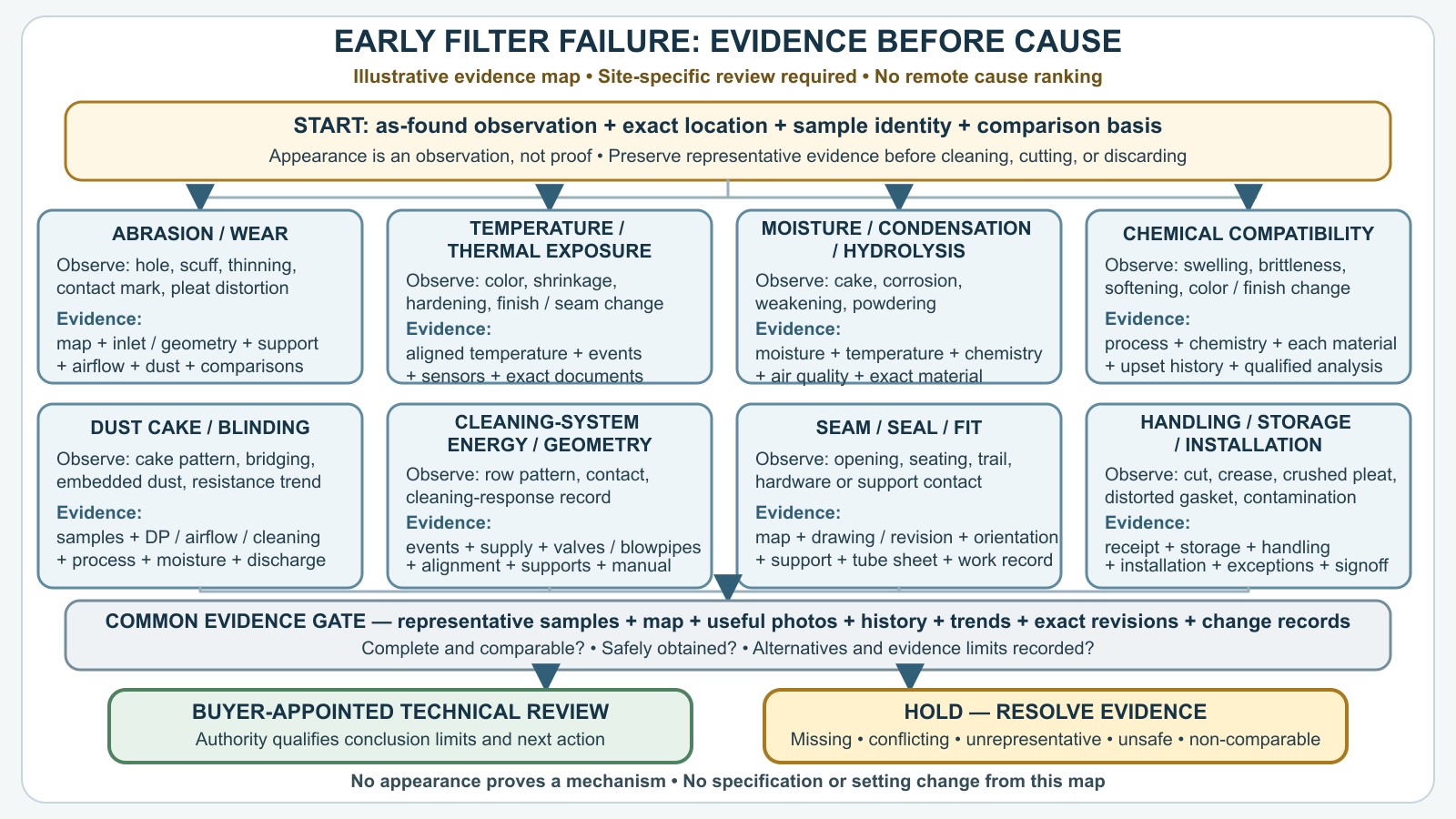
Early-filter-failure evidence map
Start with the observation and exact location, then route it to all plausible evidence families rather than picking one cause. Every family names the records or samples needed for escalation. A complete, comparable package goes to the buyer-appointed authority; missing, conflicting, unrepresentative, unsafe, or non-comparable evidence goes to HOLD — resolve evidence.
Scroll table horizontally
| Evidence family | Observation stays neutral | Evidence required before escalation |
|---|---|---|
| Abrasion / wear | Hole, scuff, thinning, contact mark, distorted pleat | Location map, inlet and geometry context, supports, airflow history, dust properties, comparison samples |
| Temperature / thermal exposure | Color, shrinkage, hardening, finish or seam change | Time-aligned temperature and event history, sensor context, exact media and component documents |
| Moisture / condensation / hydrolysis | Sticky cake, corrosion, weakening, powdering | Moisture, dew-point or condensation, temperature, chemistry, compressed-air, material and storage evidence |
| Chemical compatibility | Swelling, brittleness, softening, color or finish change | Process chemistry and upset history, exact fiber, finish, thread, seal and hardware identity, qualified analysis |
| Dust cake / blinding | Cake distribution, bridging, embedded dust, resistance observation | Representative cake and dust, synchronized DP, airflow, cleaning, process, moisture and discharge history |
| Cleaning-system energy / geometry | Row pattern, contact mark, cleaning-response observation | Controller events, supply quality, manifold, valves, blowpipes, alignment, supports and exact manual |
| Seam / seal / fit | Opening, seating, dust trail, hardware or contact observation | Position map, drawings, dimensions, revision, orientation, support, tube-sheet, hardware and work record |
| Handling / storage / installation | Cut, crease, crushed pleat, distorted gasket, contamination | Receipt, packaging, storage, transfer, unpacking, installation, exception and signoff records |
On narrow screens, scroll horizontally to inspect the full-size diagram.
Stop conditions before a failure conclusion
Pause the investigation when evidence handling, access, comparison, or authority is not controlled.
- A filter is cleaned, cut, brushed, discarded, or mixed with other samples before its as-found condition and position are recorded.
- One unusually damaged filter is treated as representative without a documented sampling basis or comparison population.
- A tear is declared abrasion, discoloration is declared overheating, brittleness is declared chemical attack, or sticky cake is declared moisture from appearance alone.
- Someone proposes entering or opening energized equipment, bypassing interlocks, forcing pulses, altering controls, or handling hazardous dust outside the site program to obtain evidence.
- Temperature, chemistry, hydrolysis, cleaning, fit, storage, or installation statements are copied from a different material, product, collector, or manual revision.
- The location map, part identity, drawing, revision, change record, operating state, process history, or time alignment is missing or conflicting.
- A universal limit, interval, service-life expectation, changeout rule, or acceptance value replaces the exact collector, filter, process, and site documentation.
- Several variables are changed at once, removing the comparison needed to evaluate the event.
- A laboratory method or result is implied without a traceable sample, qualified laboratory, method, comparison, and signed interpretation.
- A filter inquiry is treated as approval of root cause, compatibility, warranty, corrective action, or return to service.
Quote-ready early-failure evidence package
Use the active new-filter differential-pressure guide to organize synchronized system evidence and the condition-based replacement guide to keep service decisions evidence-led. Submit the defined inquiry through the RFQ path for filter identity, construction, quantity, and purchasing questions. The buyer retains failure analysis, safety, operating, compatibility, laboratory, acceptance, and corrective-action authority.
- Retained representative samples, including traceable apparently unaffected or unused comparison material when available and appropriate.
- Location and compartment map with collector, row or position, orientation, installation date, removal date, sample selection basis, and observed pattern.
- Photos from useful surfaces: dirty side, clean side, seal or cuff, seam, end construction, support contact, adjacent hardware, and surrounding collector context.
- Operating and process history aligned to the event, including startup, shutdown, upset, material, recipe, loading, fan, damper, compartment, hopper, and discharge state.
- Temperature, moisture, and chemistry evidence with sensor identity and location, instrument status, ambient context, compressed-air quality, and process composition changes.
- Differential-pressure, airflow, and cleaning trends on a synchronized time basis, plus controller, manifold, valve, blowpipe, support, and authorized maintenance evidence.
- Part, drawing, and revision for the filter, media, treatment, seam, seal, end construction, cage or support, hardware, collector, and approved substitutions.
- Installation and change records covering receipt, packaging, storage, handling, unpacking, orientation, seating, hardware, exceptions, inspection, and signoff.
- Named buyer-appointed authority, evidence owners, unresolved alternatives, safe evidence plan, requested quantity, and the exact filter question requiring clarification.
Product path
- Replacement Dust Collector FiltersRoute an identified replacement requirement through the existing commercial replacement path.
- Dust Collector Filter BagsOrganize bag geometry, top and bottom construction, media, finish, seam, and cage relationship for a defined inquiry.
- Dust Collector Cartridge FiltersOrganize cartridge dimensions, end caps, gaskets, media, pleat condition, hardware, and collector fit.
- Request a Filter QuoteSubmit traceable part, construction, quantity, and purchasing questions after the buyer-owned evidence review.
Frequently asked questions
Can a tear or hole identify why a filter failed?
No. Record the shape, location, orientation, surrounding geometry, support contact, inlet path, dust, operating history, and comparison population. A tear can route the review toward mechanical evidence, but it does not prove abrasion or identify the responsible mechanism. [2] [4]
Does discoloration confirm that a filter overheated?
No. Compare the exact media, finish, seam, seal, and support documents with time-aligned temperature, sensor, process, startup, shutdown, and upset records. BWF lists chemical-physical and microscopic methods within its own laboratory-service scope; that does not diagnose this case. Appearance alone does not confirm thermal exposure. [1] [8]
Can sticky or hardened dust cake prove a moisture problem?
No. Preserve representative cake and filter samples, then compare temperature, condensation or dew-point evidence, process moisture, chemistry, compressed-air quality, cleaning, airflow, hopper, and discharge history. Keep moisture, chemistry, and cleaning hypotheses separate. [1] [2]
How should hydrolysis be evaluated?
First confirm the exact fiber, scrim, finish, thread, exposure chemistry, moisture, temperature history, and product documentation. Hydrolysis susceptibility is material- and condition-specific. BWF lists fibre and chemical-structure analysis within its own laboratory-service scope; it does not establish a mechanism for this case. [7] [8]
Can cleaning settings be changed to test whether pulsing caused damage?
Not from this guide. Preserve controller and event records, compressed-air quality, manifold, valve, blowpipe, alignment, support, and row-pattern evidence. Use the exact collector manual and authorized technical process; do not force pulses or change controls to create a test. [5]
Which filters should be retained for review?
Use a documented, buyer-owned sampling plan that preserves representative suspect filters, their exact locations, and appropriate apparently unaffected or unused comparisons when available. BWF states that used filter media are analyzed, making traceable sampling important, while BWF does not define this page's sampling plan. Do not select only the most dramatic part or mix samples with different identities, duties, or histories. [8]
What should be submitted with a replacement filter inquiry?
Send collector and filter identity, drawings or dimensions, media and construction, quantity, location map, photos, representative sample traceability, operating and process context, cleaning and DP trends, change records, and unresolved fit or specification questions. The buyer retains root-cause and corrective-action authority.
Sources
- US EPA: Monitoring by Control Technique — Fabric Filters
- US EPA: Operation and Maintenance Manual for Fabric Filters
- OSHA: Grain Handling Facilities — Appendix A to 1910.272
- Donaldson: Troubleshooting for Leaking Dust Collectors
- Donaldson: Managing Compressed Air for Industrial Dust Collectors
- Camfil APC: Farr Gold Series Installation, Operation and Maintenance Manual
- Lydall Industrial Filtration: Polyester Standard Felt
- BWF Envirotec: Top quality through Laboratory Analysis
Submit a defined filter inquiry
Send the collector and filter identity, approved drawing or dimensions, media and construction, quantity, location map, representative photos, sample traceability, operating and process context, change records, and unresolved fit or specification questions. Submit the defined inquiry through the RFQ path only after the buyer-appointed authority has separated observations, hypotheses, evidence gaps, and decisions.
Request a quote