Replacement filter buying guide
For MRO buyers, maintenance teams, and distributor sourcing teams
Reviewed by FilterBagWorks Technical Team
How to Identify a Replacement Dust Collector Filter Without an OEM Part Number
Turn an unknown bag, cartridge, or pleated element into a documented replacement inquiry without treating appearance, a partial part number, or a single dimension as proof of fit.
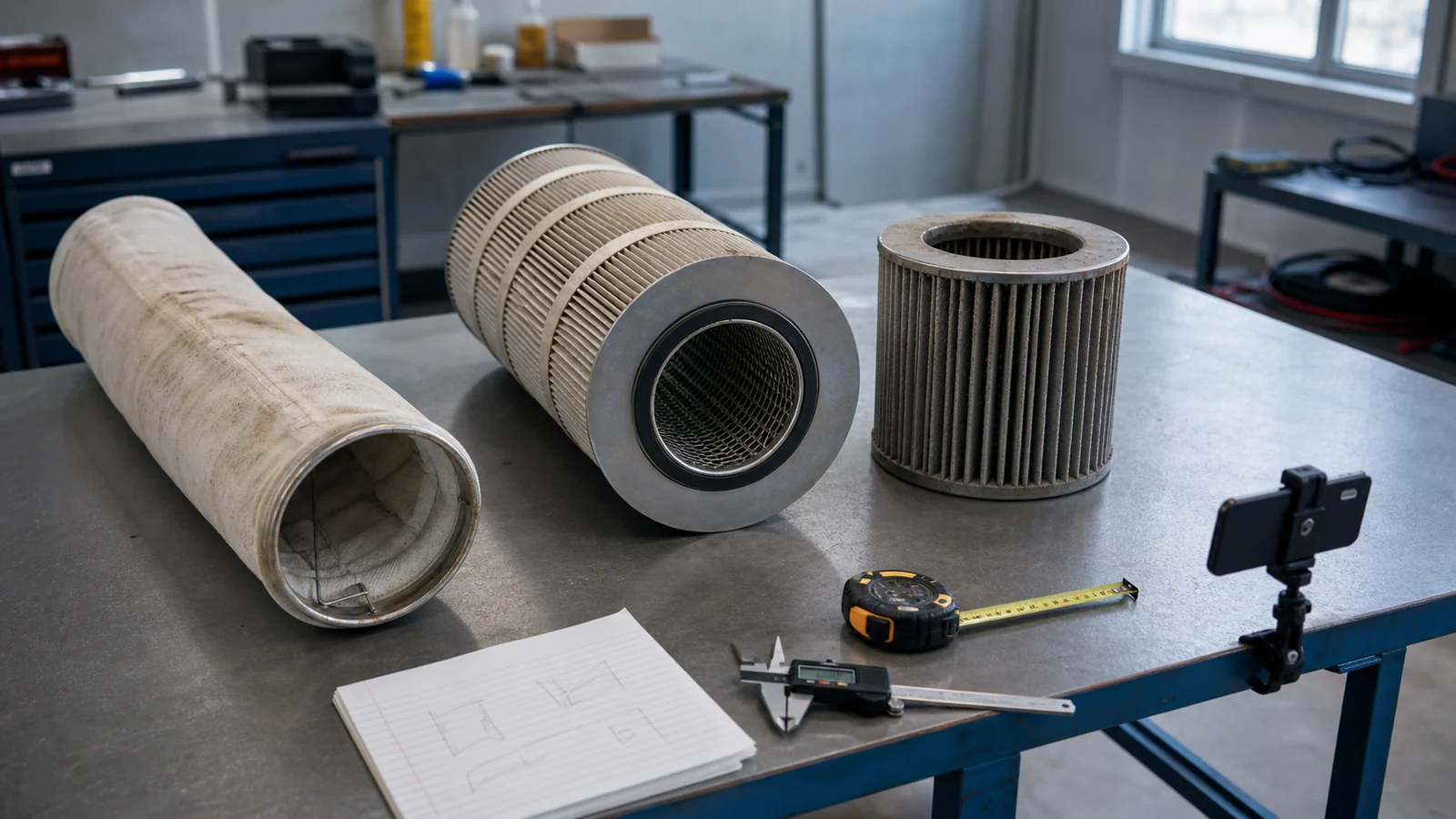
Direct answer
Do not identify replacement dust collector filters by appearance or an incomplete part number alone. First decide whether the component is a fabric bag, cartridge, or rigid pleated element. Then record family-specific dimensions, top and bottom or end-cap construction, gasket details, full and close-up photos, collector information, and operating conditions. Treat the result as a review package, not confirmation of fit, until the evidence is checked.
Scope
Use this guide when an installed filter, removed element, label, partial number, equipment record, or set of field photos is available but the exact replacement specification is not. It is an evidence-gathering workflow for industrial dust collectors, not a universal measuring standard. It does not establish media suitability, safe handling, emissions performance, combustible-dust controls, or cross-brand compatibility. The collector manual, employer procedures, process-hazard information, and project-specific technical review still control those decisions.
Replacement filter identification workflow
Work in the order below. Each step narrows the question while keeping measured facts separate from copied records, visual impressions, and unknowns. If two pieces of evidence disagree, keep both in the file and flag the conflict instead of choosing the value that seems more convenient.
Why OEM part numbers disappear or become unusable
A maintenance team may inherit a collector with no current bill of materials, an unreadable label, a distributor number that does not map cleanly to the original manufacturer, or a handwritten stock code that identifies only a purchasing record. Even a legible number can be incomplete: a family code may omit media, finish, gasket, grounding feature, top or bottom construction, revision, or length. Equipment may also have been modified, so a historical number can describe the original installation rather than the component now in the housing. Record every number exactly as found, including punctuation, prefixes, suffixes, where it appeared, and whether it came from the element, packaging, invoice, or maintenance record. Do not promote it to a confirmed specification without corroborating physical evidence.
Identify bag, cartridge, or pleated element first
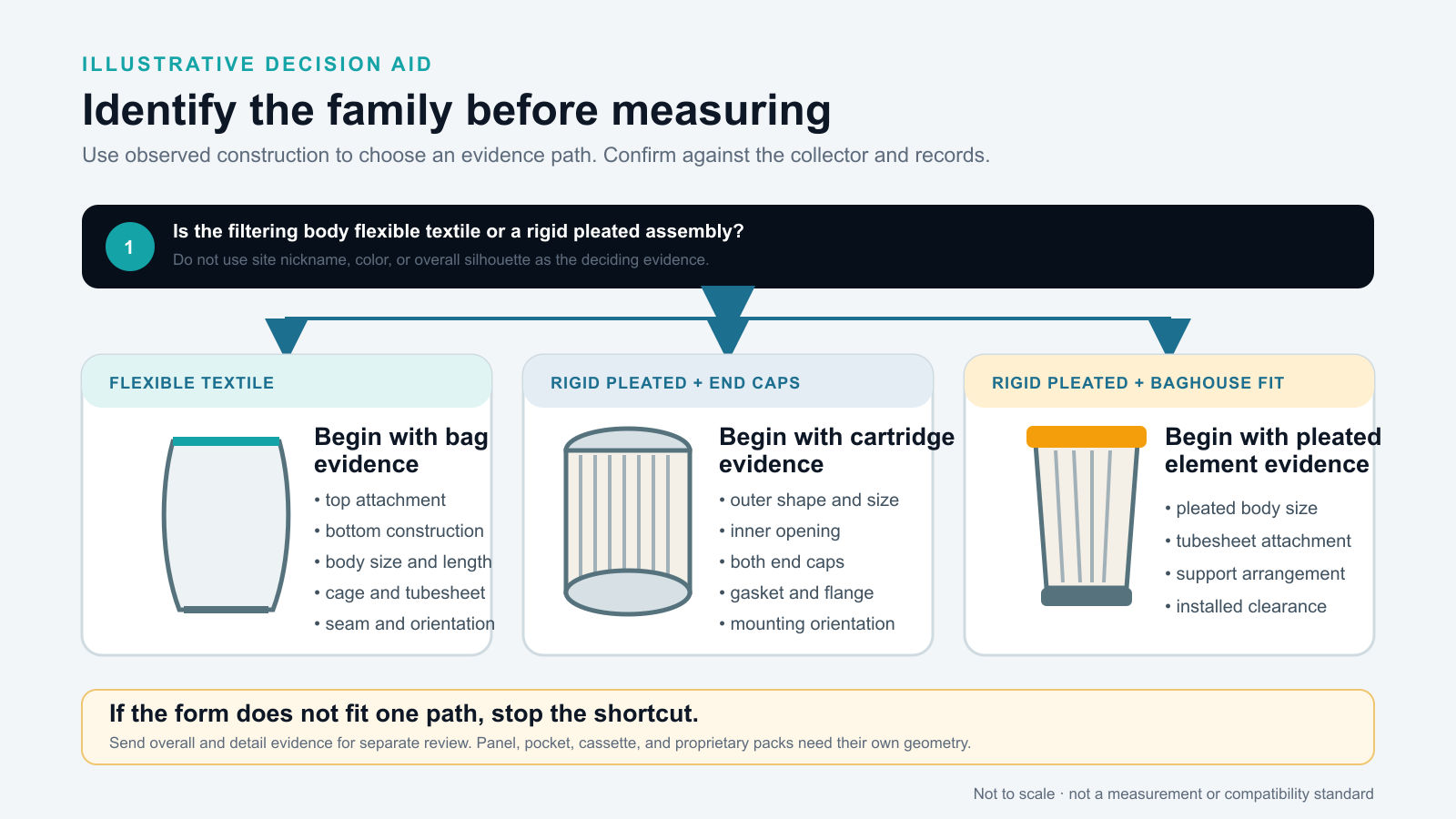
Start with construction, not the product name used at the site. A fabric filter bag is flexible and may rely on a cage, rings, or another support. A dust-collector cartridge is a self-supporting pleated assembly with end caps and one or more sealing features. A pleated baghouse element is also rigid and pleated, but its attachment and intended collector position may follow a baghouse-style tubesheet arrangement. Manufacturer literature distinguishes these families, while EPA guidance also notes that fabric filters may be configured as cartridges or bags. [1] [2] Use those definitions as orientation only; the installed geometry and collector documentation decide what must be verified.
- Flexible textile body with a sewn seam: begin in the bag path and identify its support and attachment.
- Pleated media held between rigid end caps: begin in the cartridge path and document every open, closed, or gasketed end.
- Rigid pleated element fitted where a bag and cage might otherwise be used: document it as a pleated baghouse element until its attachment is confirmed.
- Panel, envelope, pocket, cassette, or proprietary pack: stop using the three-family shortcut and send overall evidence for separate review.
Photograph the evidence a supplier needs
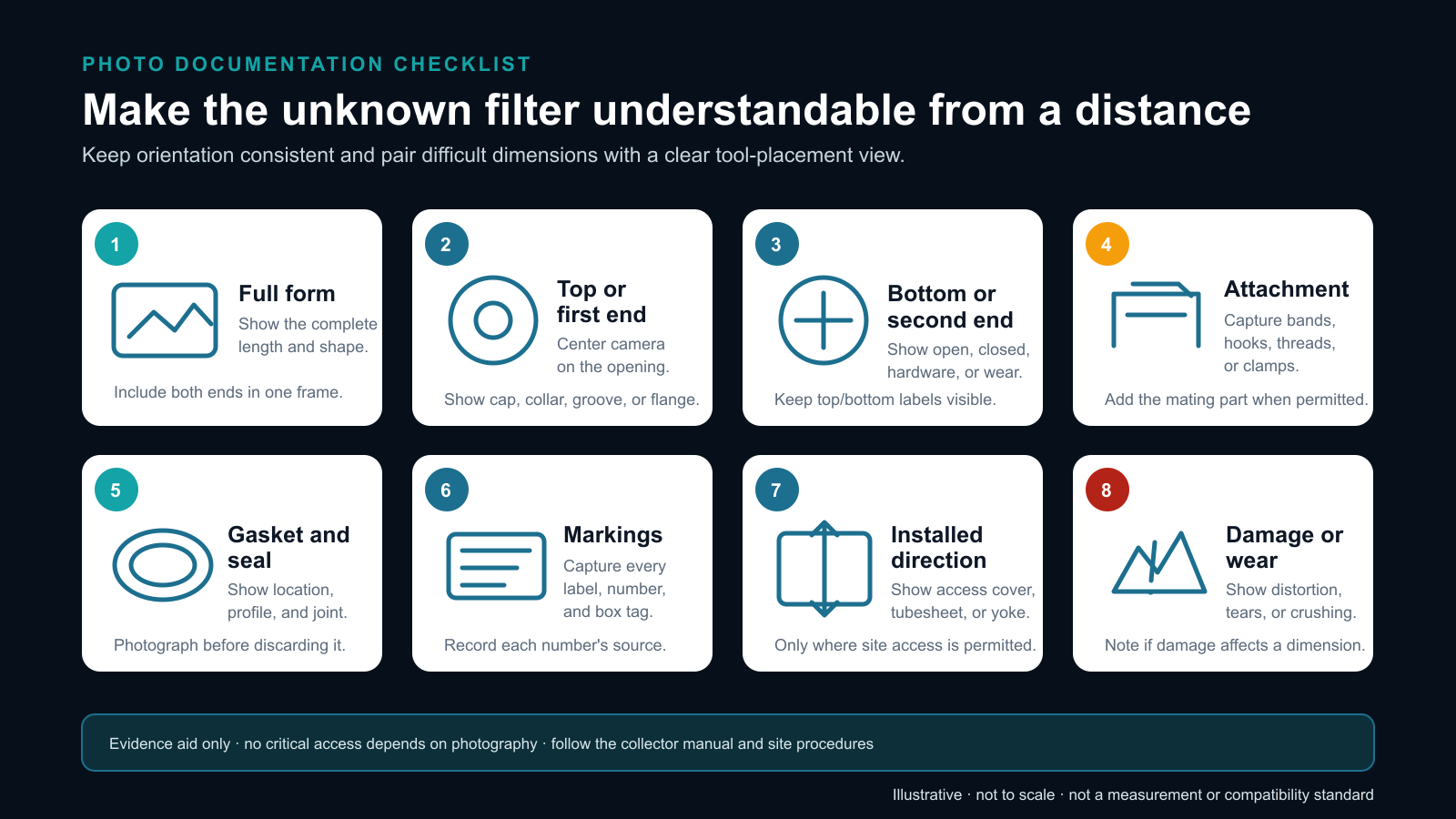
Create a sequence that lets another person understand the component without holding it. Photograph the entire filter from two sides, both ends, the attachment or sealing area, all markings, the installed orientation if safely observable, and any damage that may distort a measurement. Include a ruler or tape only when it is square to the feature and the scale is readable; keep the written value as the controlling field measurement. Before opening a collector or performing covered service, follow the collector manual, the employer’s energy-control procedure, and applicable requirements. OSHA’s hazardous-energy standard addresses unexpected startup and stored energy during covered servicing and maintenance. [3] This guide does not replace that procedure.
- Overall view: full length, full width or diameter, and recognizable ends in one frame.
- End views: camera centered on each end so openings, caps, hardware, and gasket footprints are visible.
- Detail views: top or collar, bottom, seam, band, flange, hooks, tabs, and sealing surfaces.
- Context view: installed direction, access cover, tubesheet opening, yoke, cage, or mating part when permitted.
- Evidence view: every label, marking, box label, drawing note, and failed or worn area.
Measure the critical fit points by filter family
Use one unit system consistently and state it. Measure the removed component in a relaxed, undistorted condition when practical, and say whether a textile bag was measured flat, around a cage, or across a circular opening. For bags, record overall length, body diameter or flat width, top and bottom attachment dimensions, and the cage diameter, length, ends, and joints when the cage is part of the fit. For cartridges, record overall length; outer shape and dimensions; inner opening; flange, hook, or locating geometry; gasket dimensions and location; and center-hole or closed-end features. For rigid pleated elements, record both the pleated body and baghouse-style attachment. Photograph difficult tool placement, report variation across samples, and label values as measured, copied, assumed, or unknown.
Record top, bottom, end-cap, and gasket construction
Ends often contain more identification value than the filter body. For a bag, describe the top as observed: snap band or groove, cuff, cord, ring, loop, flange, clamp area, or another construction. Describe the bottom separately, including closed shape, reinforcement, disc, loop, hardware, or wear. A Donaldson baghouse manual, for example, shows a snap-band collar seated at a tubesheet before the cage is inserted; that is evidence for documenting the collar-to-tubesheet relationship, not a universal installation instruction. [4] For cartridges, document whether each end is open or closed, the cap material and shape, gasket location and profile, flange, hooks, threads, studs, center hardware, and installed direction. Manufacturer manuals and drawings show that gasket orientation and end-cap geometry vary. [5] [6]
- Photograph the sealing surface before discarding the old gasket or cleaning away its footprint.
- Record gasket material only if documented; otherwise describe color, location, profile, and condition without guessing composition.
- Note liners, straps, conductive features, grounding tabs, support mesh, and bands as observed, without assigning a performance claim.
- Keep the installed orientation visible in the photo set so top and bottom cannot be reversed later.
Add dust, process, temperature, moisture, and cleaning details
Physical fit is only one part of a replacement review. Identify the collected dust or fume as specifically as the site can support, the process creating it, normal and upset temperature information, evidence of moisture or condensation, known chemical exposure, airflow or production changes, and the collector’s cleaning method. Include the current media and finish only when a label, drawing, prior specification, or reliable record supports them. EPA guidance identifies operating conditions, particulate characteristics, cleaning method, temperature, moisture, and chemistry as relevant to fabric-filter selection and behavior. [2] A01 does not convert those variables into a material recommendation. It gives the reviewer the context needed to ask the next project-specific questions.
- Dust or fume name, source process, and any known safety data or contamination controls.
- Normal, peak, startup, shutdown, and upset conditions when the site has documented values.
- Moisture, oil, sticky material, condensation, sparks, abrasion, or chemical exposure observed in service.
- Pulse-jet, reverse-air, shaker, or other cleaning method, plus the collector model or manual reference.
- Reason for replacement: planned changeout, damage, leakage investigation, pressure trend, process change, or stock replenishment.
When a physical sample is the safer next step
Retain a representative old filter when the label is missing, dimensions are distorted, construction is proprietary, the ends are difficult to describe, or records conflict. A sample lets a reviewer examine seams, bands, end caps, gasket footprints, support features, and material layers together when a photo cannot show a shallow groove, flexible cuff, molded detail, or worn sealing face. It is not proof of the correct replacement: the removed part may itself be incorrect, damaged, modified, contaminated, or from the wrong position. Tag its collector location, orientation, condition, and reason for removal; preserve labels; and add the normal photo and measurement package. Confirm how it may be handled, contained, cleaned, and shipped before moving it. Do not send residue or a used component when material hazards or transport requirements are unknown.
How replacement review should work without promising compatibility
A disciplined review begins by reconciling the collector record, physical family, dimensions, construction, photos, operating context, and quantity. Public replacement indexes may organize cartridges by OEM number, diameter, length, media, and end cap, which shows why a single lookup field is not enough. [7] The reviewer should return a written summary of the proposed construction and identify which fields were matched, which were interpreted, and which remain conditional. Purchasing can then compare offers against the same specification. Language such as “replacement for” or a cross-reference should be treated as a lead for verification, not a guarantee. Final approval belongs with the parties responsible for the actual collector, process, safety requirements, and purchase specification.
- Confirm the family and installed orientation before comparing part numbers.
- Reconcile every fit-critical dimension and attachment or sealing feature.
- Review media and construction against documented operating conditions rather than appearance.
- List deviations, assumptions, exclusions, and unresolved questions in the quotation or technical submittal.
- Use a drawing, sample comparison, trial process, or OEM/manual review when the evidence threshold for the project requires it.
Choose the next identification action
Use the family flow to decide which evidence path applies, then use the photo checklist to make the package understandable to someone who has never seen the collector. The diagrams are editorial aids. They are not scaled drawings, measurement procedures, tolerances, installation instructions, or confirmation that a depicted feature matches the installed equipment.
Scroll table horizontally
| Evidence available | Next action | Do not conclude |
|---|---|---|
| Partial part number only | Record its source, then add family, photos, dimensions, and construction | The number uniquely identifies fit or media |
| Clear overall photos | Add centered end views, close details, tool placement, and installed orientation | A similar silhouette is interchangeable |
| Measured used filter | Flag wear or distortion and compare more than one element when possible | Every observed dimension is nominal |
| Conflicting records | Retain the conflict and escalate to drawing, sample, collector-manual, or OEM review | One source can be silently discarded |
| Representative sample | Tag its location, condition, orientation, and reason for removal | The removed sample was correct or suitable |
On narrow screens, scroll horizontally to inspect the full-size diagram.
On narrow screens, scroll horizontally to inspect the full-size diagram.
Common identification mistakes and stop points
Pause the order when evidence conflicts or a fit-critical field is still being guessed. A fast quotation is not useful if the proposed construction cannot be traced back to the installed component and operating context.
- Ordering from color, pleat appearance, or overall length alone.
- Treating a partial number, seller listing, or previous invoice as a complete specification.
- Measuring a stretched bag, crushed cap, worn opening, or compressed gasket without noting the condition.
- Failing to distinguish top from bottom or dirty-air side from clean-air side.
- Omitting the cage, tubesheet, yoke, cover, or mating-part evidence that controls installation.
- Naming a media or gasket material from appearance without a reliable record.
- Sending close-ups with no overall view, scale, location, or orientation.
- Assuming the removed element was correct because it was installed.
- Ignoring a process, temperature, moisture, chemistry, dust, or cleaning-method change.
- Using cross-reference language as a guarantee of compatibility or application suitability.
Quote-ready replacement identification checklist
Send what is known and label what is not. A reviewer can ask better questions when measured facts, copied records, observations, and assumptions are clearly separated.
- Filter family: fabric bag, cartridge, pleated baghouse element, or other form.
- Collector manufacturer, model, serial information, compartment, and installed position when known.
- All part numbers and the source of each number.
- Full-length views, both end views, attachment and seal close-ups, labels, orientation, and damage photos.
- Bag: body size, overall length, top, bottom, seam, bands, loops, rings, cuffs, and cage relationship.
- Cartridge: outer shape, dimensions, length, inner opening, both end caps, flange or hardware, gasket, liner, and support details.
- Pleated element: pleated body dimensions plus the complete baghouse-style attachment and installed support arrangement.
- Units, measurement method, tool placement photos, and whether each value is measured, copied, assumed, or unknown.
- Current media, finish, treatment, gasket, or conductive feature only when documented.
- Dust or fume, source process, cleaning method, temperature context, moisture, chemistry, abrasion, and observed problem.
- Quantity, changeout scope, packaging or labeling needs, required documentation, and delivery destination.
- Representative sample availability, sample condition, location, orientation, and safe handling or shipping constraints.
Product path
- Replacement dust collector filtersUse the replacement path when part numbers, photos, dimensions, or an old sample need to be reconciled before a quote.
- Dust collector filter bagsReview the bag product family after the top, bottom, size, cage relationship, media record, and operating context are documented.
- Dust collector cartridge filtersUse the cartridge path after end caps, gaskets, mounting geometry, shape, dimensions, and collector details are clear enough to review.
Frequently asked questions
Can a supplier identify a replacement filter from a photo?
A photo can establish useful construction clues, but it normally cannot confirm every fit, sealing, media, or application requirement. Send full and detail views, both ends, installed orientation, labels, dimensions, collector information, and operating context. If a feature remains hidden or ambiguous, a drawing, manual, or physical sample may be the next step.
Which dimensions should I send for an unknown filter bag?
Send overall length, body diameter or flat width with the measurement method, top and bottom construction dimensions, and the matching cage and tubesheet evidence when relevant. Note whether the bag was relaxed, stretched, installed, or damaged, and label every value as measured, copied, assumed, or unknown.
Which details matter for an unknown cartridge filter?
Record the outer shape and dimensions, overall length, inner opening, both end caps, every open or closed end, gasket location and profile, flange or mounting hardware, liner or support features, installed orientation, and collector model. Add media information only when a reliable label or record supports it.
Does an OEM cross-reference guarantee that a filter will fit?
No. A cross-reference can be a useful search lead, but it should be reconciled with the actual dimensions, end or attachment construction, seals, support hardware, installed orientation, media, cleaning method, and operating conditions. Ask the quotation or submittal to state matched fields, deviations, assumptions, and exclusions.
When should I send a physical sample?
Consider a sample when labels are missing, photos cannot show the attachment or gasket geometry, measurements are distorted, construction is proprietary, or records conflict. Confirm safe handling, contamination controls, and shipping requirements before moving it. Tag the sample with its collector location, orientation, condition, and reason for removal.
Why does a replacement review need dust and operating conditions?
A physically fitting filter is not automatically suitable for the process. Dust or fume, process source, cleaning method, normal and upset temperature information, moisture, chemistry, abrasion, and observed problems frame the media and construction questions. This guide collects those fields but does not select a material or operating limit.
Sources
- Donaldson: Industrial Dust Collector Filter Types
- U.S. EPA: Fabric Filter — Pulse-Jet Cleaned Type Fact Sheet
- OSHA 29 CFR 1910.147: The Control of Hazardous Energy
- Donaldson LP Baghouse Installation and Operation Manual
- Donaldson Downflo Oval DFO 1-1 to 3-3 Installation and Operation Manual
- Donaldson Replacement Elements — Cartridges, Series 325 Quick Fix 3 Hook
- Camfil APC Dust Collector Filters Search
Request a filter review
Send the available photos, dimensions, markings, collector details, operating context, quantity, and an old sample if it can be handled and shipped under the site's requirements. Mark every unknown, assumption, conflict, and damaged measurement so the replacement review can focus on what still needs verification.
Request a quote