High-temperature filter-media comparison guide
For process engineers, EHS, reliability, maintenance, MRO, procurement, OEM replacement, and industrial sourcing teams
Buyer-appointed technical review required
Aramid vs PPS vs Fiberglass Filter Bags for High-Temperature Dust Collection
Compare only exact, traceable aramid, PPS, and fiberglass finished constructions against the same temperature profile, oxygen, chemistry, moisture, dust, collector, cleaning, mechanical, safety, and operating-history evidence. Three fiber labels are not three complete specifications.
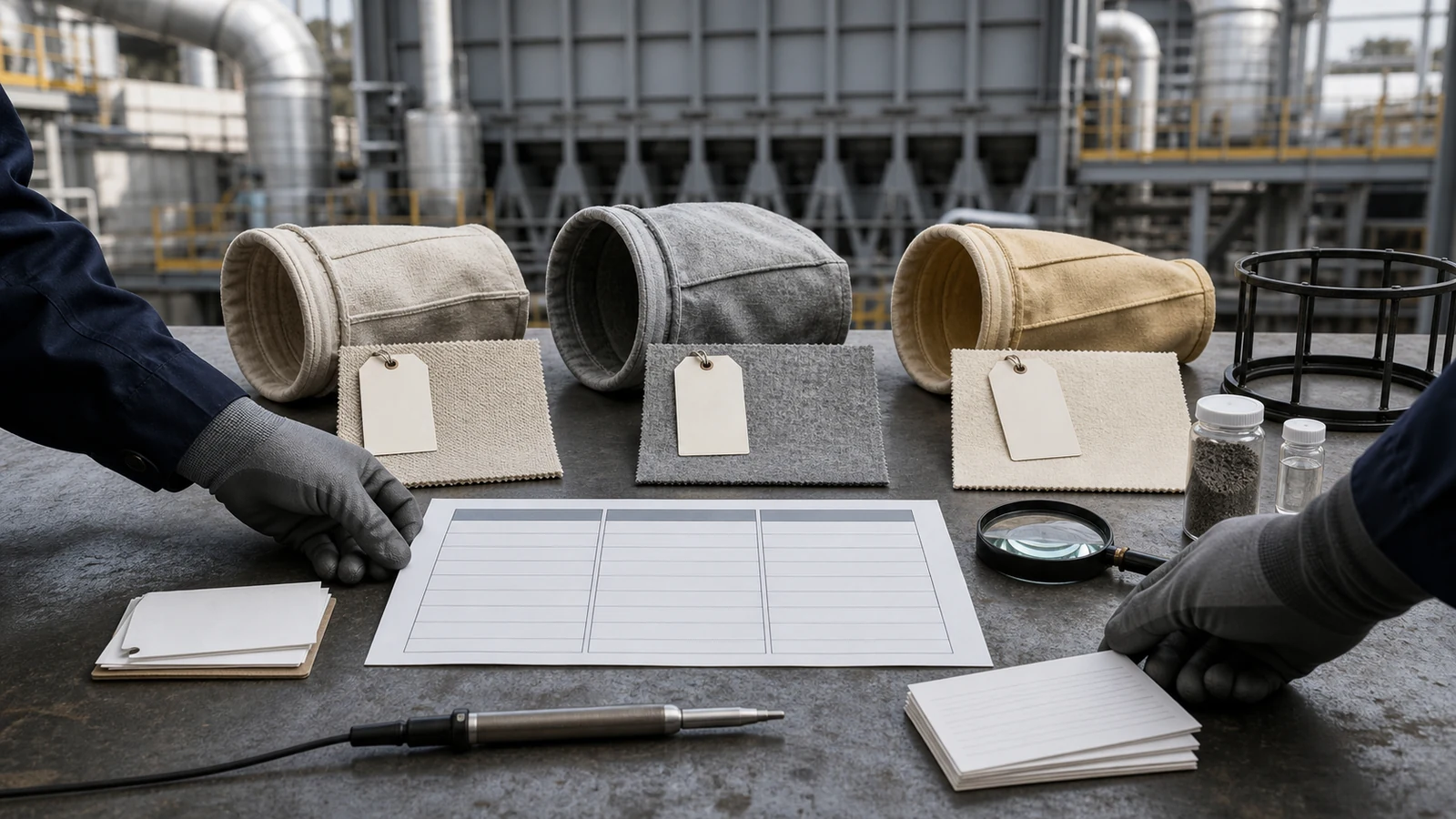
Direct answer
Do not select aramid, PPS, or fiberglass from an industry name or a temperature label. First identify each finished candidate, then compare it against the complete measured duty and the exact collector, support, cleaning, safety, and outcome requirements. A candidate stays conditional until complete, comparable, current evidence is reconciled by the buyer-appointed authority with site and OEM requirements. Incomplete, conflicting, unsafe, non-comparable, or untraceable evidence routes to HOLD.
Scope, authority, and safety boundary
This guide is an evidence-collection and purchasing framework. It is not a product data sheet, material approval, laboratory result, temperature-limit chart, fit decision, emissions finding, process-hazard review, root-cause diagnosis, operating instruction, or substitute for site/OEM review. It publishes no universal continuous, peak, or excursion temperature. It publishes no universal oxygen threshold, chemistry resistance, moisture tolerance, efficiency, pressure drop, cleaning, abrasion, flex, life, emissions, cost, ROI, compatibility, or best-material conclusion. Manufacturer values from different products, definitions, methods, and revisions are not merged into one ranking. This guide does not authorize sampling, energized access, hot handling, chemical contact, test pulsing, or setting changes. OSHA assigns hazardous-energy control during servicing and maintenance to the employer’s energy-control program. [1] The buyer’s site procedures, OEM instructions, hazard review, permits, and responsible authorities govern any work.
Compare three named constructions through the same evidence gate
Create one candidate record for each exact proposed construction. Keep original units, source revision, definition, test method, specimen, condition, duration, location, date, owner, and limitations beside each claim. Use documented, incomplete, conflicting, non-comparable, unsafe to obtain, untraceable, not applicable, and HOLD as distinct states.
1. Lock the identity of every finished candidate
Record the exact candidate fiber, media, product, construction, finish, membrane, scrim, and weight. Add supplier, product family, grade, part number, drawing, revision, lot or production reference, declaration date, approved substitutions, seam, thread, top and bottom construction, gasket or seal, and finished-bag dimensions. State whether the media is felted, woven, laminated, coated, impregnated, singed, glazed, calendered, treated, or otherwise modified. BWF describes its own industrial media family as needle felt or fiberglass fabric with supporting scrim and multiple possible treatments or membranes. [8] That product-family description shows why the construction record matters; its table is not a universal specification for another supplier’s bag. Treat aramid, PPS, fiberglass, high temperature, acid resistant, premium, equivalent, and OEM style as incomplete identifiers. A photo, color, stiffness, surface appearance, old invoice, or handwritten label cannot fill the missing fields.
2. Keep fiber evidence separate from finished-media evidence
Huvis identifies MetaOne as its named meta-aramid fiber and lists industrial bag filters among the product applications. [3] Toray describes TORCON as its named PPS fiber and lists heat, chemical, and hydrolysis characteristics for that fiber family, including use in bag-filter forms. [4] Neither source identifies an unknown installed bag, supplies its scrim, needling, weave, finish, membrane, seam, or manufacturing revision, or proves a plant result. Preserve the source’s exact fiber type, specimen, exposure, duration, method, and revision. Do not move a fiber statement into a finished-bag cell without a traceable construction link. Fiberglass is likewise not one construction: glass composition, yarn, weave, treatment, coating, membrane, seams, and support remain candidate-specific.
3. Compare only exact named finished constructions
Three Gore data sheets illustrate the necessary naming discipline without creating a universal ranking. The aramid sheet identifies a named acid-resistant aramid supported needlefelt with its own membrane, scrim, treatment, test data, declared collector context, revision, and limitations. [5] The PPS sheet identifies a different named supported needlefelt, fiber-and-scrim construction, membrane, test data, collector context, revision, and limitations. [6] The fiberglass sheet identifies a named acid-resistant woven fiberglass construction intended for a different cleaning arrangement, with its own membrane, weave, test data, revision, and limitations. [7] Those sheets do not describe every aramid, PPS, or fiberglass bag. Their values are not copied into a merged table because the products, constructions, collector contexts, definitions, and test bases are not a project comparison. Request the current document for each actual candidate and record every exception.
4. Build the complete temperature profile before reading a limit
Record normal, peak, startup, shutdown, and upset temperature with duration, location, and measurement method. Add frequency, rate of change where available, sensor tag, calibration or instrument status, data interval, gas distribution, compartment differences, process rate, bypass or dilution state, and time-aligned events. Separate a manufacturer's continuous definition from a surge, excursion, maximum service, thermal-stability test, or other label. Capture the duration and conditions attached to every term; a number without its definition is not comparable. Confirm whether the measurement represents collector inlet, outlet, hopper, duct, clean-air plenum, one compartment, or another point. Do not substitute a process setpoint for measured collector exposure. Do not average away short events that may be material, and do not treat a single peak as a complete duty profile. If candidate documentation uses different temperature terms or lacks duration, mark it non-comparable and HOLD rather than choosing the largest printed value.
5. Reconcile oxygen, chemistry, moisture, and dew point together
Document oxygen, gas chemistry, and combined exposures for normal production, startup, shutdown, upset, air ingress, fuel or feed changes, cleaning events, washdown, and seasonal operation. Include acids, alkalis, oxidants, reducing species, solvents, condensable compounds, concentration basis, moisture, condensation, and dew-point risk. Record method, location, duration, frequency, detection limits, and the responsible process source. Huvis supplies manufacturer-level property statements for its named MetaOne fiber but not this project’s concentrations, combined exposures, finished construction, or duration. [3] Toray’s TORCON page supplies manufacturer statements about named PPS fiber but does not supply this project’s combined oxygen, chemistry, moisture, temperature, and duration boundary. [4] A generic resistance word is not approval for a mixed gas. Unknown condensation, dew point, oxygen, or intermittent chemistry remains HOLD.
6. Match dust, abrasion, flex, support, and cleaning duty
Capture dust identity, particle-size distribution, loading, abrasiveness, shape, hardness evidence, stickiness, oil or liquid association, cake behavior, process variation, and representative-sample limits. Record flex and mechanical duty, collector geometry, support, cage, and cleaning method. Include airflow direction, inlet distribution, baffles, spacing, bag dimensions, tube sheet, cage wires and rings, tension or stay system, clearances, venturi or blowpipe relationship where applicable, seals, and installed quantity. Preserve cleaning settings history without prescribing settings: controller modes, events, pressure records where applicable, valves or motion maintenance, compressed-air quality, differential-pressure basis, and changes. The named Gore aramid and PPS sheets describe pulse-jet contexts, while the named fiberglass sheet describes a reverse-air context. [5] [6] [7] That difference alone prevents fiber-only substitution.
7. Define comparable filtration and operating outcomes
Write the emissions, exposure, and product-quality goals before comparing results. Add airflow or capture duty, differential-pressure boundary, cleaning objective, dust-recovery or contamination need, maintenance strategy, and any buyer-defined service or economic question. For each goal, record the governing permit, regulation, internal standard, OEM requirement, method, sampling location, instrument, units, averaging basis, process state, conditioning, detection limit, acceptance owner, and reporting period where applicable. EPA lists outlet particulate concentration or leak indication, pressure differential, temperature, gas flow, cleaning operation, and fan current as fabric-filter indicators. [2] No single indicator proves media suitability. A laboratory result becomes comparable only when exact construction, specimen conditioning, dust, loading, face velocity, cleaning sequence, method, and reporting basis align. A plant history becomes comparable only when duty, collector state, measurement, population, and period align. Otherwise preserve the result as named evidence and HOLD the ranking.
8. Preserve failures and samples without assigning cause
Build a traceable record for current media, failures, and representative samples. Include collector, compartment, row or position, orientation, installation and removal date, part identity, lot where available, handler, work order, dirty and clean sides, seam, ends, cage or support contact, apparently unaffected comparisons, and unused controls. Record discoloration, embrittlement, holes, tears, shrinkage, glazing, deposits, stiffness, scrim exposure, weave change, seam change, and surface change only as observations. One damaged bag or one industry label is not a root cause or approval. Temperature, chemistry, condensation, abrasion, flex, support, cleaning, installation, storage, handling, airflow, process variation, or another factor may share a similar observation. Use the active early filter-failure guide to keep hypotheses and evidence families separate. Any destructive analysis, microscopy, strength testing, chemistry work, or interpretation belongs to the buyer’s authorized program. Lost traceability or unresolved causation routes to HOLD.
9. Compare history by traceable cohort, not anecdotes
Assemble installation, storage, packaging, handling, process, maintenance, inspection, cleaning, differential-pressure, emissions, event, removal, and changeout history for each defined cohort. Record all installed and removed units, locations, exposure periods, removal reasons, cause status, process changes, repairs, and filters still in service. A still-running cohort does not have completed life. A removed cohort may have been changed for process, maintenance, campaign, fit, damage, or policy reasons unrelated to fiber. Do not compare the longest run from one construction with the shortest run from another, combine different collectors, exclude early failures without explanation, or convert supplier estimates into observed history. Record comparable outcome and history with source, owner, method, population, period, exclusions, and causal limitations. When the process, collector, cleaning, population, or acceptance method changed, create a separate cohort. No life, cost, emissions, or performance conclusion follows from an industry anecdote or one failed sample.
10. Record a conditional disposition and every HOLD
Three fiber labels are not three complete specifications. A candidate stays conditional until the buyer-appointed authority reconciles the exact construction, complete measured duty, collector and cleaning design, current manufacturer documents, comparable outcomes, failure history, process-safety requirements, site/OEM review, supplier limitations, and buyer goals. Incomplete, conflicting, unsafe, non-comparable, or untraceable evidence routes to HOLD. Record the affected field, sources and revisions, conflict, consequence, evidence needed, responsible owner, due date, and signed disposition. Use the active condition-first media-selection guide when the wider candidate screen remains open. Use the active membrane-versus-felt guide when surface construction and comparable cost evidence remain separate questions. A conditional purchasing path is not fit, compatibility, performance, emissions, safety, compliance, life, cost, or return-to-service approval.
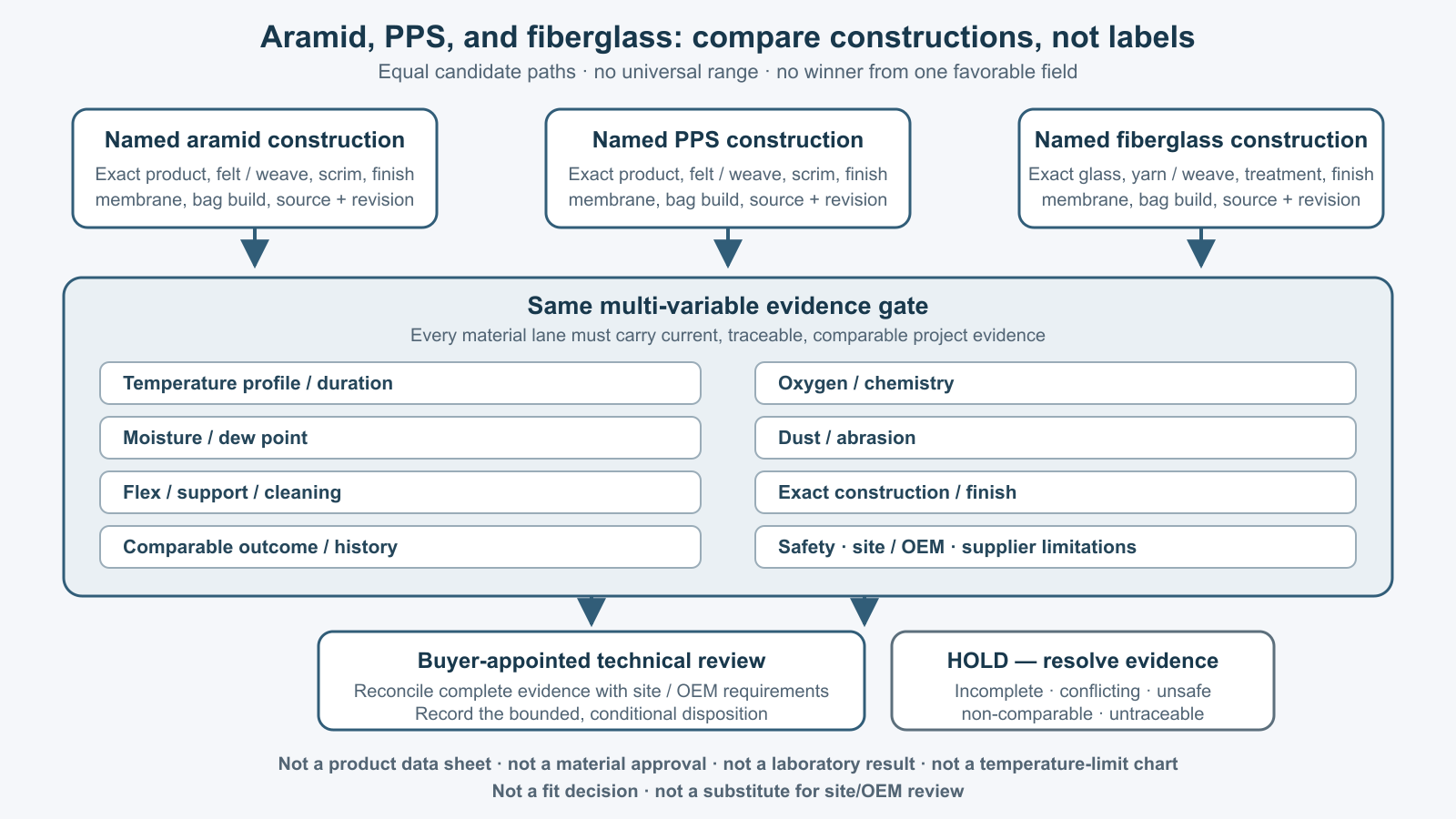
Three equal candidate lanes and one evidence gate
The diagram gives named aramid, PPS, and fiberglass constructions equal prominence. All three enter the same multi-variable evidence gate before buyer-appointed review or HOLD. It contains no universal material values, traffic-light ranking, performance arrow, winner badge, approval, or compatibility conclusion.
Scroll table horizontally
| Buyer-controlled evidence field | Named aramid construction | Named PPS construction | Named fiberglass construction | Comparable source / status |
|---|---|---|---|---|
| Exact product, fiber, media, scrim, weight, finish, membrane, construction, revision | ____________ | ____________ | ____________ | ____________ |
| Normal, peak, startup, shutdown, upset temperature; duration, location, method | ____________ | ____________ | ____________ | ____________ |
| Oxygen, chemistry, moisture, condensation, dew point, combined exposure | ____________ | ____________ | ____________ | ____________ |
| Dust loading, abrasion, stickiness, representative evidence | ____________ | ____________ | ____________ | ____________ |
| Flex, collector, support, cage, cleaning method, settings history | ____________ | ____________ | ____________ | ____________ |
| Comparable outcome, current history, source revision, supplier limitations | ____________ | ____________ | ____________ | ____________ |
| Process-safety, site/OEM and buyer-appointed disposition | HOLD until complete | HOLD until complete | HOLD until complete | No fiber-only ranking |
On narrow screens, scroll horizontally to inspect the full-size diagram.
Stop conditions before ranking a high-temperature candidate
- A candidate is identified only as aramid, PPS, fiberglass, Nomex, high temperature, acid resistant, equivalent, premium, woven, or felt.
- The exact fiber, media, product, scrim, weight, finish, membrane, seam, end construction, drawing, revision, or supplier declaration is missing.
- A continuous, peak, excursion, surge, maximum service, or stability value is used without its duration, definition, location, method, and conditions.
- Oxygen, chemistry, moisture, condensation, dew point, temperature, and duration are reviewed as separate favorable rows instead of combined exposure.
- Fiber data, finished-media data, supplier tables, laboratory results, and plant history are mixed as if they share one specimen and method.
- A pulse-jet, reverse-air, shaker, support, cage, tension, cleaning, or mechanical requirement is transferred between unlike constructions.
- One damaged filter, discoloration, hole, tear, shrinkage, glazing, deposit, or stiff sample is presented as root cause or material approval.
- An industry example for cement, asphalt, metals, boilers, incineration, chemicals, food, or another process is treated as a site recommendation.
- Unknown, conflicting, unsafe, non-comparable, untraceable, or outdated evidence is entered as acceptable, zero, or not material without an accountable disposition.
- Someone proposes energized access, uncontrolled sampling, hot handling, chemical contact, test pulsing, or setting changes to close an evidence gap.
Quote-ready high-temperature media evidence package
Submit a defined evidence package after the buyer-appointed authority marks assumptions, conflicts, non-comparable records, unsafe gaps, and HOLD items. The package supports a purchasing inquiry; it does not transfer material selection, engineering, testing, safety, compliance, fit, compatibility, performance, or acceptance authority.
- Exact candidate fiber, media, product, construction, finish, membrane, scrim, and weight, plus supplier, product family, grade, part number, drawing, revision, lot or production reference, declaration date, and substitutions.
- Finished-bag dimensions, felt or weave description, seam, thread, ends, gasket or seal, loading orientation only from the governing document, and installed quantity.
- Normal, peak, startup, shutdown, and upset temperature with duration, frequency, location, method, sensor tag, instrument status, data interval, gas distribution, and process events.
- Oxygen, gas chemistry, and combined exposures, including acids, alkalis, oxidants, reducing species, solvents, condensables, concentration basis, method, location, duration, and variation.
- Moisture, condensation, and dew-point risk across production, startup, shutdown, upset, washdown, steam, ingress, and seasonal states.
- Dust loading, abrasion, and stickiness, with identity, size distribution, shape, composition source, cake behavior, liquid association, process variation, and sample limits.
- Flex and mechanical duty, collector geometry, support, cage, cleaning method, and cleaning settings history without unapproved adjustment instructions.
- Emissions, exposure, and product-quality goals, plus airflow, differential-pressure, cleaning, recovery, contamination, maintenance, service, and economic boundaries.
- Process-safety and hazard review, employer energy-control boundary, site/OEM requirements, permits, acceptance method, accountable owners, and current revision list.
- Current media, failures, and representative samples with positions, populations, dates, cause status, unused controls, operating history, exclusions, and traceability.
- Drawings, part numbers, change history, source revision, and supplier limitations, plus every assumption, conflict, non-comparable field, unresolved cause, HOLD reason, owner, and requested decision.
Product path
- Aramid Filter BagsUse the aramid product path only after the exact felt, scrim, treatment, membrane, duty, collector, and evidence boundary are defined.
- Filter MediaConnect fiber labels to exact media construction, finish, membrane, scrim, test basis, supplier declaration, and current revision.
- Dust Collector Filter BagsConnect media evidence to finished-bag dimensions, seams, ends, seals, support, cleaning method, and quantity.
- PTFE Membrane Filter BagsUse the commercial membrane path only when a named membrane construction remains within the buyer's separate evidence screen.
- Request a Filter QuoteSubmit the buyer-released evidence package, quantity, HOLD items, and exact unresolved purchasing question.
Frequently asked questions
Which is best for high-temperature dust collection: aramid, PPS, or fiberglass?
There is no universal winner. Identify the exact finished candidates, then compare the complete temperature profile, oxygen, chemistry, moisture and dew-point risk, dust, collector, support, cleaning, mechanical duty, safety requirements, and comparable history. Missing material evidence remains HOLD.
Can a continuous-temperature value select the filter bag?
No. Continuous, peak, surge, excursion, maximum service, and stability terms can use different definitions and conditions. Record duration, location, method, revision, combined gas exposure, collector design, and the exact finished construction before comparing any value.
Why must oxygen be reviewed with chemistry and moisture?
The installed exposure is combined, not a set of isolated favorable rows. Record oxygen, oxidants, acids, alkalis, other gases, moisture, condensation, dew point, temperature, duration, location, and method together. An incomplete combined exposure keeps the candidate conditional.
Does a Nomex label fully identify an aramid filter bag?
No. A brand or fiber label does not supply the finished media, scrim, weight, felt construction, finish, treatment, membrane, seams, ends, manufacturing revision, collector relationship, or candidate declaration. Keep fiber evidence separate from finished-bag evidence.
Can a fiberglass bag replace a felt bag with the same dimensions?
Dimensions alone do not establish suitability. Weave or felt construction, support, flex duty, cage or tension system, seals, cleaning method, temperature, oxygen, chemistry, moisture, dust, finish, membrane, and manufacturer instructions must be reconciled for the exact collector.
Does one damaged or discolored bag identify the wrong material?
No. It is an observation, not root cause. Preserve position, population, construction, support, process, temperature, chemistry, moisture, cleaning, installation, handling, airflow, maintenance, and representative comparison evidence before assigning a cause.
May manufacturer media tables be combined into one comparison chart?
Only when exact products, definitions, specimens, conditions, methods, durations, units, revisions, and limitations are genuinely comparable. Otherwise keep each statement beside its source and mark the cross-candidate result non-comparable or HOLD.
What should be included in a quote inquiry?
Submit exact candidate declarations, filter and collector drawings, quantity, full measured duty, dust evidence, support and cleaning history, process-safety requirements, current media and failure history, comparable outcomes, source revisions, supplier limitations, assumptions, conflicts, and HOLD items.
Sources
- OSHA — Control of Hazardous Energy (Lockout/Tagout)
- US EPA — Monitoring by Control Technique: Fabric Filters
- Huvis — MetaOne Meta-Aramid Fiber
- Toray — TORCON Polyphenylene Sulfide (PPS) Fiber
- GORE Filter Bag 5724 — Acid-Resistant Aramid Felt Data Sheet
- GORE Filter Bag 5117 — Polyphenylene Sulfide Felt Data Sheet
- GORE High Durability Filter Bag 3141 — Acid-Resistant Fiberglass Data Sheet
- BWF Envirotec — Filter Media for Industrial Filters
Submit a defined filter inquiry
Send the exact traceable candidate records, collector and filter drawings, complete temperature profile, oxygen and gas chemistry, moisture and dew-point evidence, dust properties, support and cleaning history, process-safety boundary, comparable operating outcomes, current media and failure populations, representative sample record, quantity, source revisions, supplier limitations, assumptions, exceptions, and HOLD items. State the exact purchasing question and buyer-appointed decision owner. The buyer retains material selection, engineering, testing, safety, compliance, acceptance, fit, compatibility, performance, and return-to-service decisions.
Request a quote