Buying and replacement decisions
Replacement Dust Collector Filter Buying Guides
Build a defensible replacement request from the evidence you actually have, whether that is a part number, an old filter, field photos, dimensions, a drawing, or only collector and process details.
Direct answer
Use these guides when a replacement project begins with incomplete identification, inconsistent supplier quotes, or uncertainty about what should be replaced. First classify the filter or component, then collect photos, measurements, construction details, collector information, operating conditions, quantity, and failure evidence. Compare quotations only after confirming that fit, media, sealing, packaging, and project assumptions are stated. Unknown fields should be marked for review rather than guessed.
Choose your buying scenario
- Unknown or discontinued part: build an identification package from physical evidence.
- New or repeat RFQ: separate common fields from bag-, cartridge-, cage-, and accessory-specific fields.
- Supplier comparison: compare specification control, evidence review, quality checkpoints, packaging, and commercial assumptions.
- Price comparison: evaluate purchase price alongside labor, downtime, operating effects, disposal, and replacement frequency.
- Changeout decision: document filter age, condition, failure cause, and system behavior before choosing full or partial replacement.
- Spares planning: rank filters and components by criticality, usage, storage needs, and replenishment risk.
Guides in this collection
- How to Identify a Replacement Dust Collector Filter Without an OEM Part NumberClassify an unknown component and assemble photos, measurements, labels, and operating evidence without guessing.
- Dust Collector Filter RFQ Checklist: What Specifications Should Buyers Send?Organize common and family-specific fields for bags, cartridges, cages, venturis, and accessories.
- Cheap vs Premium Dust Collector Filters: Which Has the Lower Total Cost?Build a transparent comparison from purchase price, operating evidence, labor, downtime, disposal, and service history.
Replacement identification and purchasing workflow
Move through the sequence without converting assumptions into specifications. The last table gives a practical comparison path; it does not rate a supplier or predict total cost.
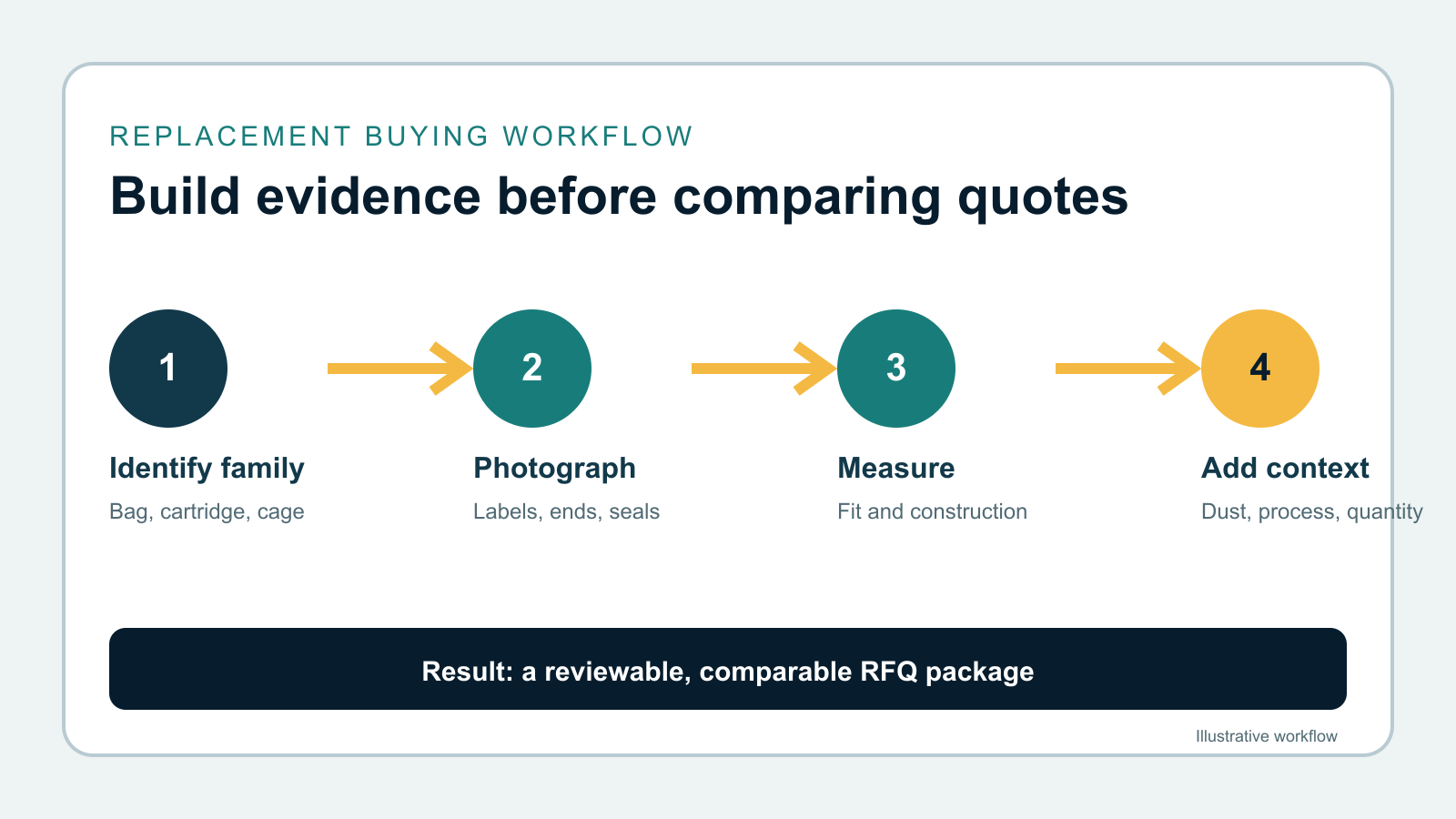
- Identify: determine bag, cartridge, pleated element, cage, venturi, or accessory family and record collector information.
- Document: photograph labels, overall form, ends, seals, joints, damage, and installed orientation.
- Measure: record the family-specific dimensions and construction details that control fit.
- Add context: include dust, process, temperature, moisture, chemistry, cleaning method, current media, quantity, and observed problem.
- Verify: separate measured, copied, assumed, and unknown information; use a sample or drawing review when evidence remains ambiguous.
- Compare: align the technical scope first, then compare price, labor, downtime, disposal, packaging, and service assumptions.
Scroll table horizontally
| Decision | Evidence to compare | Do not assume |
|---|---|---|
| Like-for-like fit | Dimensions, ends, seals, hardware, installed orientation | Similar overall size means interchangeable |
| Media and construction | Current specification, dust and process details, cleaning method | A material name alone confirms suitability |
| Purchasing scope | Quantity, packaging, labels, documentation, stated exclusions | Every quotation includes the same scope |
| Total-cost review | Price, changeout labor, downtime, disposal, operating record, replacement history | Higher or lower price predicts performance |
Request a filter review
Send overall and detail photos, measured dimensions, label or part-number evidence, collector model, current media if known, quantity, dust and operating conditions, cleaning method, observed failure or purchasing concern, and any packaging or labeling requirements. Mark every unknown or assumed field for review.
Request a quoteFrequently asked questions
What if the OEM part number is missing?
Identify the filter family and send full-length and detail photos, end or top and bottom construction, seal or gasket details, dimensions, labels, collector information, current media if known, operating context, and quantity. A retained sample may be needed when the evidence is ambiguous.
How can buyers compare two filter quotations?
Confirm that both quotations use the same fit, construction, media, finish, hardware, quantity, packaging, labeling, documentation, and stated assumptions. Review commercial price only after the technical scope is aligned.
Is the lowest purchase price the lowest total cost?
Not necessarily, and a higher price is not proof of better performance. Build a project-specific comparison from purchase price, changeout labor, downtime, disposal, operating observations, service history, and the cost of leakage or mismatch risk.
Should all filters be replaced when only one fails?
The answer depends on filter age, condition, failure cause, system arrangement, operating evidence, and whether a spot replacement creates an unacceptable mismatch. Record the failed location and inspect the remaining set before deciding.
Which details make an RFQ reviewable?
Include component family, dimensions, construction, seals, current media, collector and cleaning details, dust and process conditions, quantity, photos or drawings, failure evidence, and explicit unknowns.
Related collections
Return to the main filter guide hub, investigate operating evidence in maintenance and troubleshooting, document geometry in fit and component guides, or review conditions in media and application selection.