Filter media and application guide
For plant engineering, EHS, MRO, maintenance, procurement, OEM replacement, and industrial sourcing teams
Buyer-appointed technical review required
How to Select Dust Collector Filter Media by Dust, Temperature, Moisture and Chemistry
Screen filter-media candidates only after the duty is documented across dust, temperature, moisture, chemistry, oxygen, cleaning, collector geometry, mechanical demand, safety requirements, filtration goals, current construction, and failure history. Missing or conflicting evidence remains on HOLD.
Direct answer
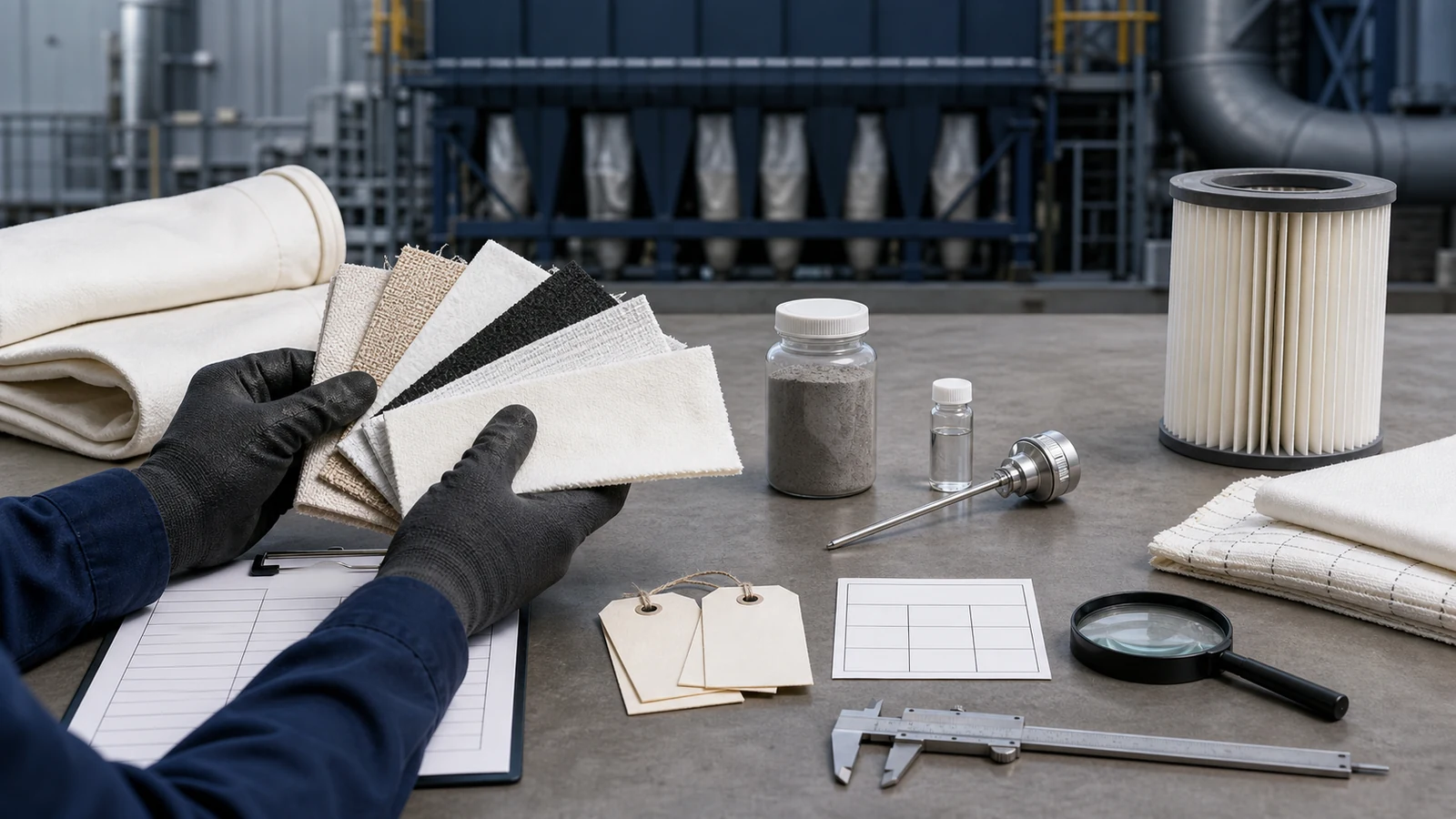
Select dust collector filter media from a controlled operating-duty record, not from a fiber name, temperature line, photograph, or industry label. First document the dust, normal and abnormal temperature history, moisture and dew-point risk, gas chemistry and oxygen, cleaning method, collector and filter geometry, mechanical duty, process-safety requirements, filtration goals, current construction, and failure evidence. Then compare named candidate constructions against current manufacturer data. Incomplete or conflicting evidence routes to HOLD, and every candidate remains conditional until the buyer-appointed authority reconciles the complete evidence package.
Scope, authority, and decision boundary
This guide organizes evidence for replacement filter bags, cartridges, and related industrial dust-collector media. It is not a material approval, product data sheet, laboratory result, hazard analysis, compliance finding, collector design, operating procedure, or return-to-service authorization. Appearance, fiber name, temperature alone, industry label, or one failed sample is not approval. No universal media ranking applies. No universal maximum, continuous, or peak temperature is supplied. There is no universal chemical resistance, moisture tolerance, filtration efficiency, pressure drop, service life, cleaning energy, emissions, cost, or ROI value. Manufacturer data from different products and test bases are not merged into one comparison. The exact collector and filter documents, current product data, representative evidence, site program, and buyer-appointed authority govern. This guide does not authorize sampling, energized access, hot handling, chemical contact, test pulsing, or setting changes. The employer’s energy-control procedure governs service access; OSHA defines the hazardous-energy control boundary for servicing and maintenance. [1]
Build the condition record before screening media
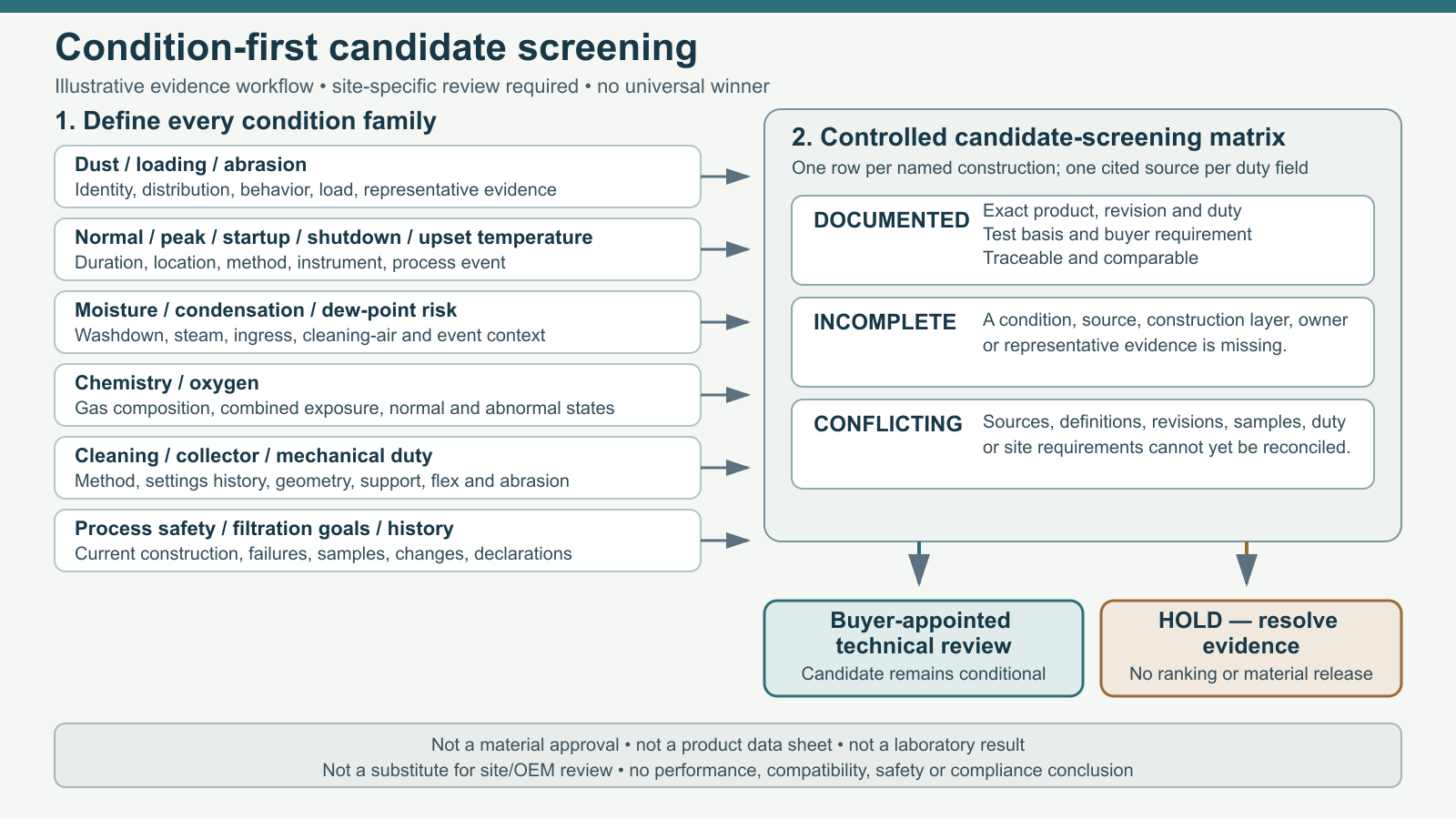
Treat each family below as an input to one controlled candidate-screening record. Mark every item documented, incomplete, conflicting, non-comparable, or not applicable, and preserve its source, revision, date, location, units where relevant, and responsible owner.
1. Define the dust before naming a medium
Record dust identity and particle-size distribution using the site’s approved information sources, including relevant process streams, blends, contamination, recycle, and change history. Add loading and abrasiveness, particle shape, fines behavior, cohesiveness, stickiness, oil or liquid association, bulk behavior, cake observations, and representative samples where the site program permits. Do not infer composition, combustibility, toxicity, electrostatic behavior, or abrasiveness from color or feel. If the material can vary by recipe, supplier, season, operating mode, or upset, keep those populations separate. The sample record should identify location, date, process state, collection method, container, custody, and whether it represents normal or abnormal duty. One failed filter or one jar of dust is not a complete application profile. Where combustible-dust questions exist, the buyer’s hazard review must control the evidence and decisions; OSHA’s combustible-dust resources describe hazard-assessment and control topics, not a media-selection shortcut. [3]
2. Build a temperature history, not one design number
Separate normal, peak, startup, shutdown, and upset temperature. For each state, capture duration, frequency, location, measurement method, instrument identity and status, time alignment, ambient context, and the process event that produced it. Include credible local variation across ducts, compartments, rows, or operating modes rather than assuming one point represents every filter. Record both high-temperature exposure and conditions that may bring the gas toward water or acid dew point. The EPA notes that high temperature can damage fabric filters and that lower temperature with acid gases may lead to condensation, corrosion, and blinding; the statement is a system-level caution, not a candidate-media limit. [2] Do not convert a manufacturer maximum, continuous, or surge value into approval until the exact product construction, definition, duration, measurement basis, chemistry, moisture, mechanical duty, and safety margin have been reconciled by the buyer-appointed authority.
3. Reconcile moisture, condensation, chemistry, and oxygen together
Document moisture, condensation, dew-point, washdown, and steam risk as operating states rather than a yes-or-no field. Include humidity or water-vapor evidence, liquid carryover, cleaning-air quality, ingress, insulation condition, startup and shutdown behavior, wash or steam events, sticky or hardened cake, corrosion, and any process change. Record gas composition, chemistry, and oxygen with normal and abnormal ranges only when supplied by an accountable source; identify acids, alkalis, oxidizers, solvents, fuels, additives, by-products, and cleaning chemicals relevant to the full filter construction. Donaldson’s application article treats temperature, moisture, and chemistry as interacting gas-stream characteristics and states that media suitability depends on the wider conditions. [7] Apply that principle without adopting a product recommendation. Unknown chemistry, oxygen, dew point, or transient exposure routes the candidate to HOLD.
4. Treat manufacturer media data as named-product evidence
Manufacturer charts can help identify questions, but they are not interchangeable. Donaldson’s North American bag-filter selector routes named Donaldson offerings through application questions such as temperature, moisture, chemical need, static concern, oil, and abrasion; its product labels and limits remain confined to that document and revision. [4] BWF’s industrial-filter-media page describes its own fiber, scrim, membrane, treatment, and resistance categories and publishes a table for its named roll-goods context. [6] Neither source approves a different supplier’s construction or this project. Record supplier, product family, grade, fiber, scrim, weight, finish, membrane, construction, test basis, revision, date, normal-versus-peak terminology, exclusions, and declaration status. If documents differ in test basis or definitions, display them separately; do not average, normalize, or create a universal ranking.
5. Match the cleaning method and collector geometry
Identify the exact collector, model, serial or asset number, compartment, revision, and cleaning method. Record whether the system is pulse jet, reverse air, shaker, or another documented arrangement; include the relevant filter orientation, airflow direction, support, cage, tube sheet, end construction, sealing interface, spacing, length, diameter or profile, pleat geometry, and installed quantity. Preserve cleaning settings history, controller events, compressed-air or motion evidence, valves, manifolds, nozzles, blowpipes, venturis, tensioning, or support features only as applicable to the named collector. The EPA cost manual distinguishes cleaning arrangements and their relationships to bag and collector design. [8] It does not authorize transferring one media or geometry to another system. A fiber that appears chemically plausible can still remain unsuitable as a finished construction if the cleaning and mechanical interfaces are unresolved.
6. Map mechanical, flex, and abrasion duty
Describe where the finished filter bends, flexes, snaps, reverses, pulses, contacts a cage or support, sees inlet dust, or carries cake. Map wear, holes, fuzzing, thinning, seam change, scrim exposure, pleat damage, cracking, delamination, gasket change, and contact marks to exact positions. Compare apparently affected and unaffected positions from traceable populations, and add inlet distribution, baffle condition, airflow history, cake load, installation, support, storage, and handling evidence. A visible hole does not prove abrasion; a crack does not prove flex fatigue; a worn surface does not identify the fiber or finish. Translate the observations into construction questions: fiber and scrim relationship, thickness or weight declaration, surface treatment, membrane or coating, seam and thread, forming, support compatibility, and manufacturing revision. Missing location, population, or operating history keeps the mechanical screen incomplete.
7. Screen filtration construction and finish only after duty is defined
A finished medium is more than its visible surface. Donaldson’s technical article says filter-media development begins with application requirements and considers the filtered material, required efficiency, pressure, vibration, temperature, humidity, and contaminant chemistry for the final filter format. [5] Keep that statement confined to design considerations; it supplies no approval or promised result. Define whether the inquiry concerns felt, woven fabric, cartridge sheet, membrane, coating, impregnation, singe, glaze, calender, antistatic construction, oleophobic or hydrophobic treatment, or another named finish. Record how the candidate is bonded, sewn, welded, formed, sealed, and supported. Filtration goals, cake release, cleanability, emissions, product quality, exposure control, and pressure history must be connected to comparable test or operating evidence. A membrane label, finish name, or visually smooth face does not prove efficiency, release, durability, or compatibility.
8. Define filtration goals without promising a result
State the decision the buyer needs to make and the outcome that the site’s program must control. Examples include a permitted emissions requirement, workplace exposure-control objective, product-recovery or contamination objective, process cleanliness need, airflow duty, pressure-loss constraint, maintenance strategy, or evidence needed after a failure. Identify the governing regulation, permit, internal standard, OEM requirement, test method, sampling location, instrument, acceptance owner, and reporting basis where applicable. The EPA lists outlet particulate concentration, opacity, differential pressure, inlet temperature, temperature difference, gas flow, cleaning mechanism operation, and fan current as possible fabric-filter indicators. [2] None of those indicators alone establishes media suitability, and this page does not supply an emissions or exposure-control value. Treat a catalog efficiency or permeability result as comparable only when the test method, specimen, conditioning, face velocity, dust, loading state, and finished construction are relevant and documented.
9. Preserve the current construction and failure history
Build a traceable baseline for the installed filter: supplier and part number, drawing and revision, approved substitutions, fiber, scrim, weight, finish, membrane, seam, thread, end construction, gasket, cage or support, manufacturing or lot evidence when available, installation date, service location, and change history. Add operating, process, cleaning, maintenance, storage, handling, and installation records for the same time period as the observed issue. Retain representative failed, suspect, apparently unaffected, and unused comparison samples only under the site’s safe evidence program. Record why each sample is representative and what exposure it received. The active early filter-failure guide separates appearance from cause and organizes sample, location, process, temperature, moisture, chemistry, airflow, cleaning, fit, and installation evidence. A replacement choice must not hide an unresolved root cause or mix unlike cohorts.
10. Control candidate screening, exceptions, and approval
Create one row per named candidate construction and one column per verified duty requirement. Cite the exact data source in each cell and mark it documented, incomplete, conflicting, non-comparable, or not applicable. Record assumptions separately. A candidate remains conditional until the buyer-appointed authority reconciles duty, collector design, manufacturer data, process-safety requirements, and representative evidence. Incomplete or conflicting conditions route to HOLD. Also route to HOLD when the evidence is unsafe to obtain, the current construction is untraceable, definitions differ, the candidate declaration has expired, or a site requirement lacks an accountable owner. Do not convert the screen into a traffic-light winner, weighted score, or lowest-cost ranking. Record exceptions with the affected field, evidence sources, purchasing or operating consequence, required resolution, owner, and signed disposition. Final approval belongs to the buyer-appointed authority using the current site, OEM, supplier, hazard, and regulatory documents.
Condition-first candidate-screening matrix
The matrix begins with six duty families, records whether each is documented, incomplete, or conflicting, and routes the package to buyer-appointed technical review or HOLD. It does not select a material. No candidate advances from one favorable field while another material condition remains unresolved.
Scroll table horizontally
| Condition family | Minimum evidence | Screening rule |
|---|---|---|
| Dust, loading, abrasion | Identity, distribution, load, shape, behavior, representative sample, change history | Unknown or non-representative dust evidence is HOLD |
| Temperature | Normal, peak, startup, shutdown, upset, duration, location, method | One design number or one sensor does not release a candidate |
| Moisture and chemistry | Condensation, dew point, washdown, steam, gas composition, chemistry, oxygen | Unresolved combined exposure is HOLD |
| Collector and cleaning | Collector revision, geometry, interfaces, support, cleaning method, settings history | Named fiber cannot override unresolved mechanical fit |
| Safety and goals | Hazard review, governing controls, emissions, quality, exposure and operating objectives | No media screen replaces the site safety or compliance decision |
| Current construction and history | Fiber, scrim, weight, finish, membrane, seam, failures, samples, changes, declarations | Untraceable baseline or incomparable evidence is HOLD |
On narrow screens, scroll horizontally to inspect the full-size diagram.
Stop conditions before a media decision
- A candidate is chosen from temperature, industry, fiber, finish, color, price, or an old part description alone.
- Normal temperature is available, but peak, startup, shutdown, upset, duration, sensor location, or measurement method is missing.
- Moisture and chemistry are reviewed separately even though condensation, dew point, oxygen, or combined exposure is unresolved.
- Manufacturer limits from different products, test methods, constructions, regions, or revisions are combined into one ranked table.
- A visually similar swatch is assumed to share fiber, scrim, weight, finish, permeability, membrane, treatment, or duty limits.
- One failed sample is treated as the material definition or root-cause proof without location, population, exposure, and comparison evidence.
- A media choice is used as a substitute for a combustible-dust, process-safety, exposure-control, grounding, compliance, or return-to-service decision.
- Someone proposes energized access, uncontrolled sampling, hot handling, chemical contact, forced pulsing, or settings changes to complete the record.
- Collector geometry, cleaning method, support, seal, current construction, approved drawing, or change history is missing or conflicting.
- A quotation or filter inquiry is treated as FilterBagWorks approval of material, performance, compatibility, root cause, safety, or compliance.
Quote-ready filter-media evidence package
Submit a controlled evidence package after the buyer-appointed authority separates documented fields, assumptions, conflicts, and HOLD items. The package supports a defined filter inquiry; it does not transfer material, hazard, process, compliance, or acceptance authority.
- Dust identity and particle-size distribution; loading and abrasiveness; process source, variation, representative sample record, and change history.
- Gas composition, chemistry, and oxygen for normal and abnormal states, with source, location, date, method, and responsible owner.
- Moisture, condensation, dew-point, washdown, and steam risk, including ingress, compressed-air quality, insulation, startup, shutdown, and upset context.
- Normal, peak, startup, shutdown, and upset temperature with duration, frequency, location, measurement method, instrument identity, and time-aligned process events.
- Collector and filter geometry, model and revision, airflow direction, cleaning method and settings history, support, cage, tube sheet, seals, spacing, and installed quantity.
- Mechanical, flex, and abrasion duty with position maps, inlet distribution, contact evidence, cake load, handling, storage, and installation history.
- Current fiber, scrim, weight, finish, and construction, including membrane, treatment, seam, thread, gasket, end construction, part number, drawing, revision, and approved changes.
- Emissions, quality, and exposure goals with governing document, test or monitoring basis, location, owner, and unresolved limitations.
- Process-safety and hazard review, applicable site controls, responsible authority, and explicit boundaries for combustible, toxic, reactive, hot, or electrostatic concerns.
- Failure history and representative samples across failed, suspect, apparently unaffected, and unused populations, with custody and comparability records.
- Drawings, part numbers, change history, and supplier declarations for every candidate, including exact product, construction, data revision, test basis, exclusions, and exception status.
- Required quantity, delivery and packaging needs, evidence owners, decision deadline, named buyer-appointed authority, and the exact unresolved filter question.
Product path
- Filter MediaUse the commercial media path only after the duty, construction, evidence sources, and decision authority are defined.
- Dust Collector Filter BagsConnect media evidence to bag dimensions, top and bottom construction, seam, finish, cage relationship, and cleaning method.
- Dust Collector Cartridge FiltersConnect media evidence to cartridge format, pleat construction, end caps, gasket, hardware, cleaning, and collector geometry.
- Replacement Dust Collector FiltersRoute the defined replacement requirement through the existing commercial product-family path.
- Request a Filter QuoteSubmit the buyer-released evidence package, quantity, and exact unresolved purchasing question.
Frequently asked questions
Can filter media be selected from operating temperature alone?
No. Temperature must be separated into normal, peak, startup, shutdown, and upset states with duration, location, and measurement method, then reconciled with moisture, dew point, chemistry, oxygen, dust, cleaning, geometry, mechanical duty, safety requirements, and the exact candidate construction.
Is one fiber family always best for a particular industry?
No. An industry label can hide different fuels, feedstocks, gas composition, oxygen, moisture, temperature events, dust behavior, cleaning systems, collector designs, filtration goals, and hazards. Compare exact duty evidence with named manufacturer products rather than assigning one universal winner.
What temperature information belongs in a media inquiry?
Record normal, peak, startup, shutdown, and upset temperature, plus duration, frequency, measurement location, method, instrument identity and status, ambient context, and the process event. Keep manufacturer continuous, peak, and surge terminology attached to its exact document and product.
How should moisture and chemistry be documented?
Record water vapor, condensation and dew-point analysis, liquid carryover, washdown or steam, compressed-air quality, ingress, insulation, gas composition, oxygen, acids, alkalis, oxidizers, solvents, additives, by-products, and abnormal events. Unknown combined exposure remains on HOLD.
Can a media swatch identify the installed construction?
Not by appearance alone. A similar swatch may differ in fiber, scrim, weight, finish, membrane, treatment, seam, forming, permeability, and duty limits. Use traceable part, drawing, revision, supplier declaration, and representative sample evidence.
Does a membrane or finish name prove better filtration or cleaning?
No. A label does not prove efficiency, pressure behavior, cake release, durability, chemical compatibility, cleanability, or service life for the project. Compare the exact finished construction and applicable test basis with the documented operating duty and goal.
What happens when candidate data use different tests or definitions?
Keep the data separate and mark it non-comparable. Do not average values, convert unlike categories into a score, or rank candidates from incomplete rows. Ask for comparable declarations or route the affected decision to HOLD for buyer-appointed resolution.
Who approves the final filter-media selection?
The buyer-appointed authority approves the selection after reconciling the site duty, collector and filter design, current manufacturer data, process-safety and regulatory requirements, representative evidence, exceptions, and any required testing. A quotation or this guide is not approval.
Sources
- OSHA 29 CFR 1910.147 — The control of hazardous energy (lockout/tagout)
- US EPA — Monitoring by Control Technique: Fabric Filters
- OSHA Publications — Combustible Dust
- Donaldson Bag Filter Selection Guide
- Donaldson — 5 Things You Should Know About Dust Collector Filter Media
- BWF Envirotec — Filter Media for Industrial Filters
- Donaldson — Ensuring Effective Dust Collection in Challenging Environments
- US EPA Air Pollution Control Cost Manual, Section 6, Chapter 1 — Baghouses and Filters
Submit a defined filter inquiry
Send the controlled collector and filter identification, current construction, dimensions and drawings, dust and process evidence, full temperature history, moisture and dew-point context, chemistry and oxygen, cleaning and mechanical duty, filtration goals, hazard-review boundary, failure and sample record, quantity, and candidate declarations. Identify assumptions, conflicts, HOLD items, evidence owners, and the exact purchasing question. The buyer-appointed authority retains material selection, engineering, safety, compliance, testing, acceptance, and return-to-service decisions.
Request a quote