Maintenance and storeroom planning guide
For maintenance, reliability, storeroom, distributor, and procurement teams
Buyer-appointed technical review required
Which Dust Collector Spare Parts Should Maintenance Teams Keep in Stock?
Build a controlled spare-parts file, verify what is usable, and route buyer-entered min/max decisions through evidence and approval instead of copying a generic stocking list.
Direct answer
Build the stock file from each collector’s controlled equipment record, current manual, bill of material, purchase history, and verified installed configuration—not from a generic spare-parts list. For every candidate, document identity and revision, compatible installed population, consequence, usage, replenishment evidence, storage and shelf-life evidence, usable on-hand stock, open orders, and approval ownership. Enter site-specific min/max fields only after that review. Missing compatibility, condition, or material evidence routes the item to HOLD rather than usable stock.
Scope
Use this guide to create a buyer-owned planning and review record for dust collector filter bags, cartridges, cages, venturi-like components, pulse valves, diaphragm kits, pilots or solenoids, controllers, seals, clamps, and hardware. It is not a stock recommendation, compatibility approval, shelf-life assignment, failure prediction, service interval, purchasing authorization, or inspection procedure. The exact equipment documentation, supplier evidence, site risk review, storeroom controls, and authorized buyer govern. Inventory work does not authorize collector access or servicing; OSHA 29 CFR 1910.147 applies to covered servicing where unexpected energization, startup, or stored-energy release could injure employees. [1]
How to build a site-specific dust collection system spare-parts file
Treat every line as a controlled evidence record. A component family belongs on the candidate list only because the named collector, installed configuration, maintenance plan, or approved contingency makes it relevant. A candidate becomes usable stock only after identity, compatibility, condition, storage, allocation, and authority are resolved.
1. Start with the exact collector record, not a universal parts list
Create a separate equipment record for each collector model, serial or configured unit, compartment arrangement, controller, and material duty where those differences affect parts. Attach the current manufacturer manual, drawings, bill of material, original packing list, prior approved orders, and site modifications. Donaldson’s current DFPRE1/2/3 manual tells users ordering parts to provide the collector model and serial number and lists configuration-specific filter assemblies, a diaphragm valve, different solenoid enclosures for DFPRE2 and DFPRE3, an access-door gasket, and a controller. [2] That list applies only to the named DFPRE equipment and manual; it is not a general recommendation for another collector.
2. Build a candidate list by component family, then verify each line
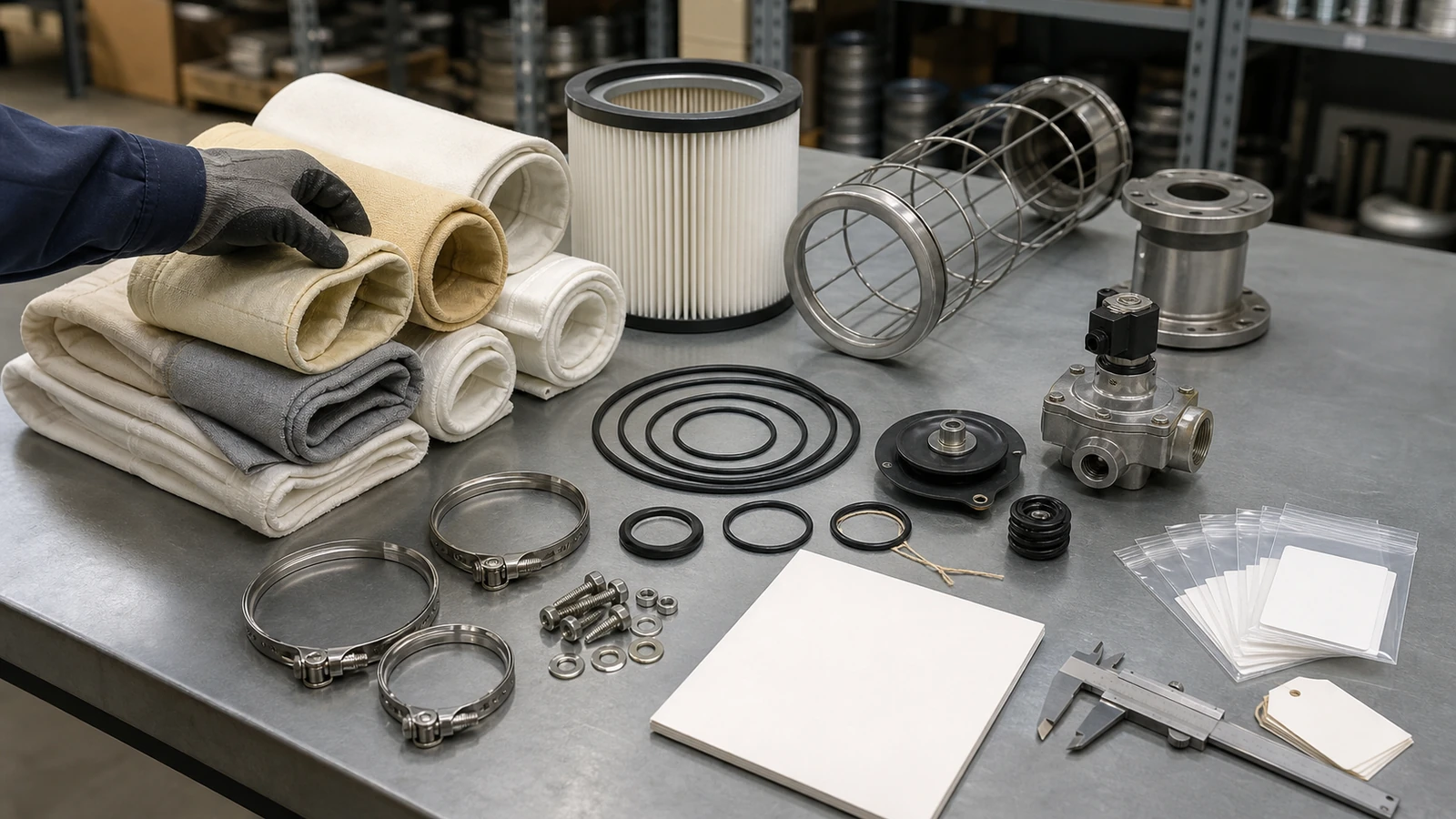
Candidate families commonly encountered in equipment records include filter bags or cartridges; cages, retainers, venturi-like parts, clamps, and fasteners; pulse-valve bodies, diaphragm or pilot repair parts, solenoids, tubing and fittings; door, hopper, or filter seals; and timers, differential-pressure controls, sensors, fuses, or interface hardware. Camfil APC’s GSP4 manual lists cartridges, a diaphragm valve and repair kit, a timer/valve, a pilot repair kit, a door gasket, clamps, bolts, hose, and other items for that named GSP4. It also directs the reader to the bill of lading or original packing slip to determine which filters and components match the specific collector and application. [3] Use the list as an identification example, not permission to stock every family or substitute it elsewhere.
3. Control part identity and revision
Give each line one controlled identity: site item number, manufacturer and supplier part numbers, description, equipment association, controlling drawing or manual revision, unit of issue, and supersession. Add the fit, material, interface, or control-revision fields needed to distinguish the family. Photos and measurements are evidence, not approval. If records conflict, preserve both and route the line to HOLD — verify evidence until an authorized technical owner resolves which identity controls.
4. Separate every compatibility question
Keep separate fields for physical interchangeability; material compatibility with the duty; pneumatic connection and pilot arrangement; electrical characteristics and wiring; and control or software revision. A part that passes one category can fail another. Approved substitutions need their own evidence, effective date, affected population, limitations, and authority; a cross-reference alone does not make stock usable.
5. Map the installed and compatible population
Count the exact assets or positions that can use the verified line, separating collectors that only look similar. Record asset ID, configuration, revision, duty, exclusions, and planned changes. The population is an input, not a multiplier that automatically produces a stock level. Reconcile the asset register with work orders and approved modifications. If coverage is unknown, mixed, or based only on nominal dimensions, use HOLD — verify evidence.
6. Record consequence and criticality without turning labels into quantities
Describe what the site would have to decide if the part were unavailable: whether the affected collector has redundancy, whether production can pause or reroute, what environmental or occupational controls govern, what repair skills and access are required, and who can authorize the response. Do not let a word such as critical automatically set a min/max value. A 2024 DOE Inspector General audit of Western Area Power Administration examined a power-transmission context and reported gaps where critical parts had not been specified for each critical asset, identified in inventory, assigned sparing levels or reorder points, or staged. [5] It supports connecting asset consequence to controlled part records and ownership; it supplies no dust-collector stocking quantity.
7. Use usage and demand history as evidence, not a forecast by itself
Capture issues, returns, emergency withdrawals, planned changeouts, installation dates, failed or quarantined receipts, and demand that could not be filled. Separate recurring planned use from one-time projects, commissioning stock, design changes, and abnormal events. DOE’s audit of spare-parts practices at selected facilities described the value of an up-to-date catalog showing availability for issue, retained usage data, updates after facility modifications, approval routing, location tracking, and controlled tagging or indexing. [4] That audit is not a dust-collector standard. It supports the record categories and the need to replace informal cabinet knowledge with traceable usage evidence.
8. Obtain configuration-specific replenishment evidence
Record supplier, quotation date, exact configuration, quoted quantity basis, material or drawing status, approval dependencies, production stage, transport boundary, validity, and written constraints. Record the supplier-stated replenishment estimate as dated evidence, not as a guaranteed or universal lead time. Note approved alternate sources and what requalification or sample review they require. NIST MEP’s current supply-chain guidance connects forecasting, demand planning, operations planning, inventory management, supplier segmentation, and critical-path lead-time work. [7] It provides no dust-collector replenishment value. The buyer should review changes in supplier, design, material, quantity, and route rather than carrying an old estimate forward unchanged.
9. Require storage and shelf-life evidence before calling stock usable
For filters, seals, O-rings, diaphragms, adhesives, electronics, coated cages, and other stored components, obtain the exact manufacturer or supplier storage instructions, packaging requirements, lot or date identity, inspection or test criteria, and any documented shelf-life or serviceability decision. DoD’s shelf-life program is a government-specific system, but it illustrates that deteriorative characteristics, storage standards, inspection, testing, restoration, markings, and audit trails are distinct evidence fields. [9] DLA’s active MIL-HDBK-695 record also states that its elastomer storage-life guidance is not mandatory and that the responsible agency decides whether to impose a limit. [10] Do not invent or extend a shelf life.
10. Reconcile usable on-hand and open orders
Count by exact identity, location, lot or revision where required, and serviceability state. Subtract stock that is allocated, expired under controlling evidence, damaged, contaminated, incomplete, unidentified, awaiting inspection, revision-unknown, or quarantined. Keep those quantities visible but outside usable on-hand. Add open purchase orders separately with supplier, configuration, quantity, promised evidence, status, and allocation; an open order is not shelf stock. DOE FEMP’s O&M guide identifies reconciliation between inventory on the books and on the shelves as an inventory-control measure, and describes CMMS information as supporting forecasting rather than making decisions. [6] GAO’s physical-count guide likewise emphasizes controlled counts and comparison with recorded on-hand quantities. [8]
11. Complete a buyer-entered min/max review and approval
Bring the evidence together without using a universal formula. The buyer enters the proposed minimum, maximum, review trigger, and order action only after reviewing part identity and revision, installed and compatible population, consequence and criticality, usage and demand history, replenishment evidence, storage and shelf-life evidence, usable on-hand and open orders, planned work, budget, and approved contingency. Name the maintenance, reliability, engineering, storeroom, procurement, safety or environmental, and financial owners appropriate to the site. Record who accepts compatibility evidence, who owns the count, who can place an order, and who approves exceptions. Reopen the review after modifications, supersession, supplier change, material change, abnormal demand, damage, obsolescence, or a failed count reconciliation.
Blank buyer-entered spare-parts inventory matrix
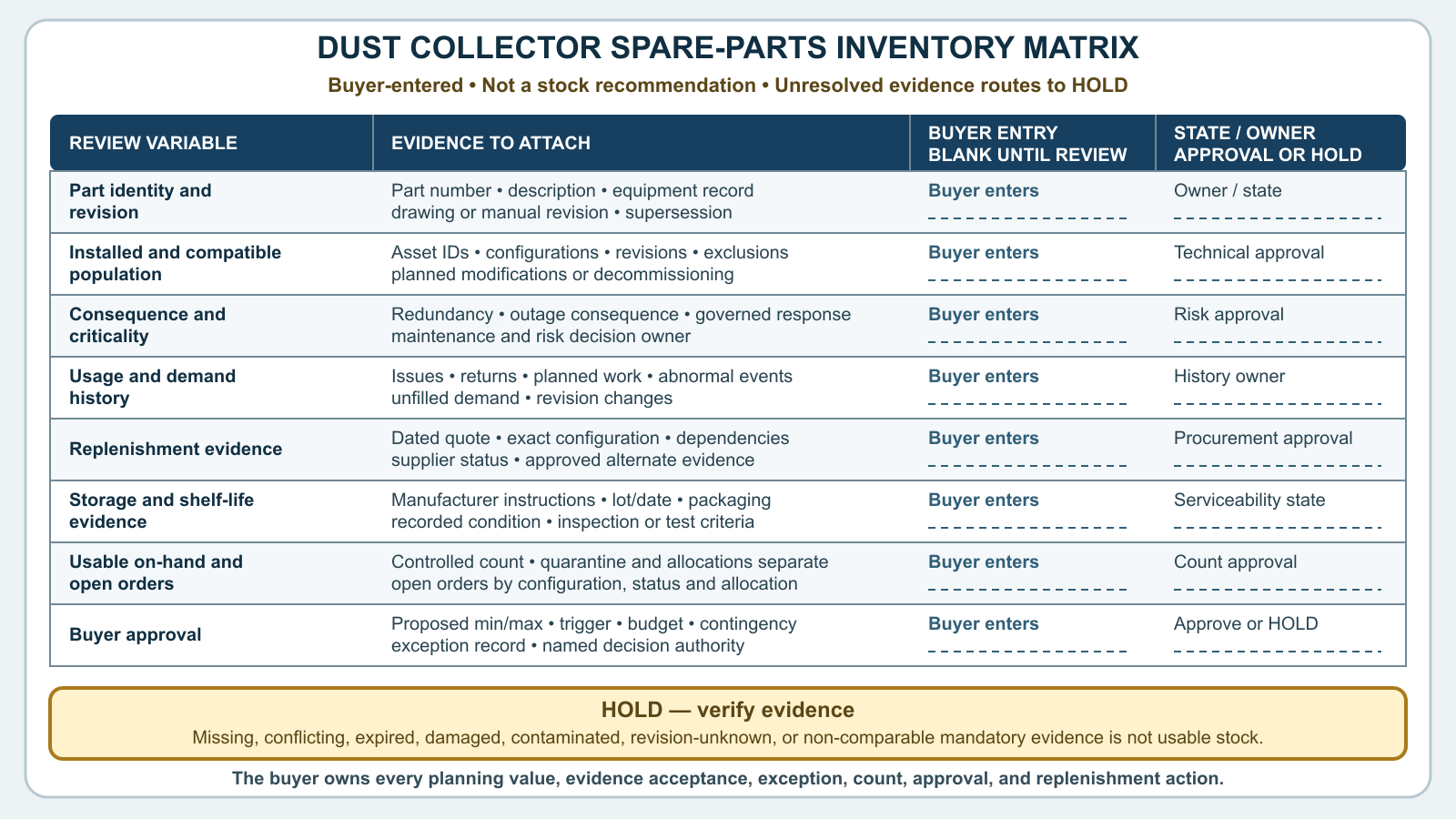
Use one row set for each verified part identity. The matrix keeps the required evidence categories together and leaves all values blank for the buyer. It is not a stock recommendation and contains no FilterBagWorks min/max, safety stock, lead time, shelf life, failure rate, service interval, or availability data. Any missing, conflicting, expired, damaged, contaminated, revision-unknown, or non-comparable mandatory evidence routes to HOLD — verify evidence.
Scroll table horizontally
| Review variable | Evidence to attach | Buyer entry | State / approval |
|---|---|---|---|
| Part identity and revision | Part number, equipment record, controlling revision | Buyer enters identity and revision | Buyer enters owner and state |
| Installed and compatible population | Asset IDs, configurations, revisions, exclusions | Buyer enters covered population | Buyer enters technical approval |
| Consequence and criticality | Redundancy, consequence, governed response | Buyer enters classification | Buyer enters risk approval |
| Usage and demand history | Issues, returns, planned work, abnormal demand | Buyer enters reviewed history | Buyer enters history owner |
| Replenishment evidence | Dated quote, configuration, dependencies, status | Buyer enters supplier evidence | Buyer enters procurement approval |
| Storage and shelf-life evidence | Instructions, lot/date, packaging, condition | Buyer enters verified evidence | Buyer enters serviceability state |
| Usable on-hand and open orders | Controlled count, quarantine, allocations, POs | Buyer enters reconciled positions | Buyer enters count approval |
| Buyer approval | Proposed min/max, trigger, budget, exception | Buyer enters planning values | Buyer enters approver or HOLD |
On narrow screens, scroll horizontally to inspect the full-size diagram.
Inventory records that need a hold or escalation
Do not count a candidate as usable or release a replenishment action while a required identity, compatibility, condition, storage, evidence, or authority question remains open.
- A bag, cartridge, cage, valve, diaphragm, seal, controller, or kit has no exact part identity or controlling revision.
- Nominal dimensions or a cross-reference are treated as complete physical, material, pneumatic, electrical, or control compatibility evidence.
- Installed population is copied from an old project quantity without reconciling current assets and modifications.
- Criticality is assigned without a named asset, consequence, redundancy, governed response, or authorized owner.
- One abnormal project or failure event is mixed into recurring demand without explanation.
- An old supplier estimate is treated as a current guaranteed replenishment time.
- A seal, O-ring, diaphragm, adhesive, filter, electronic control, or coated part has no controlling storage and shelf-life documentation.
- Expired, unidentified, contaminated, damaged, incomplete, allocated, revision-unknown, or quarantined items remain inside usable on-hand.
- Open orders are added to shelf stock without configuration, status, allocation, or receiving evidence.
- A min/max value has no buyer-entered inputs, approval owner, review date, or change trigger.
Quote-ready dust collector spare-parts evidence package
Use the active dust collector filter RFQ checklist for filter identification, then add the asset, inventory, and replenishment fields below. Submit the defined inquiry through the RFQ path with the evidence package; the buyer retains compatibility, stocking, storage, serviceability, criticality, and approval decisions.
- Plant, area, collector manufacturer, model, serial or configuration evidence, asset IDs, current manual, drawings, bill of material, and modification history.
- Part family, site item number, manufacturer and supplier part numbers, description, controlling revision, supersession status, photos, and prior approved order evidence.
- Filter dimensions and construction; cage geometry, material and finish; valve and diaphragm arrangement; seal profile and material; controller or sensor revision as applicable.
- Physical, material, pneumatic, electrical, and control compatibility evidence, including approved substitutions, limitations, and affected installed population.
- Buyer-defined consequence, redundancy, governed response, planned work, usage history, abnormal demand, unfilled demand, and decision owner.
- Supplier quotation and date, exact configuration, quantity basis, drawing or material status, approval dependencies, route, validity, constraints, alternate-source evidence, and open questions.
- Storage instructions, packaging, lot or date identity, shelf-life documentation when assigned, inspection or test criteria, recorded condition, location, quarantine, and serviceability owner.
- Physical count by identity and location, usable on-hand, allocations, quarantined stock, open orders, expected receiving evidence, and reconciliation date.
- Buyer-entered proposed min/max, review trigger, budget and contingency context, exception record, technical acceptance, count owner, purchasing authority, and final approver.
Product path
- Dust collector accessoriesReview the accessory path for defined cages, venturis, valves, diaphragms, gaskets, clamps, hardware, or control-component inquiries.
- Dust collector filter bagsReview bag dimensions, top and bottom construction, media, finish, cage relationship, cleaning method, and application evidence.
- Filter cagesReview cage geometry, wire arrangement, material, finish, joint, venturi relationship, and bag fit evidence.
Frequently asked questions
Is there a standard quantity of dust collector spare parts every plant should keep?
No. Use exact identity and revision, compatible population, consequence, usage, replenishment, storage and shelf-life evidence, usable on-hand, open orders, planned work, and buyer approval. This article supplies no universal quantity or FilterBagWorks stocking value.
Which component families belong in the candidate spare-parts file?
Start from each collector’s current manual, bill of material, approved orders, and installed configuration. Candidate families may include filters, cages or retainers, venturi-like parts, pulse valves and repair components, seals, clamps, hardware, and controls. The Donaldson DFPRE and Camfil GSP4 lists are examples limited to their named equipment, not general stocking lists. [2] [3]
Can two collectors share a spare when their parts look the same?
Appearance is insufficient. Verify physical, material, pneumatic, electrical, and control compatibility as applicable, then record the covered assets and approval basis. If a mandatory category remains unresolved, keep the part on HOLD.
Should open purchase orders count as on-hand inventory?
No. Keep open orders separate with configuration, supplier, quantity, status, allocation, expected documentation, and receiving requirements. Reconcile usable shelf stock independently; an order can change, arrive incomplete, fail inspection, or be allocated before receipt.
Can old seals, O-rings, diaphragms, or filters be counted as usable?
Only when the exact identity, packaging, storage history, condition, and any manufacturer- or supplier-assigned shelf-life, inspection, or test requirement support use. Do not invent an extension. DLA’s elastomer handbook record expressly leaves the decision about a storage-life limit to the responsible agency. [10]
How often should the spare-parts file be reviewed?
The buyer defines the trigger. Reopen the file after relevant equipment, revision, supplier, demand, condition, obsolescence, order, count, or ownership changes. This guide sets no universal calendar interval.
Can FilterBagWorks set min/max values from a parts list?
No. A parts list can help identify a candidate, but it does not establish site consequence, compatible population, actual demand, replenishment conditions, storage evidence, usable on-hand, open orders, budget, or buyer authority. Send the technical inquiry for review; the buyer owns all stocking and approval values.
Sources
- OSHA 29 CFR 1910.147 — The Control of Hazardous Energy (Lockout/Tagout)
- Donaldson DFPRE1/2/3 Dust Collectors Installation, Operation and Maintenance Manual
- Camfil APC Farr Gold Series GSP4 Installation, Operation and Maintenance Manual — Section 420 Spare Parts
- U.S. Department of Energy Office of Inspector General: Spare Parts at Selected Department of Energy Facilities (DOE/IG-0936)
- U.S. Department of Energy Office of Inspector General Audit DOE-OIG-24-30 — Western Area Power Administration's Critical Spare Parts
- U.S. Department of Energy FEMP: Operations and Maintenance Best Practices Guide, Release 3.0
- NIST Manufacturing Extension Partnership: Supply Chain Management
- U.S. GAO Executive Guide: Best Practices in Achieving Consistent, Accurate Physical Counts of Inventory and Related Property (GAO-02-447G)
- DoD Manual 4140.27, Volume 1 — DoD Shelf-Life Management Program: Program Administration
- DLA ASSIST Document Record: MIL-HDBK-695 — Rubber Products: Recommended Shelf Life
Request a filter review
Send the collector and part identity, controlled drawings or manual references, photos and measurements, installed population, material and compatibility evidence, buyer-entered quantity request, required delivery context, storage or documentation needs, and unresolved questions. Submit the defined inquiry through the RFQ path. The buyer retains inventory policy, technical approval, site safety, supplier acceptance, and purchase authority.
Request a quote